

The first time I stood on the shore of Qinghai Lake, the wind off the water was so cold and clean it felt like it had never touched another person. I had come from Xining, the capital of Qinghai, China, an hour and a half east by car, and the land had changed from dusty blocks to grassland so vast it seemed to bend under the sky. Qinghai Lake — Qinghai Hu in Mandarin — is the largest lake in China, a saline lake at roughly 3,200 meters on the northeastern edge of the Tibetan Plateau. It is not a place you tick off on a rushed loop. It is a place you feel in your lungs.
What makes this lake different from every other famous body of water in China is exactly that altitude and the culture wrapped around it. The lake lies inside Qinghai, China, and its surrounding grasslands are home to Tibetan herders whose families have grazed yaks and sheep here for generations. When you visit, you are not just looking at a scenic lake. You are passing through one of the great living pastoral landscapes of Asia, where prayer flags snap in the wind and a nomad on a motorbike may ride past leading a yak on a rope.
Getting There: Xining Is Your Gateway
Almost every foreign traveler reaches Qinghai Lake through Xining, the capital of Qinghai, China. Xining sits at about 2,300 meters and is well connected to the rest of the country by high-speed rail. I usually tell people to fly or take a train into Xining first, then arrange the lake as a side trip. There is no airport at the lake itself, and trying to drive in from far away wastes two days you could spend on the shore.
From Xining you have three realistic options. The first is a hired car with a driver, which is what I did and recommend for first-timers — the drive takes about two hours to the southern shore and lets you stop wherever the light looks good. The second is a package tour bus from Xining, cheaper but rigid. The third, and the one I respect most, is cycling the loop yourself. More on that.
If you are building a longer China trip, Xining connects easily. Many travelers combine the lake with a classic route: start in Xi’an to see the Terracotta Army, swing west to Chengdu for pandas, then push on to Xining and the lake before continuing toward Lhasa in Tibet, China. Our Xi’an travel guide, Chengdu travel guide, and Lhasa, Tibet travel guide cover those legs in detail. For the rail logistics, our China high-speed train guide for foreigners explains how to book the Xining connection without stress.
The July Rapeseed Bloom: Why I Keep Coming Back
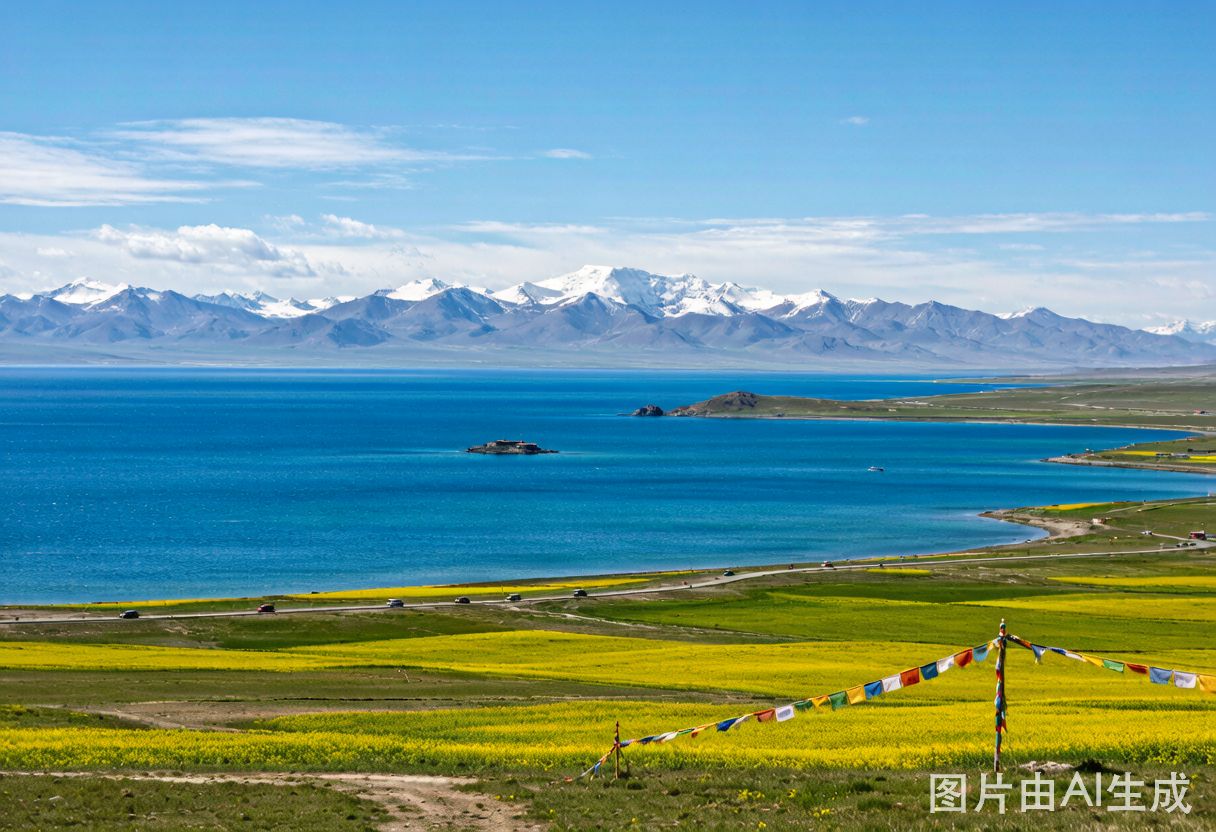
If there is one reason to time your visit, it is July. The lake sits in a cold, high basin, and by early July the surrounding fields explode into yellow. Vast terraces of rapeseed (canola) bloom right up to the blue waterline, and the contrast — electric yellow against a deeper-than-deep blue under a thin, bright sky — is the single most photographed scene in all of Qinghai, China. I have seen a lot of pretty lakes. None of them hit me the way this one does in peak bloom.
The bloom window is short, roughly early July through late July, sometimes into the first week of August. Go in June and you miss it; go in September and the fields are already cut. July days are mild, highs around 15 to 20°C, but the wind off the lake is sharp, so I always pack a windproof layer. Mornings and evenings drop near freezing, part of the charm if you camp.
The best bloom viewpoints are along the lake’s eastern and southern shores, especially near the town of Heimahe and the rapeseed fields around Erlangjian scenic area. Arrive at sunrise if you can. The light is soft, the tour buses have not arrived, and you can stand alone with a Tibetan herder and a few hundred yaks.
Cycling the Lake Loop: The Real Adventure
I want to be honest: the cycling route around Qinghai Lake is one of the most rewarding rides in the world, and also one of the most demanding. The loop is about 360 kilometers, and most riders take three to four days, sleeping in guesthouses or tents along the way. The road is paved and mostly flat by plateau standards, but the altitude — remember, 3,200 meters — means your legs tire faster than they would at sea level. My first day I planned 100 kilometers and managed 60, then slept for eleven hours.
What you get in return is unforgettable. You pedal past monasteries where monks in maroon robes wave as you pass. You crest a rise and the whole lake opens in front of you, a sheet of blue with no far shore visible. You stop at a nomad tent and are handed a bowl of butter tea you did not ask for but absolutely needed. This is the Tibetan areas of Qinghai, China at its most generous.
If a full loop sounds like too much, rent a bike in Xining and ride just the southern shore for a day — flat, stunning, back for dinner. Sunscreen is not optional. At this altitude the UV is brutal, and I came home from my first ride looking like a cooked lobster despite a hat.
Bird Island and the Spring Migration
Most visitors come for July, but I will make a quiet case for spring, roughly April to May. That is when Bird Island — on the lake’s western side — becomes one of the most important breeding grounds for migratory birds on the Central Asian flyway. Tens of thousands of bar-headed geese, cormorants, and gulls arrive, and the air above the reeds is thick with wings. It is noisy, smelly in the best way, and completely different from the summer postcard.
A note on access: the Bird Island scenic area has been managed and sometimes restricted in recent years to protect the ecology, so check the current status before you go. Even when the island is closed, the western shore wetlands offer excellent birdwatching from a distance. Bring binoculars; the birds do not perform on cue.
Tibetan Nomad Culture: Meeting the Herders
The human heart of Qinghai Lake is its Tibetan herders. The Tibetan areas of Qinghai, China have a pastoral tradition stretching back over a thousand years, and around the lake you can still see it functioning. Families move with their flocks between summer and winter pastures. Yurts — round, white, felt-walled — dot the grasslands. Prayer flags mark every pass and every home.
I spent an afternoon with a herding family near the eastern shore. They showed me how they churn yak butter, how they braid the hair of their yaks for luck, and how they read the weather from the clouds over the water. They spoke little Mandarin and I spoke no Tibetan, but we communicated fine over bowls of salty milk tea. If you want this kind of encounter, respect is everything: ask before photographing people, accept offered tea sitting down, and never walk across a ceremonial site or touch a prayer flag without permission.
A few practical cautions. The herders are not a tourist show; they are working people. Do not treat their home like a zoo. Buy their yak cheese or wool if you can — a fair exchange that supports a hard life on hard land. Dress modestly when visiting any monastery or family camp.
Altitude, Health, and When to Go
Let me be direct about the altitude, because it affects everyone. At 3,200 meters, Qinghai Lake is high enough that some travelers feel shortness of breath, headache, or trouble sleeping on their first night. I acclimatized in Xining (2,300 meters) for a day before driving up, and I suggest you do the same. Drink water constantly, go easy on alcohol, and do not plan a hard bike ride on day one. If you have a heart or lung condition, talk to your doctor before flying into this part of Qinghai, China.
As for timing, it depends on what you want. July is the rapeseed bloom and the most popular, most crowded, most expensive month — but also the mildest and most beautiful. May brings birds and fewer crowds. September and October are golden and quiet, with crisp light and empty roads, though the flowers are gone and nights are cold. Our best time to visit China guide has a broader seasonal breakdown if you are planning a multi-region trip that includes Yunnan — see our Kunming travel guide for the southern contrast.
Practical Tips From the Shore
A few things I wish someone had told me before my first visit. Cash is useful at small roadside stalls, though Alipay and WeChat Pay work in Xining and at the major scenic areas. The scenic zones charge entrance fees and some require shuttle buses — budget for both. Mobile signal is decent near the shores but weak on the remote eastern and western ends, so download maps offline. Food near the lake is simple: noodles, yak meat, momos (Tibetan dumplings), plenty of milk tea. For a proper restaurant meal, eat in Xining before you leave.
Where to stay? Most base themselves in Xining and do the lake as a day or overnight trip, or sleep in a lakeside guesthouse near Erlangjian or Heimahe. Tents are available in summer but cold — bring a sleeping bag rated for zero degrees if camping. Book ahead in July; the bloom brings domestic tourists in large numbers.
Final Word
Qinghai Lake is not the easiest place in China to reach, and that is precisely why it stays with you. It is a high, cold, luminous world where China’s largest lake meets the oldest pastoral culture on the plateau. Ride the loop, watch the birds, drink the butter tea, and let the wind do the rest. A few hours from Xining, on the grasslands of Qinghai, China, you will find a version of this country most visitors never see.
For current conditions, access rules, and conservation status of the lake and its bird habitats, the official resource I trust is the Qinghai Lake UNESCO Biosphere Reserve information page, which tracks the protected status of this unique high-altitude ecosystem.