

Standing at the edge of the Gobi Desert in northwest Gansu, China, the Mogao Caves near Dunhuang stopped me in my tracks the first time I walked into Cave 96 and looked up at the nine-story facade built around a 35-meter seated Buddha. I had read about the “Thousand-Buddha Caves” for years, but no photograph prepares you for the scale of 735 caves carved into a cliff face, 492 of them still holding murals and painted sculpture, with nearly 45,000 square meters of wall paintings that survived more than a thousand years of desert wind, sand, and sun.
I’m Karl, and I’ve been writing practical travel guides for foreign visitors to China since before the high-speed rail reached the northwest. Dunhuang is one of those places that rewards the planner and punishes the casual drop-in, so this guide covers exactly how I recommend you book, what to see, how to get there, and when to go.
Why Dunhuang Matters on the Silk Road
Dunhuang was the last oasis of the Central Asian trade routes before merchants pushed east into the heart of China, or the first green stop heading west out of the Hexi Corridor. From roughly the 4th century until the 14th, caravans carrying silk, jade, Buddhist scriptures, and ideas funneled through this desert town. The Mogao Grottoes were dug by monks, local officials, and wealthy patrons who wanted merit and protection on a dangerous road. What they left is the single richest collection of Buddhist art on the old Silk Road — and a UNESCO World Heritage Site inscribed in 1987 for exactly that reason.
What makes the site special is not just age but layering. Walk the cliff with a guide and you see Tang dynasty bodhisattvas with flowing, almost secular robes next to fierce guardian kings, then a cave funded by a 10th-century local dynasty, then a Yuan-era mandala. The art is a timeline you can walk through. For travelers building a broader northwest itinerary, Dunhuang pairs naturally with the Silk Road routes that continue into Xinjiang, China — my Xinjiang travel guide covers the next leg west — and with the desert oasis towns of Turpan’s Silk Road guide.
Booking Tickets: The Daily Cap Is Real
Here is the single most important practical fact: the Mogao Grottoes limit visitors to about 6,000 tickets per day in peak season and fewer off-season, and they sell them online in timed slots. The caves are fragile, and the management closes the site to walk-up crowds when the cap is hit. I have watched travelers arrive in Dunhuang on a July afternoon expecting to buy a ticket at the gate and leave disappointed. Don’t be that person.
Book through the official site (www.mgk.org.cn) or the authorized Chinese platforms, ideally 7–30 days ahead in summer and on Chinese public holidays. A standard “A” ticket includes the Digital Exhibition Center film plus a guided visit to about 8 caves; a cheaper “B” ticket (winter or when A sells out) drops the films and shows 4 caves. Either way, your visit is guided in a small group — you cannot wander the cliff alone, and that is a good thing for preservation and for understanding what you’re looking at.
Bring your passport. Tickets are tied to the ID number you book with, and staff check it at entry. If your name is long or spelled unusually, double-check the booking confirmation matches your passport exactly.
The Digital Exhibition Center: See First, Then Enter
Before you ever set foot in a cave, the experience begins 25 kilometers east of the cliffs at the Digital Exhibition Center, which every A-ticket holder visits first. Two short films — one on the history of the grottoes, one an immersive 360-degree projection of caves you won’t physically enter — are genuinely the best introduction I’ve seen at any heritage site in China. They explain the layering of dynasties and show you the famous Library Cave (Cave 17) and the giant sleeping Buddha of Cave 158 at a scale and lighting the real caves can’t safely provide.
A free shuttle then runs you from the center to the cliff itself. Plan the whole sequence as a half-day: roughly an hour of films, 20 minutes on the bus, and 90 minutes to two hours on the cliff with your guide. I tell first-timers to treat the Digital Center as non-negotiable, not optional.
What You’ll Actually See on the Cliff
Your guide controls which caves open, and the rotation changes to spread wear. On a typical A-ticket visit you’ll see a cross-section: an early Northern Wei cave with austere, almost severe figures; a lavish Tang cave with the famous ” Flying Apsaras” (feitian) — those weightless musicians and dancers who became the symbol of Dunhuang; and a cave with a colossal Buddha. The murals cover everything from sermons and jataka tales to detailed scenes of Silk Road life: traders, camels, musicians, and even a 9th-century image of a Central Asian merchant that historians love.
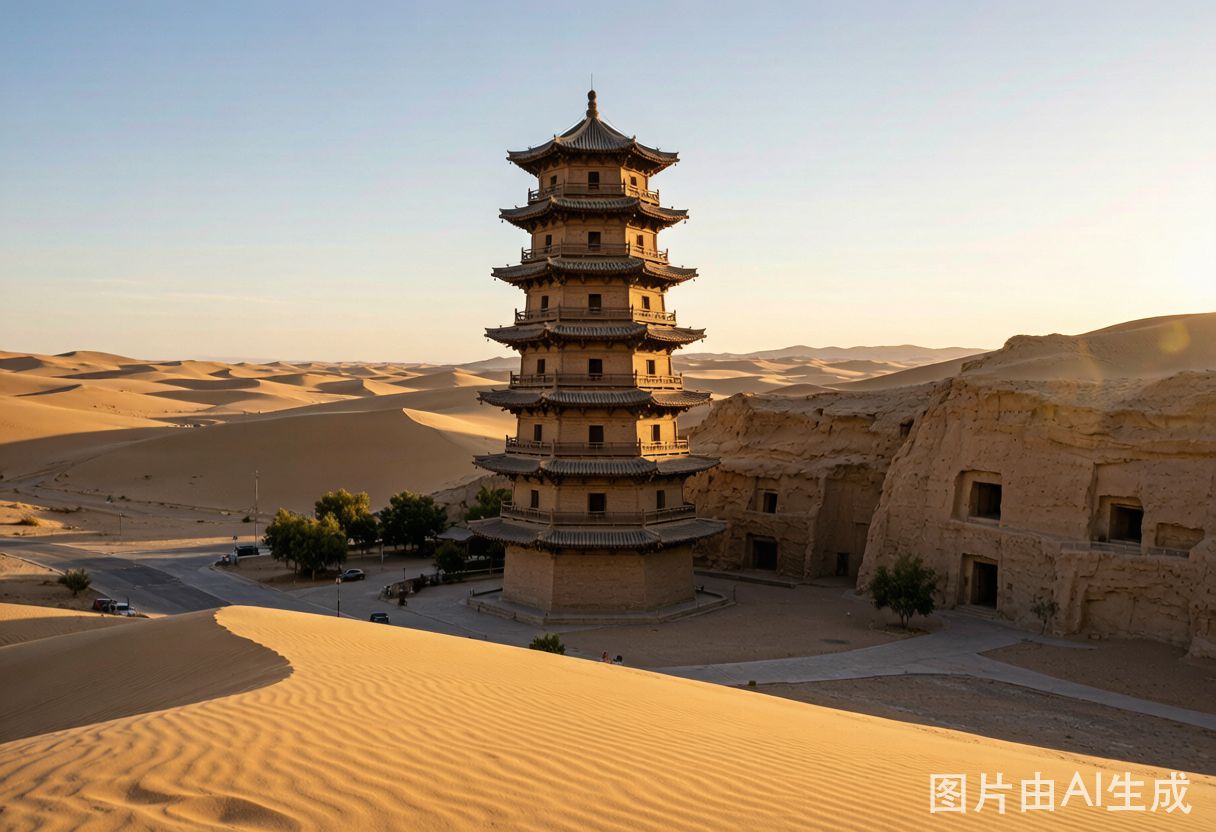
Two caves deserve special mention. Cave 17, the Library Cave, is tiny but historically explosive: in 1900 the Taoist monk Wang Yuanlu found it sealed with some 50,000 manuscripts and paintings, a trove that ended up scattered across institutions from London to Paris to Beijing. And Cave 96’s giant Buddha is the one you see from the nine-story tower. Photography inside the caves is strictly forbidden — the flash and even the carbon dioxide from crowds accelerate damage — so put the camera away and look.
Crescent Lake and the Singing Sand Dunes
Dunhuang is not only about caves. Five kilometers south of town, the Crescent Lake (Yueyaquan) sits cradled by the Singing Sand Dunes (Mingshashan), a crescent of water that has survived in the middle of a shifting desert for who knows how long. Climb the dunes at sunset — they “sing” (a low rumble) when the wind moves the sand, hence the name — and watch the lake turn gold and then blue. I rate this as the best single hour in Dunhuang, and it’s an easy half-day that balances the brain-heavy cave visit.
You can ride a camel around the dune base, sandboard, or just sit. Bring a scarf for your face; the wind picks up grit late afternoon. The site is open late in summer precisely so you can time the sunset.
How to Get to Dunhuang
Dunhuang has its own airport (DNH) and a high-speed rail station, which makes it far more reachable than its remote location suggests.
Flying in. Direct flights connect Dunhuang with Xi’an, Lanzhou, Beijing, Shanghai, and Chengdu, among others, seasonally. The simplest hub approach is to fly Xi’an → Dunhuang, since Xi’an is the classic Silk Road gateway and my Xi’an travel guide lays out how to pair the Terracotta Army with a northwest swing. See also the Xi’an Terracotta Warriors visit guide if you’re building that leg.
By train. The high-speed line now links Lanzhou to Dunhuang, and there are overnight and daytime services from Xi’an that shorten the old two-day journey to a single comfortable day. If you’re coming from the east, I usually route people through Lanzhou (a transport hub for all of Gansu) or Xi’an. For the mechanics of booking, the China train ticket guide for foreigners walks through the 12306 app and passport requirements step by step.
On a longer trip. Dunhuang slots cleanly into a northwest loop with Jiayuguan, Zhangye, and Turpan. If you want the bigger picture, the China 2-week itinerary shows one way to thread these cities together without backtracking.
Best Season to Visit
Dunhuang is a true desert climate: brutal summers, freezing winters, and a short, glorious shoulder season. I send people in May–June and September–October. Days are warm but not punishing, the light is extraordinary for photography, and the crowds are lighter than July–August. Summer (July–August) is hottest and busiest, and the daily ticket cap bites hardest then — book early or risk missing out. Winter is cold, some services thin out, but the B-ticket prices drop and you may have the cliff nearly to yourself; just confirm cave rotations in advance. For context on national weather patterns, the best time to visit China guide helps you coordinate Dunhuang with the rest of your route.
One more note for planners: Chinese public holidays (especially Golden Week in early October) turn the site and the town hotels into a scrum. If your dates are fixed to a holiday, book accommodation and tickets the moment they open.
A Note on Responsible Visiting
The Mogao Grottoes are genuinely at risk — moisture, microbes, and visitor load all threaten the murals. The strict no-photo rule, the daily cap, and the guided-only access aren’t theater; they’re why the paintings survived this long. Follow the rules, don’t touch the walls, and consider that every cave you enter is one more small tax on a thousand-year-old surface. The UNESCO World Heritage listing for the Mogao Caves explains the site’s outstanding universal value in the organization’s own words.
Want the full Silk Road sweep? Pair Dunhuang with Xi’an and the Terracotta Army using our [Xi’an travel guide](https://www.chinatravelplaces.com/xian-travel-guide/).
Booking the high-speed train from Lanzhou or Xi’an? Read the [China train ticket guide for foreigners](https://www.chinatravelplaces.com/how-to-book-china-train-tickets-12306/) before you hit the 12306 app.
Planning a longer northwest loop through Gansu and Xinjiang, China? Our [China 2-week itinerary](https://www.chinatravelplaces.com/china-2-week-itinerary/) shows how to string it together.