

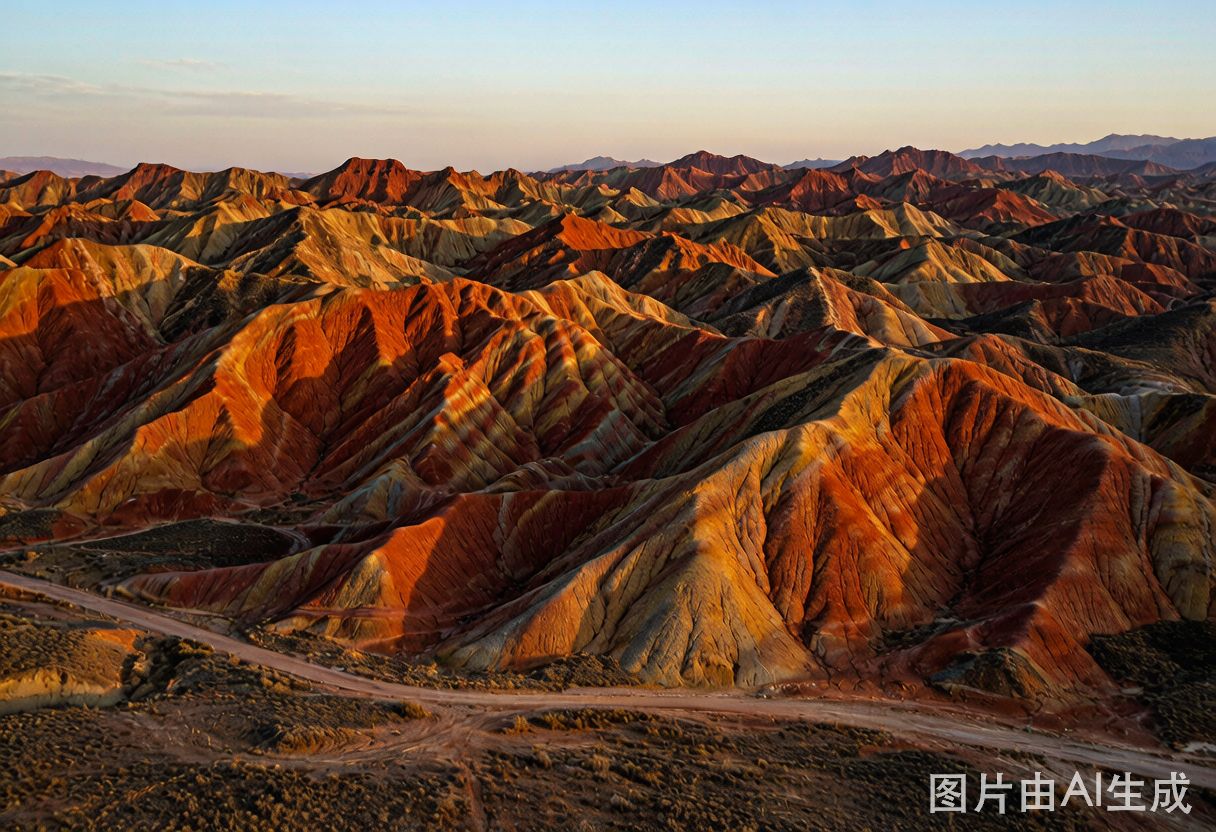
I still remember the first time I stood on the fourth overlook at Zhangye Danxia and watched the late-afternoon sun slide across the hills. The sandstone in front of me wasn’t just red — it was streaked with ochre, mustard, teal-green and a kind of bruised purple that looked almost painted on. I had seen the photos, of course, and assumed they were heavily saturated. They weren’t. The place is genuinely that loud, and the trick is being there when the light does the talking. This guide is everything I wish I’d known before my first trip: what the park actually is, when the colors pop, the four viewing platforms, and how to slot it into a wider Silk Road route through Gansu, China.
What Zhangye Danxia actually is
Zhangye Danxia Geopark (officially Zhangye National Geopark, sometimes marketed as the “Rainbow Mountains”) sits about 40 km west of Zhangye city in Gansu Province, in the northwest of China. It’s a danxia landform — a type of scenery built from reddish sandstone and conglomerate laid down over millions of years, then folded, lifted and cut apart by erosion. The rainbow effect comes from mineral deposits: iron oxide gives the reds and rusts, while trace amounts of other minerals add yellows, greens and greys.
What surprised me most as a visitor isn’t the color but the scale. These aren’t thin striped cliffs you photograph from a distance — they’re rolling, ribbed hills that stretch to the horizon, ripped open like layered cake. The park is huge, and you see it from a series of fixed overlooks connected by a shuttle bus loop. You don’t wander freely across the formations (the ground is fragile and the paths are roped), so the experience is really a sequence of “stop, look, photograph, move on” at designated viewpoints.
If you’re building a China itinerary around dramatic landscapes, pair this with the karst peaks further south — but honestly, nothing else in the country looks quite like this. It’s one of the few places where the geology itself is the headline act rather than a backdrop to a temple or a wall.
The four overlooks (and which to prioritize)
The main scenic area uses a one-way shuttle loop with four numbered viewing platforms. The bus drops you at each, you climb the steps, you shoot, you board the next bus. Here’s how I’d rank them after two visits:
- Overlook 1 (七彩仙缘台 / Qicai Xianyuan): The first stop and the gentlest climb. Good for context and wide shots, but the colors here are subtler than later stops. Hit it, don’t linger.
- Overlook 2 (七彩云海台 / Qicai Yunhai): My favorite for breadth. A long wooden boardwalk gives you a panoramic sweep of layered ridges. Best in the soft light of early morning.
- Overlook 3 (七彩锦绣台 / Qicai Jinxiu): Smaller and often skipped by rushed tours, but the striping up close is fantastic. Worth the few extra minutes.
- Overlook 4 (七彩霞台 / Qicai Xiatai): The famous one. This is the postcard viewpoint with the deep, saturated bands, and it’s the best spot for sunset. Most tour buses time their loop to end here around golden hour — for good reason.
If your time or energy is limited, prioritize Overlooks 2 and 4. Together they cover the “wow” and the “that’s the photo” shots.
Best light: sunrise vs sunset
This is the single most important practical tip I can give you. The colors at Zhangye Danxia are real, but they’re shy in flat midday light. Under harsh noon sun the hills look dusty and brown. The magic happens when the sun is low and raking across the striations.
- Sunrise: Cooler, calmer, fewer tour groups. The east-facing overlooks (especially 2) glow. If you hate crowds and like tripod silence, go early.
- Sunset: Warmer, more saturated, and Overlook 4 is built for it. This is when the reds and oranges go nuclear. The downside is that every bus tour on the planet also knows this, so expect company.
My honest recommendation: if you can only do one visit, do late afternoon into sunset. Arrive about two hours before sundown, work the loop from overlook 1 to 4, and let the light build. Midday visits are fine if that’s all your schedule allows, but you’ll leave thinking the photos oversold it — they didn’t, you just had the wrong light.
How to get to Zhangye Danxia
Step one is getting to Zhangye city. Zhangye has its own train station and a small airport (Zhangye Ganzhou Airport). For most foreign travelers the realistic entry points are Xi’an or Lanzhou.
- From Xi’an: High-speed trains run to Zhangye West (Zhangye Xi) in roughly 5.5–7 hours depending on the service. This is the comfortable option and lets you connect Zhangye to a broader Silk Road sweep. If you’re starting your trip in the old capital, read up first on the Xi’an travel guide so you can plan the rail hop north.
- From Lanzhou: The provincial capital of Gansu and a common flight hub. Trains to Zhangye take around 3–4 hours. Lanzhou is also the gateway if you’re continuing west toward Xinjiang, China.
- From within Gansu: Zhangye sits neatly between Jiayuguan and Dunhuang on the classic Hexi Corridor route, so it drops naturally into a westbound Silk Road drive or train journey.
Step two is the park itself. From Zhangye city center it’s a 40–50 minute drive to the Linze entrance. Options: pre-booked private car, a Didi/ride-hail (works in the city but return trips can be sparse — arrange a pickup time), or the seasonal tourist shuttle buses that run from Zhangye West station area. Buy your park ticket (entry + mandatory shuttle bus) at the gate; the shuttle is not optional because the overlooks are far apart.
For train booking mechanics across China, my high-speed train guide for foreigners walks through the apps and ID requirements, which will save you real headaches on this leg.
When to go
Gansu is dry and continental, so timing matters more than you’d think.
- June to September is peak season: warm days, blue skies, and the occasional dramatic thunderstorm that (bonus) makes the colors pop right after rain. This is also when crowds peak.
- October is my personal sweet spot — crisp air, fewer tour groups, and still-plenty of light.
- Winter (Nov–Mar) is brutally cold and some services thin out, but you get the hills dusted with snow, which is genuinely spectacular and nearly crowd-free.
- Avoid the week-long National Day holiday (early October) unless you enjoy human traffic jams; Chinese holiday crowds here are no joke.
Rain is rare but when it comes the park sometimes closes temporarily for safety, and right after a shower the saturated colors are at their absolute best — so a little patience pays off.
Building it into a Silk Road route
Zhangye is not a one-stop destination; it’s a bead on the Hexi Corridor string of the ancient Silk Road, and that’s exactly why it’s worth the detour. A natural westbound route looks like: Xi’an → Lanzhou → Zhangye → Jiayuguan → Dunhuang, and from Dunhuang you can fly or train onward toward Turpan and the desert towns of Xinjiang, China.
If you want the oasis-and-ruins side of the Silk Road rather than the geology, the Turpan Silk Road guide covers the grape valleys, bezeklik caves and the flaming mountains just east of there. And for travelers who keep going west and then south onto the plateau, the Lhasa, Tibet, China travel guide is the logical next chapter after Xinjiang — though plan that leg carefully, because Tibet, China requires the separate permit process most foreign visitors don’t expect.
I’d budget at least one full day for Zhangye Danxia itself (arrive afternoon, stay for sunset), plus a half-day for the city’s own sights — the giant reclining Buddha at Dafo Temple is a genuine sleeper hit and an easy half-morning.
Practical tips I learned the hard way
- Bring water and a hat. There is almost no shade at the overlooks and the altitude (around 1,800–2,000 m) plus dry air dehydrates you fast.
- Wear real shoes. The boardwalks are fine, but the climbs to the higher platforms are steeper than they look.
- Don’t rely on mobile data for navigation inside the park — the shuttle loop is clearly signed, but signal is patchy. Download your maps beforehand. If you need help getting online across remote Gansu, see the guide to using the internet in China.
- Drone rules are strict. Flying is prohibited in the scenic area; park staff will ask you to land. Shoot from the platforms instead.
- Stay overnight in Zhangye city, not at the park. The town has the better hotels, food (the beef noodles alone are worth it) and an easy morning launch.
The verdict
Zhangye Danxia is one of those rare places that lives up to its screenshots. The rainbows are real, the silence at sunrise is real, and the “how did nature do that” feeling is real. Time your light, take the full shuttle loop, and give it a proper place in a Silk Road itinerary rather than treating it as a box to tick. For me it remains the most visually arresting hour I’ve spent in northwest China — and I’ve spent a lot of hours out there.
For the official geological background and conservation status of the danxia landforms, see the UNESCO World Heritage Centre entry on “China Danxia” at https://whc.unesco.org/en/list/1335/.