

Most first-time visitors to China make the same mistake: they try to see everything. Beijing, Xi’an, Shanghai, Guilin, Chengdu, Zhangjiajie — all in nine days. They spend more time on bullet trains and airport security than on the sights themselves, and they leave exhausted and a little resentful. If you only have a week, the smart move is to go deep on three cities that together tell China’s whole story: the imperial capital, the ancient heartland, and the global metropolis. This China 1-week itinerary does exactly that, using high-speed trains to keep travel time short and the experience rich.
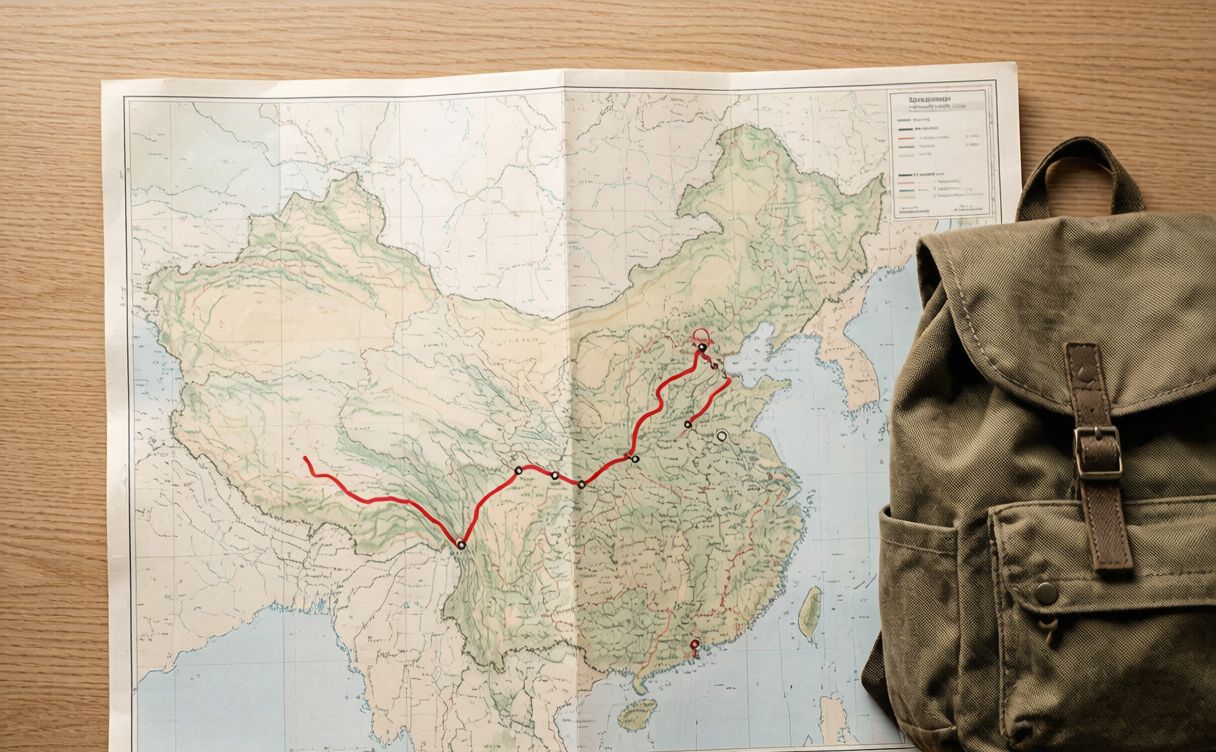
The route is Beijing → Xi’an → Shanghai. It’s a clean west-to-east arc, and every leg runs on one of the world’s best rail networks. You’ll touch 3,000 years of history and still have time for a lazy dumpling lunch. Here’s how to do it without burning out.
At a Glance: Your 7 Days
- Day 1 — Arrive in Beijing. Settle in, walk a hutong, adjust to the time zone. Light day.
- Day 2 — Forbidden City + Tiananmen + Jingshan Park. The imperial core, done right.
- Day 3 — Great Wall (Mutianyu). A full-day trip out of the city, back for dinner.
- Day 4 — Morning train to Xi’an (4–5.5 hrs). Afternoon at the city wall and Muslim Quarter.
- Day 5 — Terracotta Warriors + Shaanxi History Museum. The must-sees, paced over one day.
- Day 6 — Morning train to Shanghai (5.5–6.5 hrs). The Bund at night.
- Day 7 — Shanghai old-and-new + depart. Yu Garden, the waterfront, then fly home.
That’s it. Three cities, two overnight train rides, zero frantic dawn departures. Below, the detail that makes it work.
Beijing: Three Days Is the Sweet Spot
Beijing rewards a slow start. After a long international flight, Day 1 should be about feet on pavement, not a checklist. Pick a hutong neighborhood near the Bell and Drum Towers, wander, and eat. Save your energy.
Day 2 is the imperial center. The Forbidden City is enormous — 70-odd palaces — and most people see it wrong by rushing the central axis and missing the side galleries. Book tickets online in advance (they cap daily entries), enter through the Meridian Gate, and walk north to south so you exit at the perfect spot: Jingshan Park, whose hill gives you the postcard view back over the rooftops.
Where you stay shapes the whole Beijing leg. The subway is excellent, but a central location near Line 2 or a hutong guesthouse saves you 40 minutes each way. Our where to stay in Beijing guide breaks down the neighborhoods by budget and mood.
The Great Wall Without the Crowds
Skip Badaling. It’s the most famous section and the most packaged. Mutianyu, about 70 km northeast of the city, is restored but far less congested, surrounded by forested hills, and has a toboggan run back down that’s genuinely fun. A private car or a small-group tour gets you there in roughly 1.5 hours. Go early, walk the ramparts west toward the quieter towers, and you’ll have long stretches to yourself. If you want the photography specifics, our Great Wall day trip guide covers timing and logistics.
Xi’an: One Full Day, Done Well
The train from Beijing to Xi’an takes four to five and a half hours on the G-network — sit back, watch the countryside flatten into the Loess Plateau, and arrive midday. Xi’an was the eastern terminus of the Silk Road and capital for eleven dynasties, and it wears that history lightly.
Spend your arrival afternoon on the city wall, acomplete medieval fortification you can cycle atop for the full 14 km loop or just a section. Then drift into the Muslim Quarter for dinner — hand-pulled noodles, stewed persimmon cakes, and cumin lamb that beats anything at a hotel banquet.
Day 5 belongs to the Terracotta Warriors. They’re 40 km east of the city, so go early with a guide or good audio tour; the on-site museum is three pits plus the bronze chariots, and two to three hours is enough. Pair it with the Shaanxi History Museum back in town if you have the afternoon — book free tickets ahead, as they sell out.
What to Skip in Xi’an
You don’t need the Tang Dynasty dinner show, the hot-spring resort, or a second day trip to Huashan Mountain on a one-week trip. Huashan is spectacular but eats a full day you don’t have. Save it for a return trip. The point of this itinerary is restraint.
Shanghai: Modern China, Quietly
The Beijing–Shanghai line is the flagship of Chinese high-speed rail — trains hit 300+ km/h and the ride is smooth enough to nap. You’ll arrive with most of the day left.
Shanghai is where the itinerary finally exhales. The Bund at night is the obvious draw, and it earns the reputation: colonial facades across the river from the neon towers of Pudong. But spend equal time in the lanes of the Former French Concession, where plane trees and low cafés feel a world away from the skyline.
On your last full day, do Yu Garden and the old town in the morning (go early to beat tour groups), then choose: the Shanghai Museum for bronzes and ceramics, or a wander through Xintiandi’s rebuilt shikumen houses. Eat well, walk a lot, and don’t overschedule — you’re leaving tomorrow.
Getting Between Cities: The Trains
This itinerary lives or dies on the rail network, and it lives well. China’s high-speed trains are punctual, clean, and cheap by Western standards — a second-class Beijing–Xi’an ticket runs roughly ¥515–¥650. Book through the official 12306 app or a trusted reseller; our high-speed train guide for foreigners walks through account setup, ID requirements, and seat classes.
A few practical notes:
– Book 10–14 days out for popular G-trains, especially around holidays.
– Arrive 30–40 minutes early — stations are huge and security takes time.
– Bring your passport, not a copy. It’s checked against the ticket at the gate.
– Pack snacks and a power bank. Stations sell both, but the train ride is more pleasant prepared.
What to Skip (and Why Pacing Wins)
The biggest risk to a one-week trip isn’t missing a sight — it’s trying to add one. Resist these:
- Guilin and the Li River. Gorgeous, but it’s a flight south and a full detour. Save it.
- Chengdu’s pandas. Tempting, but adds a leg and a day you’d pull from Beijing or Shanghai.
- Zhangjiajie’s peaks. Stunning, remote, and at least two days round-trip. Not this trip.
- Hong Kong, China. Worth a visit, but it’s a separate travel ecosystem (own rail card, payment apps, entry rules). Bundle it on a future trip.
The discipline here is the point. Three cities, each with a clear identity, each reachable by a comfortable train. You’ll leave having actually felt China rather than having collected passport stamps.
Before You Go: A Few First-Timer Essentials
Set up mobile payment (Alipay works with foreign cards now) before you land — it covers trains, taxis, and street food. Get an eSIM or local SIM at the airport so maps work the moment you step out. And check the visa-free transit rules if you’re routing through a hub city; many nationalities can now enter for up to 144 hours without a visa.
For the bigger picture — weather, regional differences, and how the pieces fit — start with a solid first-timer’s overview before you book. It pairs well with this route.
One reliable external reference for schedules and station maps is TravelChinaGuide’s China trains section, which keeps current timetables and fares in English.
This route isn’t the most ambitious one you could plan. It’s the one you’ll actually enjoy. Seven days, three cities, two train rides, and a real sense of a country that’s far more legible — and far friendlier — than the headlines suggest.
Written by Karl.