

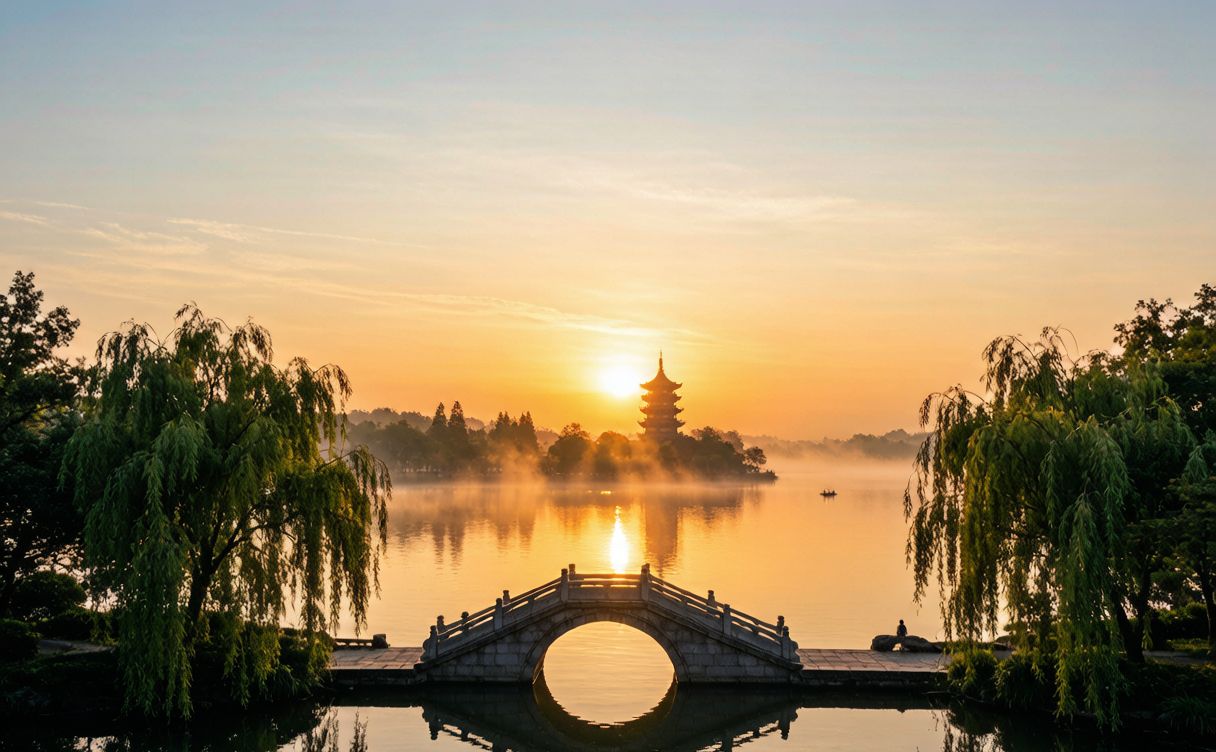
I still remember my first morning at West Lake. The mist had not yet lifted, a few old men were practicing tai chi on the shore, and a wooden boat slid silently past a willow tree that looked like it had been posing for a thousand years. That is the thing about West Lake Hangzhou — it does not announce itself with noise. It just settles into you. This guide walks you through the spots worth your time, how to ride the lake without the crowds, how to reach Hangzhou from Shanghai or Beijing, where to sleep, and two ready-made itineraries so you can build the perfect day without overthinking it.
Why West Lake Matters
West Lake is not a random pretty pond. It earned a place on the UNESCO World Heritage list in 2011 for shaping the ideal of a “poetic landscape” that went on to influence garden design across East Asia for centuries. UNESCO’s own West Lake World Heritage listing lays out why the lake, its islands, and the hills around it count as a masterpiece of human-made nature. The short version: for over a millennium, scholars, poets, and emperors treated this water as a canvas, building causeways, pavilions, and pagodas that turn a walk into a slow conversation with history.
That heritage is also why the lake is free to enter. You can stroll the loop, sit on a bench, and watch the light move across the water without spending a single yuan. The paid experiences — boats, the pagoda, temples — are optional layers on top.
Top Spots Around the Lake
Hangzhou West Lake is a loop of about 15 kilometers, ringed by paths and dotted with named viewpoints. You will not see all of it in one visit, and that is fine. These are the anchors most travelers actually enjoy.
Su Causeway and Bai Causeway
Two long, tree-lined embankments cut across the water. The Su Causeway, built by the poet Su Shi in the 11th century, runs nearly three kilometers and is the most pleasant stretch for a slow walk or a bike ride. In spring the peach and willow trees on either side drop petals onto the path. The Bai Causeway connects the north shore to the Broken Bridge.
Broken Bridge
Despite the name, it is not broken. The “broken” effect happens on snowy mornings when the bridge’s middle, warmed by foot traffic, melts first and looks severed from the banks. It is the most photographed spot on the lake and the eastern end of the Bai Causeway. Go early or accept the crowd.
Leifeng Pagoda
Sitting on Sunset Hill to the south, Leifeng Pagoda is the postcard you have probably already seen. The original collapsed in 1924; the current structure is a steel-and-concrete rebuild (2002) that wraps around the ruin, so you can ride an elevator up and look down on the whole lake. Tickets run about ¥40 (roughly $5.50). It opens around 8:00 and stays open until 20:30 in summer, with the sunset view from the top worth timing your climb for.
Lingyin Temple
A short taxi or bus ride west of the lake, Lingyin is one of the oldest and richest Buddhist temples in southeast China, fronted by the Feilai Peak carvings — hundreds of Buddhist statues cut into limestone cliffs. Entry is ¥75 (about $10.50) including the peak grottoes, and the temple closes near 18:00. Wear modest clothing and expect a fair number of steps.
Meijiawu and Longjing Tea
The hills southwest of the lake grow Longjing (Dragon Well) tea, the green tea Hangzhou is famous for. Meijiawu village lets you sit with a farmer, taste a few grades of spring tea, and buy leaves at source prices. A pot of good Longjing in a teahouse runs ¥30–80 ($4–11). Spring picking season, late March to April, is the liveliest time to visit.
Boat Rides and Cycling the Causeways
A Hangzhou West Lake boat ride is the single experience I tell everyone not to skip. Two styles exist. The big public painted boats leave from hubs like the Wharf near the Broken Bridge and do a 45–60 minute loop of the lake’s main islands for about ¥70 ($10). The smaller rowing boats, hired by the hour from various points, cost roughly ¥150 ($21) for up to six people and feel far more intimate — your rower might even point out the spot where a famous love story played out.
Prefer wheels to water? A bike lets you cover the full loop in under two hours with stops. Rental kiosks near the lake rent public shared bikes by the minute; a half-day on your own bike runs about ¥20–40 ($3–6). The flat, dedicated paths make it an easy ride even if you have not cycled in years.
How to Get There
West Lake sits in central Hangzhou, Zhejiang province, and the city is built around making the trip easy.
- From Shanghai: High-speed trains run from Hongqiao or Shanghai stations to Hangzhou East every few minutes. The ride takes about one hour, and a second-class seat costs ¥73 ($10). From Hangzhou East, the metro line 1 to Longxiangqiao plus a short taxi puts you at the lake in another 30 minutes. Many visitors pair the lake with a few days in the city using our Shanghai first-timer guide.
- From Beijing: Bullet trains take 5–6 hours and cost ¥550–650 ($77–91) one way. Flights are similar in time once you add airport transfers.
- Getting around the lake: Walk, cycle, or hop the tourist sightseeing bus that circles the shore. Ride-hailing apps work well, though the immediate lakeside roads are pedestrian-only in spots.
Best Time to Visit
Spring (March–May) and autumn (September–November) are the sweet spots. Spring brings the willows and peach blossoms, while autumn paints the surrounding hills in red and gold and cools the air enough for long walks. Summer is green and lush but hot and crowded; winter is quiet and sometimes snowy, which the locals love for that “broken bridge” effect. If you want the calmer version, arrive at the shore before 8:00 and save the pagoda climb for late afternoon. For timing the wider region, our best time to visit Shanghai guide lines up neatly with a Hangzhou add-on.
Where to Stay
Most visitors stay either on the lake’s eastern edge (higher prices, steps from the water) or in central Hangzhou near the metro for better value. The lakeside hotels charge a premium for a view room but let you walk out at dawn before the day-trippers arrive. Budget and mid-range chains cluster around Hubin and the pedestrian street, a ten-minute walk from the shore. If Shanghai is also on your list, our where to stay in Shanghai breakdown helps you split your nights sensibly.
Half-Day and Full-Day Itineraries
Pressed for time, do the half-day. Have the whole day, do the full loop.
Half-day (4–5 hours)
– 07:30 Arrive at the Broken Bridge, walk the Bai Causeway as the light clears.
– 08:30 Public boat loop of the lake’s islands.
– 10:00 Climb Leifeng Pagoda for the overhead view.
– 11:30 Late breakfast or early lunch near Hubin pedestrian street.
Full day (8–9 hours)
– Morning: Broken Bridge, Su Causeway walk or bike, boat ride.
– Noon: Lunch and a Longjing tea tasting in Meijiawu.
– Afternoon: Lingyin Temple and Feilai Peak carvings.
– Late afternoon: Climb Leifeng Pagoda for sunset, then dinner by the water.
A Shanghai-based traveler can comfortably do the half-day version as a day trip and still catch an evening train back.
Food Nearby
Hangzhou cooking is one of China’s recognized regional styles, lighter and a little sweet compared with the north. Around the lake you will find West Lake Vinegar Fish, Longjing shrimp (fresh prawns cooked with the local tea), and beggar’s chicken. A solid meal for two at a mid-range restaurant runs ¥120–200 ($17–28). For a cheaper, fun option, the Hubin pedestrian street has dumpling and noodle stalls under ¥30 ($4) a bowl.
Practical Notes and Safety
West Lake is about as safe and tourist-friendly as China gets. A few things from experience:
- Money: The lake itself is free; budget roughly ¥200–350 ($28–49) per person per day for boats, a temple, tea, and a meal.
- Cashless: Alipay and WeChat Pay rule here. Bring a linked card or a Chinese SIM so payment apps work.
- Crowds: National holidays (Golden Week in early October, Spring Festival) turn the shore into a shoulder-to-shoulder crush. Pick a normal weekday if you can.
- Heat and water: Summer afternoons get sticky. Carry water, use sunscreen, and duck into a temple or teahouse during the worst of it.
The Bottom Line
West Lake rewards a slow pace more than any checklist. Spend a morning on the water, climb one pagoda, drink one pot of Longjing, and let the rest happen by accident. It pairs beautifully with a few days in Shanghai — an hour apart by train, a world apart in feel — and slots cleanly into almost any Hangzhou itinerary you are building. Do that, and you will leave understanding why poets kept coming back for a thousand years.
Written by Karl — last updated July 2026. Karl has spent three years helping foreign visitors plan low-stress trips across China.