

The Shanghai Bund night view — the lit-up skyline of Pudong’s supertall towers mirrored on the Huangpu River — is best seen from the Bund promenade on the river’s west bank, during the 30-minute window around sunset when the buildings switch on at once. I’ve stood on that railing six times. The night it finally clicked was a chilly April evening in 2018, my first trip to Shanghai. I wandered out at 9 p.m. and thought, “Huh, nice.” Nice is the consolation prize. Only on my second night, when a local friend dragged me out at 5:45 p.m. and made me wait, did I watch the city flip from grey silhouettes to a wall of blue and gold light in a single breath. That’s the version you came for.
You’ve seen the Bund in photos. What they don’t show is where to stand so the reflection lands right, which bank frames it better, and how to get the shot with the phone in your pocket. Our things to do in Shanghai list covers the whole city, but this guide goes deep on the one experience visitors rate a trip highlight.
Here’s what you’ll get: the five best spots for the view, exactly when to arrive for the light-up, a phone-and-camera photo cheat-sheet, and step-by-step directions from the airport and your hotel. We’ll end with where to eat the moment the towers switch on.
Key Takeaways
– The Bund’s west-bank promenade is the classic, free viewpoint — arrive 30–45 minutes before sunset for the “light-up.”
– The Pudong (east) riverside and a Huangpu River cruise show the same skyline from the opposite bank, often with fewer crowds.
– Rooftop bars in the Bund’s heritage buildings offer elevated, paid views with a drink in hand.
– For photos, shoot during blue hour, use a small tripod, and lock in low ISO with a 2–4 second exposure.
– Take Metro Line 2 or 10 to East Nanjing Road; it’s a flat 10-minute walk to the railing.
– From Pudong Airport, the Maglev then metro is fastest — about 50 minutes to the Bund.
What Makes the Bund Night View Special
The Bund (外滩) is a 1.5 km riverfront strip on the Huangpu’s west bank, where 52 colonial buildings — neoclassical, baroque, gothic, art-deco — line up like a museum of old Shanghai. Across the water, Lujiazui is the opposite story: the Oriental Pearl Tower, the Jin Mao Tower, the Shanghai Tower (China’s tallest at 632 m), and a forest of LED-clad towers. The magic is the contrast — stone history on one bank, glass future on the other — and at night both light up while the river doubles the whole thing.
It’s free and open 24 hours, which is rare for a world-class viewpoint. No ticket, no gate, no paid “best seat” — though a few paid options are worth it. For first-timers it’s also the least stressful big sight in China: English signage, a metro that drops you a short walk away, and a flat, well-lit promenade that’s safe after dark. That contrast is exactly why the Shanghai Bund night view tops so many first-timers’ lists.
The 5 Best Viewing Spots
Not all Bund viewpoints are equal. Here are the five I actually send people to.
1. The Bund Promenade (West Bank) — The Classic
This is the postcard. Stand at the riverside railing between the bronze bull (near Nanjing East Road) and the Waibaidu Bridge for the full Pudong skyline dead ahead, framed by old buildings behind you. It’s free, open all night, and the light-up feels most dramatic here because you’re looking up at the towers switching on.
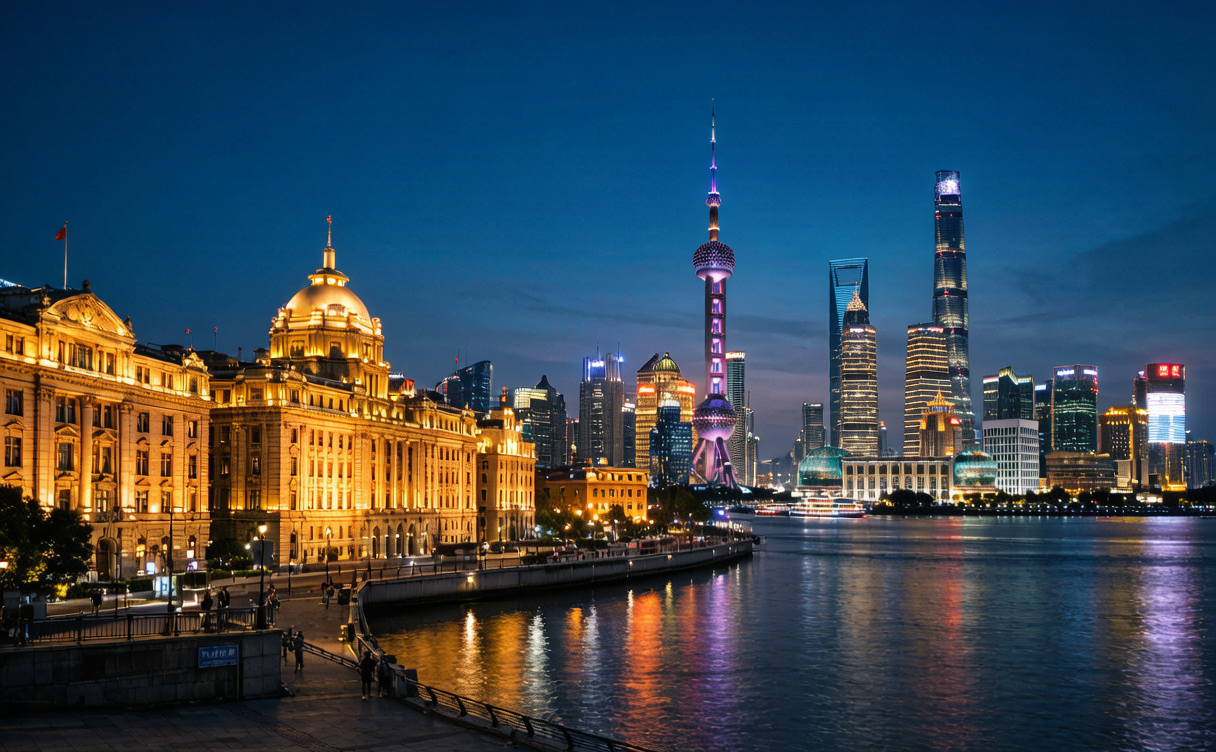
The catch is the crowd. By 7 p.m. in peak season the railing is three deep. The fix is simple: arrive early and walk north toward the Waibaidu Bridge, where the numbers thin out but the view holds.
2. The Pudong Riverside (East Bank) — The Mirror
Cross the river and the composition flips. From the Lujiazui riverside walkway you look back at the Bund’s lit stone façades, the Oriental Pearl glowing beside you. Fewer tourists do this, and the reflection of the historic waterfront is genuinely prettier than the towers’ — the old buildings are lower and broader, so the river catches more of them. Come here to look up at the Shanghai Tower after photographing it from afar all evening.
3. A Huangpu River Cruise — The Moving View
For about ¥120–150 ($17–21), a 45–60 minute evening cruise loops past both banks. You get the skyline from mid-river, often timed so the light-up happens while you’re onboard. It’s touristy, but it’s a relaxing way to see the whole sweep without the promenade crush, and the open upper deck is the best wind-in-your-hair photo spot. Book at the pier or via Trip.com earlier in the day — same-night walk-up tickets sell out on weekends.
4. Rooftop Bars & Restaurants — The Elevated View
Several Bund heritage buildings hide rooftop bars with paid, elevated sightlines. A terrace on a Bund-front hotel or a high floor nearby gives you the skyline with a cocktail and no railing-jostling. Expect ¥80–150 ($11–21) a drink — a view that costs ten times more in New York or London. Go for a celebration, not your primary photo run.
5. Waibaidu Bridge & Suzhou Creek — The Quiet Angle
Walk to the Bund’s north end where the Huangpu meets Suzhou Creek, and you’ll find the red Waibaidu Bridge. From here the skyline sits off to your right and the creek adds a second ribbon of light. Almost nobody shoots from this angle, so you’ll get a frame that isn’t in everyone’s album. It’s my secret favorite with a long exposure.
Plan your route: Turn this into a timed evening with our Shanghai 2-day itinerary — the Bund at night is Day 1’s finale.
When to Go: Timing the Light-Up
The single biggest mistake visitors make is arriving after dark. The Shanghai Bund night view is best caught becoming lit, not already lit. Here’s the rhythm:
- Blue hour is the 20–30 minutes after sunset when the sky turns deep blue but still holds light. Photos look cinematic — the buildings glow and the sky isn’t a flat black void.
- The light-up happens roughly at sunset in summer (around 6:15–6:45 p.m.) and closer to 5 p.m. in winter. The towers don’t fade in gradually; they switch on in a wave within a minute or two.
- Arrive 30–45 minutes before that switch-on. Claim your spot and watch the show happen in front of you.
On a February 2023 trip I timed it badly — slow at dinner, at the promenade by 6:10 p.m. in near-darkness. Towers already on, moment gone, a static postcard for a cross-city ride. Next night I left at 4:40, was at the rail by 5:05, and got the full grey-to-gold-to-blue performance. Same city, completely different memory. The Bund rewards the early, punishes the late.
If your dates are flexible, shoulder seasons are kindest — clearer skies and thinner crowds in March–May and October–November (details in our best time to visit China guide). For current tower light-show schedules, the official Shanghai tourism site is what I check before each visit.
Photo Tips for the Perfect Shot
You don’t need a fancy camera. Some of my favorite Bund shots came from a phone — but a few habits separate the postcard from the blur.
Stabilize everything. Night shots need light, and light needs time. Even a small phone tripod that wraps a railing turns a shaky 1/8-second shot crisp. I keep a pocket one in my daypack every Shanghai trip; on that April 2018 night it’s the only reason I came home with a photo I actually printed.
Lock your settings. On a phone, tap to focus on the brightest tower, then drag exposure down so the lights don’t blow out. On a camera, start at ISO 100–200, f/8, and a 2–4 second shutter; a longer exposure turns the river into a smooth mirror.
Shoot the reflection, not just the towers. The Huangpu is half the picture. Compose with water in the bottom third and wait for a boat to trail light across it.
Go wide, then long. Wide gets the whole skyline; zoom isolates the Oriental Pearl or the Shanghai Tower’s twist. Most people take only the wide one and miss the details.
Edit lightly. Lift shadows, cool the blues a touch, resist oversaturation. The real Bund at night is spectacular enough without becoming a neon cartoon.
How to Get There
The Bund is central and easy. The promenade runs along Zhongshan East Road, and the nearest metro puts you a flat walk away.
From the metro: Line 2 or 10 to East Nanjing Road (南京东路). Use Exit 2 or 4, walk east toward the river, and you’ll hit the promenade in about 10 minutes. Line 12 to Tiantong Road also works if you’re coming from the north. The Bund itself has no station — don’t trust a map app’s “The Bund” pin and expect to be there; East Nanjing Road is the stop.
From Nanjing Road: Already on pedestrian Nanjing East Road? Keep walking east — a straight, car-free shot to the water, about 15 minutes, a nice warm-up for the view.
From Pudong Airport (PVG): Fastest is the Maglev to Longyang Road (it hits 300 km/h / 186 mph, ¥50 / $7), then Line 2 west to East Nanjing Road — about 50 minutes total. A DiDi runs ¥160–180 ($22–25), 45–70 minutes by traffic.
From Hongqiao: Line 2 runs direct east to East Nanjing Road — no transfer, 30–40 minutes.
Crossing to Pudong: The Bund Sightseeing Tunnel is a kitschy tube under the river (¥50 / $7, fun once), but the metro or a short DiDi is simpler. Line 2 to Lujiazui drops you right at the east-bank riverside.
Stay connected: Grab an eSIM or SIM card before you fly so maps and translation work the moment you land — the Bund is easy to find, but the rest of your evening won’t be without them.
What to Eat Nearby After Dark
The light-up builds an appetite, and options sit within a 10-minute walk.
- Yu Garden Bazaar (south of the Bund): Red lanterns, snack stalls, and the Nanxiang branch that claims to have invented the soup dumpling. A basket of xiaolongbao runs ¥25–40 ($3.50–5.50). Touristy but fun; the Old Town glows at night.
- Nanjing East Road: The pedestrian strip back toward the metro is lined with dumpling chains and bubble-tea stalls — easy, cheap, open late.
- Riverside restaurants: A few Bund-front spots serve Shanghainese food with a view, at a premium. Save these for a splurge night.
One warning: China is near-cashless and small stalls expect a QR code, not notes. I watched a traveler in 2019 dig through his wallet for minutes while his dumplings cooled because he couldn’t scan. Don’t be that person.
Pay like a local: Set up Alipay and WeChat Pay at home on Wi-Fi so you can scan to pay for dumplings and the metro with a foreign card — 15 minutes now beats a confused standoff at the stall later.
A Night on the Bund: Karl’s Take
My favorite Bund memory isn’t the famous railing shot. It’s a warm October evening in 2022: I’d photographed the skyline from the promenade, crossed to Pudong, then rode the Maglev back just to watch the towers recede. I ended on a quiet stretch near the Waibaidu Bridge, long-exposure tripod out, a ¥6 ($0.85) lamb skewer from a cart behind me. A local grandfather stopped, watched my screen fill with light trails, and gave a thumbs-up in Mandarin I didn’t understand but completely got. That’s the view at its best: a free, absurdly beautiful show that feels personal the moment you stop rushing and just stand there.
Conclusion
The Shanghai Bund night view rewards a simple plan: arrive 30–45 minutes before sunset, claim the west-bank railing, and let the city switch itself on. See it again from Pudong or a cruise if you have energy, bring a tripod for the shot, and end with a dumpling. It’s free, it’s central, and it’s the memory you’ll pull up long after the rest of the trip blurs.
Build the rest of your stay around it with our Shanghai 2-day itinerary, and keep our China travel guide for first-timers open for visas, packing, and the rest of the country.
Written by Karl · Updated July 2026