

The call to prayer rolls out over the mud-brick lanes of Kashgar’s old town just as the first light hits the rooftops, and for a moment the only sound is the clink of a tea glass being set down on a wooden stool. This is China’s northwest frontier at its most alive — and the reason so many travelers tell me a Xinjiang travel guide was the first thing they bookmarked before the rest of their China trip. Xinjiang is huge (it covers about one-sixth of China’s land area), wildly diverse, and unlike anywhere else in the country. If you have even a week, it deserves a place on your itinerary.
Key Takeaways
– Best time to go: Late spring (May–June) and autumn (September–October) offer the most comfortable weather and the best light for photography; summers are hot but lively, winters are brutal but empty.
– Getting there: Fly into Ürümqi Diwopu International Airport (URC), or take a long-distance high-speed or sleeper train from cities like Xi’an or Lanzhou.
– Must-see trio: Kashgar’s old town, the Turpan oasis and Silk Road ruins, and Heavenly Lake (Tianchi) near Ürümqi.
– Food highlight: Uyghur cuisine — hand-pulled laghman noodles, sizzling lamb kebabs, and flaky nang bread — is the best reason to slow down.
– Plan smart: Xinjiang spans multiple time zones and climates; a realistic 7-day loop is far better than rushing the whole region. Pair this with our Xinjiang 7-day itinerary for a day-by-day plan.
If this is your first trip to China overall, start with our broader China travel guide for first-timers — it covers payments, apps, and the practical basics that make everything else easier.
When to Go
Xinjiang’s climate is extreme and continental, so timing matters more here than almost anywhere else in China.
Spring (May–June): My favorite window. The apricot blossoms around Kashgar and the Tianshan foothills are spectacular, and daytime temperatures sit in a comfortable 15–28°C range.
Summer (July–August): Hot in the basins (Turpan can top 40°C), but this is when the grasslands of the north — places like Nalati and Bayinbuluke — turn emerald green. It’s also peak domestic-tourist season, so book trains and hotels early.
Autumn (September–October): The golden season. The leaves around Heavenly Lake turn, the light is soft, and the fruit markets overflow with grapes, melons, and pears. This is when I send most photographers.
Winter (November–March): Cold, quiet, and cheap. The skiing near Ürümqi is genuinely good, but many seasonal guesthouses and some mountain roads close.
The Visa-Free Question
A common worry is paperwork. Good news: China has steadily expanded visa-free entry, and many travelers now arrive without a standard tourist visa at all. If you’re transiting through a major hub, the China 144-hour visa-free transit policy may cover you. Either way, Xinjiang is fully open to foreign tourists with normal documentation.
How to Get There
Fly in. Ürümqi Diwopu International Airport (URC) is the main gateway, with domestic connections from Beijing, Shanghai, Xi’an, Chengdu, and more. Direct international flights exist from a handful of Central Asian and Middle Eastern cities. From the airport, a cheap airport bus or taxi gets you into the city.
Take the train. This is the romantic option. The high-speed line now links Ürümqi with Xi’an and Lanzhou, and sleeper trains run deep into the region toward Kashgar. Our China high-speed train guide for foreigners walks you through booking and the real-name ID rules you’ll need to follow.
In September 2024, I boarded the sleeper train from Xi’an to Ürümqi and woke somewhere near the Gobi as the sun came up over a horizon with no end. A retired teacher in the bunk across from me pushed a thermos of tea into my hands without a word. That slow, 24-hour glide is part of the Xinjiang experience — you feel the country getting wider.
Getting around inside Xinjiang. Distances are enormous. Ürümqi to Kashgar is roughly 1,500 km. Domestic flights connect the major hubs, while long-distance buses and the occasional train serve smaller towns. Rent a car only if you’re comfortable with Chinese road signs and long drives.
Top Places to Visit
Kashgar Old Town
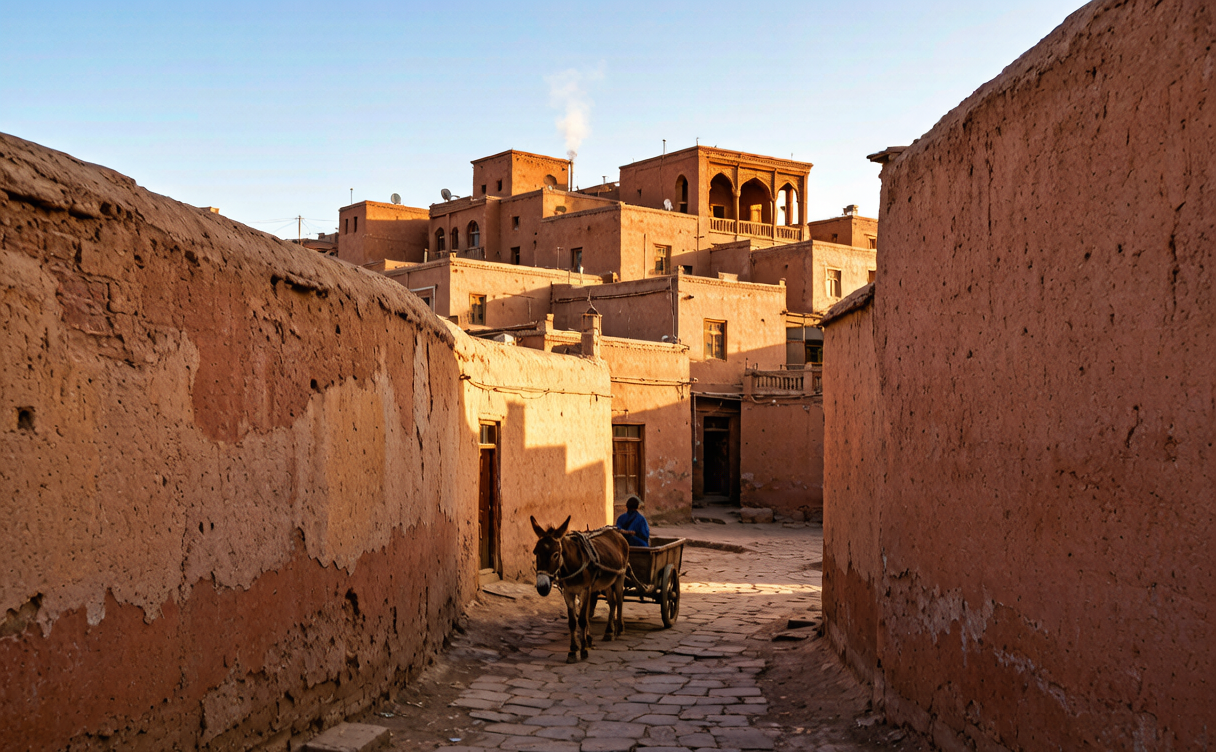
The heart of southern Xinjiang. Kashgar’s old town (Kashgar Lao Cheng) is a living maze of low mud-brick houses, rooftop cafés, and artisans hammering copper. The famous Id Kah Mosque anchors the center. Wander without a plan, get lost, accept the invitation to tea. The old town was extensively renovated over the past decade, but it remains genuinely Uyghur in character and rhythm.
Turpan — The Silk Road Oasis
Turpan sits in a basin that is one of the hottest, lowest places in China. It’s also packed with history: the ancient Jiaohe ruins, the Bezeklik Thousand Buddha Caves, and the brilliant karez underground irrigation channels that still feed the vineyards. In October 2023, I rented a bicycle outside Turpan and pedaled between grape-drying houses as families waved me over to taste sun-dried seedless grapes still warm from the racks. The sweetness was unlike anything in a supermarket back home.
Heavenly Lake (Tianchi)
Just 90 minutes from Ürümqi, Heavenly Lake is a turquoise alpine reservoir ringed by snow peaks. Cable cars and boardwalks make it easy, even for casual walkers. Go early to beat tour groups. It’s the perfect half-day reset after a long train ride.
The Silk Road Heritage
Xinjiang was the crossroads of the ancient Silk Road, and several of its sites are on the UNESCO World Heritage List for the Silk Roads. From the Buddhist caves of Kizil to the desert forts near Khotan, the layers of history here — Buddhist, Persian, Chinese, and Islamic — are unmatched anywhere in China.
Food: The Real Reason to Slow Down
Uyghur cuisine is the soul of a Xinjiang trip, and it’s some of the best food in all of China.
- Laghman: Hand-pulled noodles tossed with tomatoes, peppers, and sometimes lamb. The “pulling” is done by hand in front of you at many joints.
- Kebabs (kawap): Skewers of cumin-and-chili lamb grilled over charcoal. Cheap, smoky, and addictive.
- Nang: The round, sesame-speckled flatbread baked in domed ovens. Buy one warm and snack all day.
- Polo (pilaf): Rice with carrot, raisin, and lamb — comfort food after a cold morning.
- Samsa: Spiced-meat pastries baked in the tandoor-style oven.
Markets in Kashgar and Ürümqi’s International Grand Bazaar are the best hunting grounds. A full plate of kebabs and a nang rarely costs more than a few dollars.
Safety & Cultural Etiquette
Xinjiang is generally safe for tourists, and the region is heavily policed — expect security checks at stations, hotels, and major sites. Keep your passport on you, since ID checks are routine. For context on staying secure across the country, read our China travel safety tips.
A few etiquette notes go a long way:
- Dress modestly at religious sites; cover shoulders and knees near mosques.
- Ask before photographing people, especially in the old town and at markets.
- Respect prayer times and don’t walk in front of worshippers.
- Learn a few words — “rahmet” (thank you) and “yaxshi” (good) in Uyghur open more doors than you’d expect.
One more practical thing: the internet. Many Western apps and sites are blocked in China, so set up connectivity before you fly. Our China eSIM & SIM card for tourists guide explains the simplest options for staying online on the ground.
A Realistic Itinerary Sketch
You can’t see all of Xinjiang in a week — don’t try. Here’s a balanced southern-and-northern loop:
- Day 1–2: Arrive Ürümqi, visit Heavenly Lake, explore the International Grand Bazaar.
- Day 3: Fly or train to Turpan; see Jiaohe ruins and the karez channels.
- Day 4–5: Fly to Kashgar; wander the old town, visit Id Kah Mosque, day-trip to Karakul Lake near Mount Muztagh Ata.
- Day 6: Slow morning in Kashgar’s Sunday livestock market (if your dates line up), then travel back.
- Day 7: Depart from Ürümqi or Kashgar.
For a tighter, fully mapped day-by-day version, grab our Xinjiang 7-day itinerary.
FAQ
Do I need a special permit to visit Xinjiang as a foreigner?
No. Foreign tourists visit Xinjiang with the same passport and visa (or visa-free eligibility) required elsewhere in China. Some remote border areas, like the Karakoram Highway toward Pakistan or certain military zones, do require extra permits — ask your hotel or a local agency if your route goes that far west.
Is Xinjiang safe for solo travelers?
Yes. The region has a strong security presence, and tourists — including solo women — generally report feeling safe. The main hassles are routine ID checks and occasional road closures, not personal safety. Keep your passport handy and build buffer time into transfers.
What’s the food like if I don’t eat lamb?
Plenty of options. Vegetarians can enjoy nang bread, hand-pulled noodles with vegetables, lentil soups, fresh fruit, and dairy like yogurt and kaymak. Just confirm dishes aren’t cooked in lamb fat, and learn the phrase “göshsiz” (without meat) to make ordering easier.
How many days do I really need?
A minimum of 5–7 days lets you combine the north (Ürümqi, Heavenly Lake) with the south (Kashgar, Turpan). Anything under five days means picking one region and skipping the other. If you only have time for one stop, make it Kashgar.
Written by Karl. Karl has spent the last three years helping foreign visitors plan practical, low-stress trips across China.