

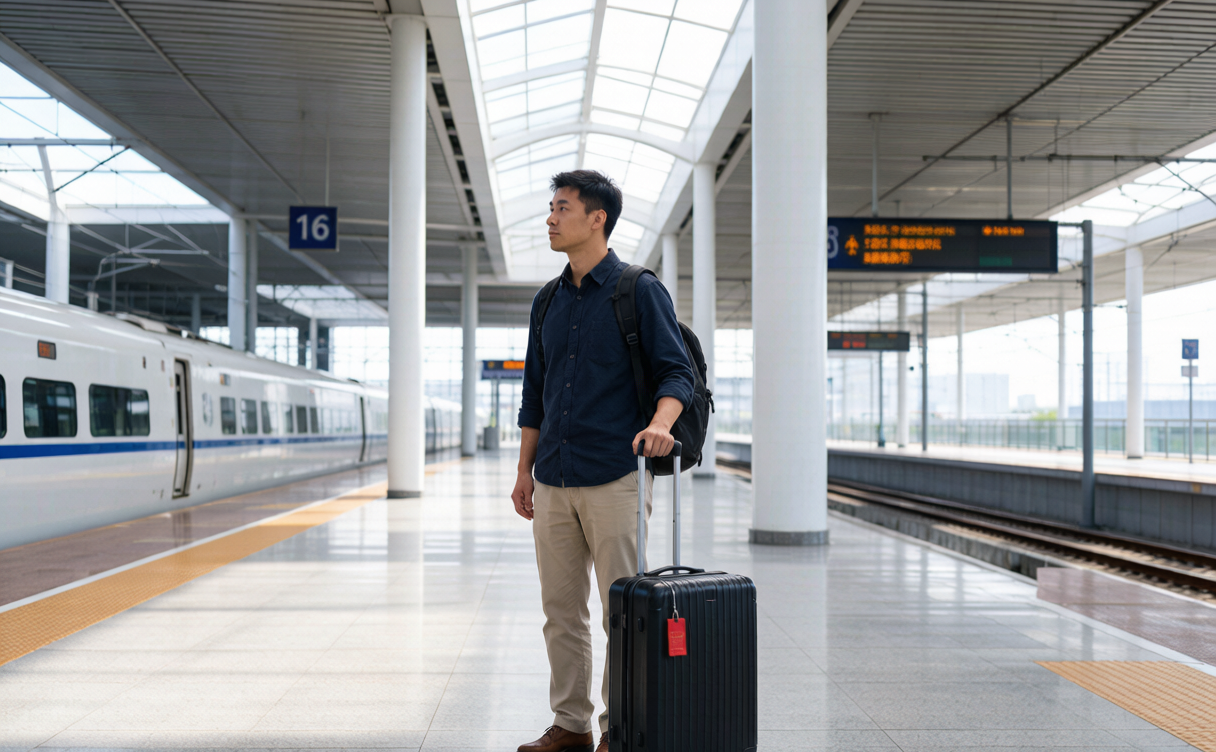
The first time I stood at Beijing South Railway Station with a paper ticket and no idea which gate to use, I almost missed my train to Xi’an. If you are planning a trip and feeling the same dread about the booking apps, this guide is exactly what I wish I’d owned back then. China’s bullet trains are fast, punctual, and shockingly cheap — but the booking system was not built with foreign passports in mind. Across three separate trips between 2023 and 2025, I learned the tricks that save hours and avoid expensive mistakes. Below is everything you need to book, board, and ride with real confidence.
Key Takeaways
– Book through the official 12306 app (now in English) or Trip.com; both accept foreign passports and international cards.
– Always carry the exact passport you used to buy the ticket — China trains use real-name verification at every gate.
– Arrive 30–45 minutes early; security is airport-style and gates close 3–5 minutes before departure.
– You can change (改签) or refund tickets in the app, but fees climb as departure nears — act early.
– There is no free onboard WiFi; download shows beforehand and keep luggage within 20 kg per adult.
How to Buy Tickets: 12306 vs. Trip.com
Booking is where most foreigners get stuck — so let’s start there. You have two realistic options, and both work with a foreign passport.
Using the Official 12306 App
12306 (www.12306.cn) is the state railway operator’s own platform and the only source of every seat on every train. In 2024 the app added a full English interface, and you can now register with a foreign passport number instead of a Chinese ID. After installing it, switch the language to English, tap “Register,” and enter your passport details exactly as they appear on the document. You then complete a one-time passport verification — usually instant, occasionally a few hours.
Once verified, search by city pair (for example, “Beijing South” to “Shanghai Hongqiao”), pick a date, and choose your seat. Payment inside the app accepts Visa, Mastercard, and UnionPay as of 2025. If the app feels clunky, the official English website works too: the 12306 English portal handles the same bookings.
Booking Through Trip.com
Trip.com is the international arm of China’s Ctrip and the easiest alternative for foreigners. It shows the same trains, adds a small service fee (usually ¥15–¥30 per ticket), and supports PayPal, Visa, and Mastercard without the verification hoop. The trade-off: popular trains sell out on Trip.com a few minutes after 12306, because it pulls inventory from the official pool. For peace of mind on your first booking, the fee is worth it.
You will still need a payment app for station snacks and taxis, so read up on Alipay and WeChat Pay for foreigners before you travel.
New to China entirely? Our China travel guide for first-timers covers visas, SIM cards, and city-hopping in one place.
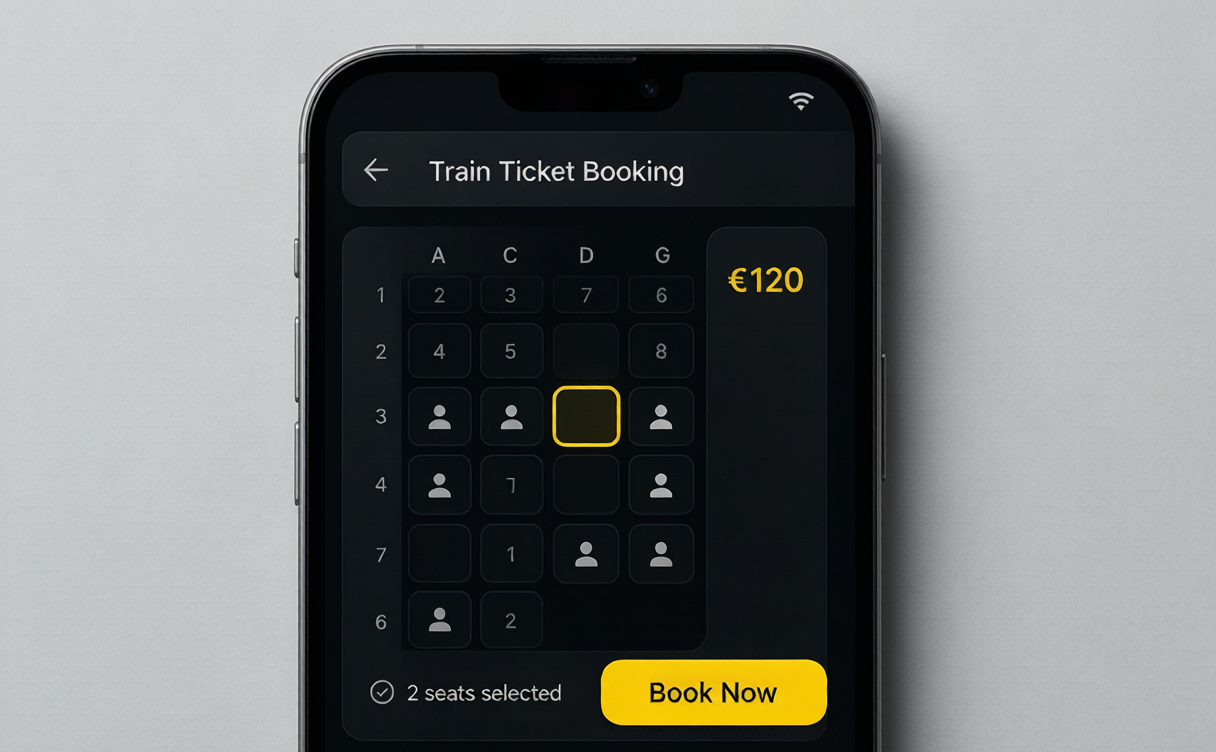
Want the zero-stress option? Book your first China train on Trip.com — no app verification, instant confirmation, and English support if something goes wrong.
Choosing Your Seat and Train Class
Chinese high-speed trains are labeled G, D, and C. G-trains (gaosu) are the fastest, hitting 300–350 km/h on dedicated tracks; D-trains are slightly slower but cover more routes; C-trains are short-haul commuter bullets around big cities. For a first trip, G is the sweet spot.
Seat Classes
| Class | Approx. price (Beijing–Shanghai) | Notes |
|---|---|---|
| Second class (二等座) | ¥553 | Standard 3-2 layout. Comfortable, cheap, and what most travelers book. |
| First class (一等座) | ¥933 | Wider 2-2 seats, quieter cars. |
| Business class (商务座) | ¥1,743 | Lie-flat pods with meals — a splurge, not a necessity. |
On the seat map, window seats face the direction of travel on one side; if you get motion sick, pick a forward-facing window. Trains run on the right-hand track, so the south- or west-facing side often has better light — minor, but it matters on a four-hour ride.
At the Station: Security, Check-in, and Boarding
Last April, my friend Daniel arrived at Shanghai Hongqiao just 18 minutes before his train to Hangzhou. He cleared security fine but could not find his gate — the display flipped to “Boarding” with two minutes left, and the gate had already closed. He bought a same-day standby ticket and lost 40 minutes plus ¥73. The lesson stuck with both of us: treat a Chinese train station like a small airport.
Security is airport-style. Liquids under 100 ml are fine, but sharp objects and obvious weapons are out. You scan your passport at the entry gate (real-name check) and again at the platform gate. Gates close 3–5 minutes before departure — there is no “just made it” grace period. Plan to be inside the station 45 minutes early during holidays and 30 minutes off-peak. Keep your passport in hand; a photo on your phone will not open the gate.
Changing or Refunding Tickets (改签 & 退票)
Plans change, and China’s system handles it — for a price.
- Refunds (退票): Free if you cancel more than 8 days ahead. Between 48 hours and 8 days, you lose 5%. Within 48 hours, the fee rises to 10–20%.
- Changes (改签): You can switch to another train on the same route once, for free if the new ticket is equal or cheaper; pay the difference plus a small fee if it is pricier. You cannot change to a different origin or destination — that requires a refund and rebook.
Both actions happen in the 12306 app or Trip.com under “Orders.” Note the cutoff: 12306 sells and changes tickets from 5:00 to 1:00 the next day (closing 23:30 on Tuesdays), so don’t count on a 3 a.m. rebook. In plain English: do your changes before you sleep.
If you are in China on a layover, the 144-hour visa-free transit policy lets you ride bullet trains between approved cities without a visa — a perfect excuse to sample the network.
On Board: WiFi, Food, and Luggage
WiFi and Connectivity
Here is the disappointment: there is no free WiFi on Chinese high-speed trains. Some G-trains advertise 5G coverage, but it is patchy at best. Before you board, sort out mobile data — an eSIM or a roaming plan from your home carrier — or download Netflix episodes and offline maps. I learned this the hard way on a six-hour Chengdu–Beijing ride in 2024 with a dead phone and nothing to watch.
Food
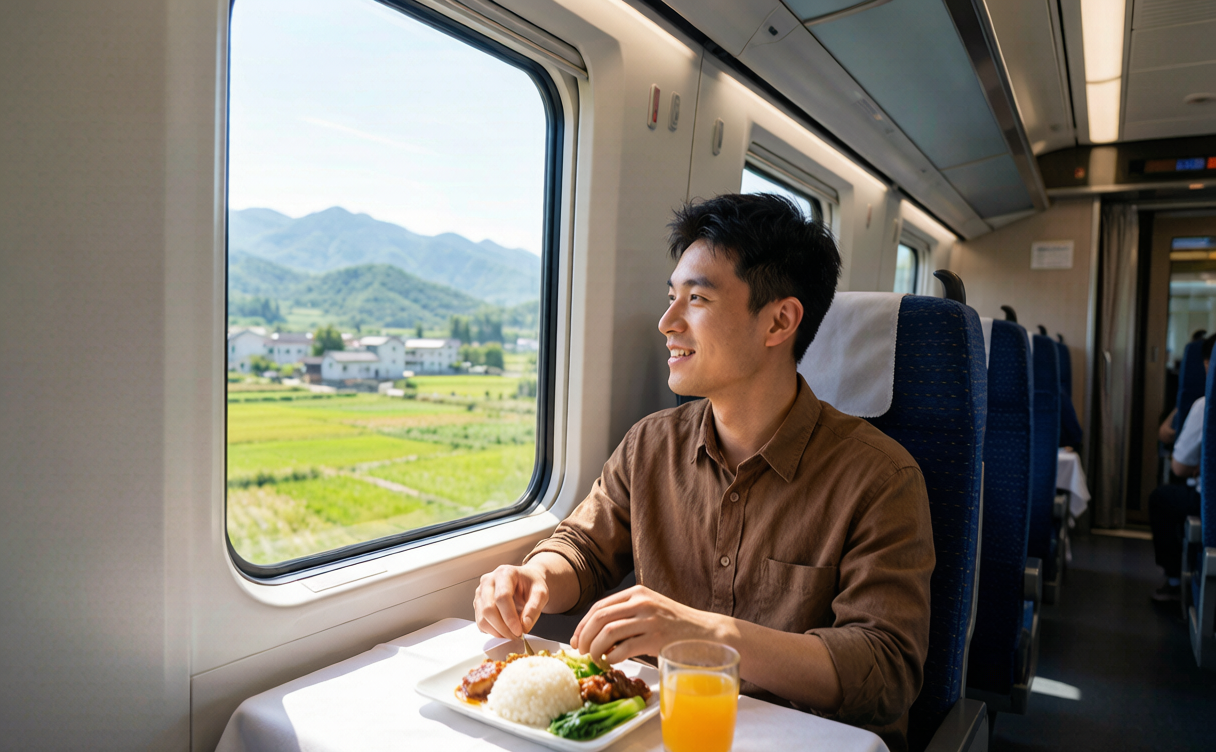
Each train has a dining car and a snack trolley. Hot meals (¥25–¥45) include rice sets, noodles, and the occasional KFC or local chain option at major stations, deliverable to your seat if ordered on the 12306 app before departure. Bringing your own food is completely normal — I always grab a jianbing (煎饼) or a sandwich at the station.
Luggage
The allowance is 20 kg per adult, with a longest-side limit of 130 cm. In practice, nobody weighs your bag; the overhead racks fit a 24-inch suitcase, and larger cases go at the carriage ends. Just do not block the aisle.
Practical Tips for a Smooth Ride
The best time to visit China affects train crowds as much as weather. Spring (April–May) and autumn (September–October) bring blue skies and manageable stations; avoid the Spring Festival (usually January–February) and National Day (early October), when hundreds of millions of trips cram the network and tickets vanish in seconds.
A few final habits from my own trips:
– Screenshot your ticket QR in case the app buffers at the gate.
– Bring a power bank — not every seat has a working outlet.
– Save a translation phrase like “I’m at car 07, seat F” before you lose signal.
Ready to ride? Start by installing the 12306 app or opening Trip.com, and book your first route this week. Trains sell out fast around holidays — lock in your dates early and travel light. Do that, and you’ll go from panic at the gate to watching the countryside blur by at 300 km/h — no Chinese needed.
Written by Karl — I have ridden China’s high-speed network across nine provinces between 2023 and 2025, from the Beijing–Shanghai line to the Chengdu–Chongqing bullet. Questions? The comments are open.