

On a blustery April morning in Weifang, the sky stops being empty. Dragons ripple across the blue like living creatures, butterflies the size of small cars tumble in the wind, and long chains of painted diamonds flash in the sun. This is the world of the Chinese kite, a folk art that has been built, painted, and flown for more than two thousand years. For travelers, a Chinese kite is far more than a toy on a string: it is a compact lesson in engineering, symbolism, and regional identity, all visible in a single object dancing overhead.
This Chinese kite guide takes you from the earliest military experiments to the modern festival fields of Shandong. We will look at how a Chinese kite is made, which designs are the most famous, where you can fly one yourself, and how to time your visit so the wind and the crowds are on your side. Whether you are a curious first-time visitor or a dedicated kite enthusiast, the sky above China has room for you.
The Long History Behind the Chinese Kite
Any honest traditional Chinese kite history begins in the Warring States period, around the fifth century BCE. The invention of the kite is usually credited to the philosopher Mozi (Mo Di), who is said to have spent three years crafting a wooden kite, and to the carpenter Lu Ban, who is said to have refined the design. These early kites were not toys at all. They were practical tools used to signal across battlefields, to measure distances, and to test the direction and strength of the wind before a military move.
The invention of paper during the Han dynasty changed everything. A Chinese kite could now be light, inexpensive, and easy to decorate. By the Tang dynasty, kite flying had become a popular pastime of the court and the countryside alike. Kites were flown during the Qingming festival, and stories spread of kites carrying messages across rivers or lifting brave pilots into the air. The Song dynasty saw organized kite competitions and public kite meets, while the Ming and Qing dynasties pushed kite making into a genuine folk art, with distinct regional schools emerging in Beijing, Tianjin, Nantong, and Weifang.
To see the surviving objects and the craft traditions firsthand, many travelers build their route around Ancient china collections in the great city museums. For a broader outside perspective on how kites developed across cultures, the Britannica overview of kites is a useful reference. The modern chapter began in 1984, when Weifang hosted its first international kite festival. The event grew into a global gathering and earned the city a reputation as the kite capital of the world.
Trace the craft from ancient workshops to modern museums on your next trip.
The Weifang Kite Festival: China’s Sky on Display
The Weifang kite festival is the single best reason to put this corner of eastern China on your itinerary. Held every April, usually beginning around the third weekend of the month and running for roughly a week, the Weifang International Kite Festival draws flyers, makers, and spectators from dozens of countries. The opening ceremony is a spectacle in itself, but the real magic happens out in the flying fields and along the riverbanks.
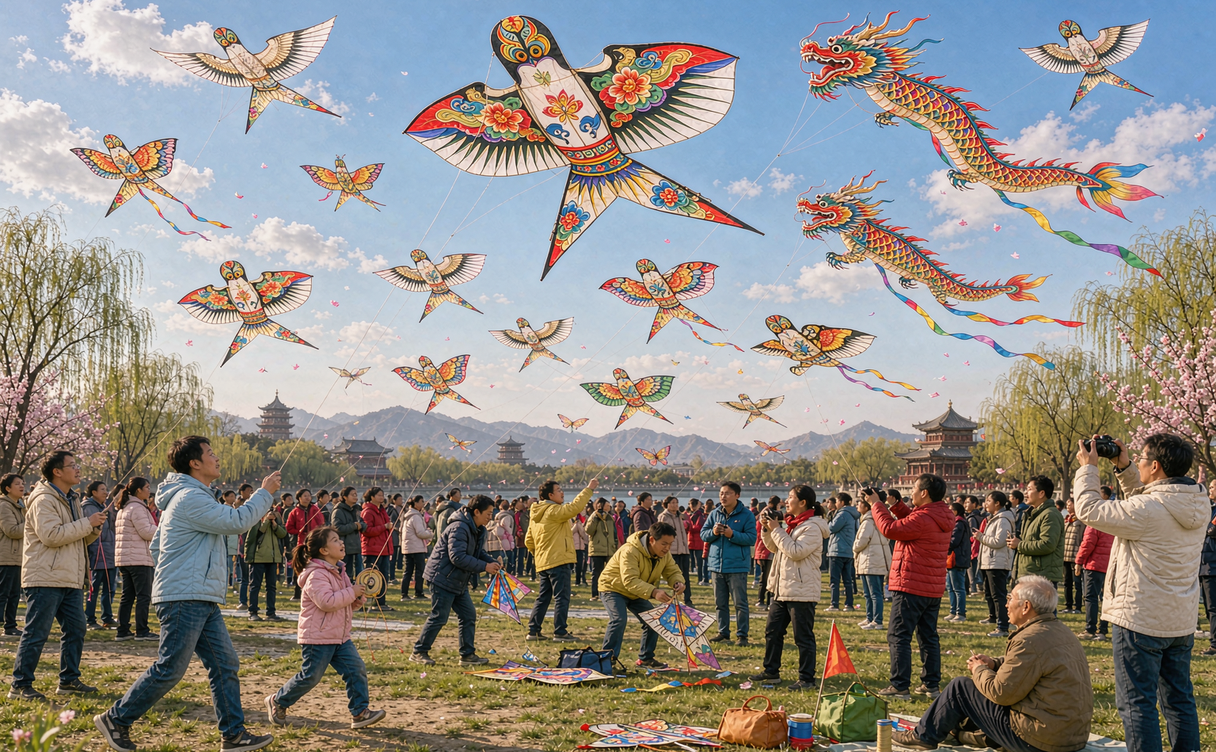
Competitions range from traditional static kites, judged on craftsmanship and painting, to stunt kites that duel for control of the air. The most photographed entries are the giant dragon and centipede kites, long chains of segmented discs that can stretch for hundreds of meters and require a team of handlers to launch. At night, illuminated kites rigged with lights turn the sky into a moving constellation. The scale is hard to imagine until you stand beneath one and watch the handlers run to keep the line taut.
Between flights, visit the Weifang World Kite Museum, widely regarded as the largest kite museum in the world. Its halls hold thousands of kites from China and abroad, ranging from tiny finger-sized pieces to room-filling giants, along with displays on the history, materials, and regional styles of the craft. Weifang is easy to reach by high-speed rail from Jinan and Qingdao, and the city makes a natural base for exploring the wider province. Plan extra time: flyers and vendors are happy to talk about their work for hours, and the best conversations often happen away from the main stage.
For transport, where to stay during the festival, and other local tips, see our Shandong destination guide.
Famous Chinese Kite Designs and What They Mean
Chinese kite designs are a visual vocabulary of luck, nature, and folklore. The most recognizable is the dragon kite, a long articulated creature whose body is made of many round segments linked together. In flight, the segments undulate like a real dragon, and the effect is both comic and majestic. Dragon kites are the signature of Weifang and the centerpiece of the festival, with some entries taking months to build.
The butterfly kite is another firm favourite. Its symmetrical wings are painted with bold patterns, and some versions use small mirrors or painted eye motifs that flash as the kite turns. The sand swallow, a Beijing classic, is a stylized swallow with swept wings and decorative motifs of bats and clouds, both symbols of good fortune. Its bright reds and pinks make it one of the most photographed kites in the air.
Other famous Chinese kite designs include the eagle and hawk kites associated with Tianjin, the goldfish and flower-basket kites that symbolize abundance, and the whistling board kites of Nantong, which sing as air rushes through small tubes fixed to the frame. Opera figures, lucky characters, and auspicious animals round out the repertoire. Each region has its own visual signature: Weifang kites favour bold geometric forms and folk painting, while Beijing kites are more delicate and literary. Learning to tell them apart turns a simple flight into a small lesson in Chinese art history.
Inside a Chinese Kite Making Workshop
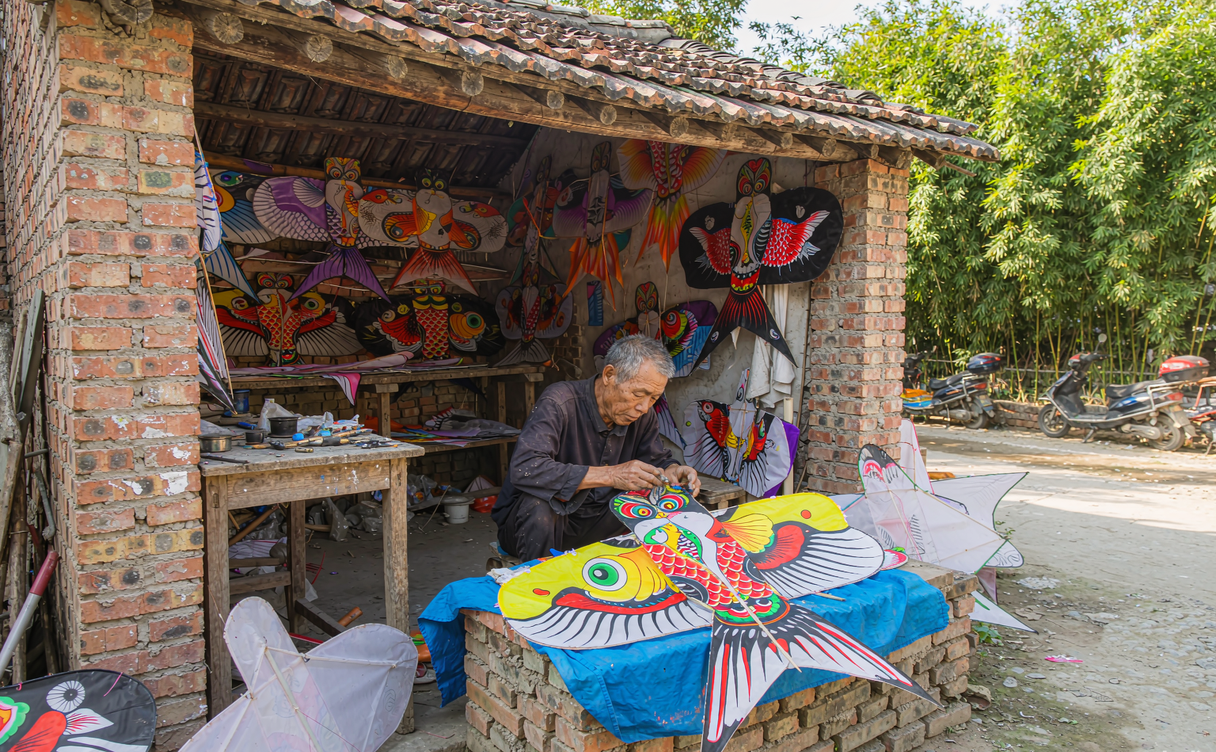
Watching a kite fly is one thing; building one is a revelation. Traditional Chinese kite making rests on four skills: tying, pasting, painting, and flying. The craft begins with bamboo. A maker selects a section, splits it into fine strips, and shaves and bends them over a flame until they hold the desired curve. The strips are tied into a frame with thread, a step that demands real precision, because the Chinese kite must be light yet strong enough to resist a sudden gust.
Next comes the covering. Paper or silk is laid over the frame and pasted down, then trimmed with a knife. The paste must be even, or the kite will twist in the air. Painting follows, with artisans applying bright mineral pigments, ink outlines, and auspicious motifs freehand. Finally, the maker attaches the bridle and tail, then tests the kite in the wind and adjusts the balance until it flies straight. A well-balanced Chinese kite needs surprisingly little wind to stay up.
In Weifang, Beijing, and several other cities, you can join a Chinese kite making workshop and build a small kite of your own in a couple of hours. These sessions are family-friendly and usually include the painting step, so you leave with a unique souvenir that you helped create. They pair beautifully with a calligraphy or brush-painting session, since both crafts reward a steady hand and an eye for line. If you enjoy that side of Chinese culture, our Tang dynasty arts guide is a good place to begin exploring.
Where to Fly Kites in China
Weifang is the undisputed capital, but it is far from the only place to fly. If you are wondering where to fly kites in China, start with the country’s big open spaces, parks, and festival grounds.
Beijing has a long kite culture. Kites were once flown over the old city walls and imperial squares, and today parks such as Chaoyang Park and the Olympic Forest Park are popular weekend spots on windy days. Shanghai offers wide waterfront lawns and large parks like Century Park, where weekend flyers gather. In Nantong and Tianjin, local kite clubs keep the regional traditions alive, and Qingdao’s coastal breeze makes its beaches and promenades pleasant flying grounds. In the west of the country, cities such as Chengdu have lively park cultures where a kite is a normal part of a leisurely afternoon.
Wherever you go, the rules are similar: choose an open area away from power lines, roads, and busy flight paths, and check local regulations before launching a large kite. Spring is the classic season because the winds are steady, but autumn can be excellent too. A kite line is also a social passport in China; striking up a conversation with a fellow flyer is one of the easiest ways to meet locals and learn a new trick.
Make the most of the windy season by planning your trip around the Lunar calendar and local festival dates.
Frequently Asked Questions
When is Chinese New Year 2026?
Chinese New Year 2026 falls on 17 February 2026, the first day of the Year of the Horse. Kite flying is a beloved Spring Festival activity, especially for children, and many families head to open parks and riverbanks in the days after the holiday. If your goal is to see kites in a festive setting rather than at a competition, the weeks around the holiday are an excellent time to visit.
When is Lunar New Year and why does the date change?
Lunar New Year is the same holiday, and its date shifts each year because the traditional Chinese calendar is lunisolar. The first day of the first lunar month can land anywhere from late January to mid-February on the standard Gregorian calendar. This is why festival dates and kite events move around, and why checking the calendar before you book is wise.
What Is the Capital of China, and Can You Fly Kites There?
The capital of China is Beijing, and yes, kite flying is a familiar sight there. While the old tradition of flying kites over central squares is now restricted, the city’s many parks and green belts welcome flyers, and a spring weekend will usually produce a colourful crowd. Beijing is also a good place to shop for a handmade kite to take home.
Do I need to bring my own kite?
No. Shops in Weifang and other kite cities sell everything from simple diamonds to elaborate dragons, and many vendors will help you launch. If you plan to fly a large or stunt kite, bringing your own is more reliable, and it saves you hunting for a specialist shop on arrival.
Chinese New Year is the liveliest week to see kites in the sky; read our Chinese new year travel guide before you go.