

I have eaten my way through most of Shanghai’s neighborhoods, and the first lesson was a humbling one: the dumplings everyone photographs near Yu Garden are a small slice of what this city actually cooks. Shanghai cuisine is a whole register of breakfast stalls, noodle counters, braised dishes and pastry windows, and the food locals reach for on an ordinary Tuesday morning is rarely the food printed on a tourist menu. This is the guide I wish someone had handed me in my first week here — real dishes, real shop names, and the small habits that separate a mediocre meal from a memorable one.
Shanghai food is a region, not a single dish
When people say “Shanghai food” they usually mean one of three things, and mixing them up leads to disappointing meals. There is the home-style cooking of the city itself — slow-braised, dark, glossy, generous with soy sauce and rock sugar. There is the street and snack layer that grew out of a port city with one foot in Jiangsu and Zhejiang. And there is the *Haipai* or Shanghai-style Western food that arrived with the treaty-port era and survives in old cafés and bakeries. Local dishes in Shanghai draw from all three. I learned to ask “what kind of meal is this?” before ordering, because a perfect bowl of noodles and a perfect plate of red-braised pork come from completely different places and should not be judged by the same standard. The city’s location matters here: it absorbed Suzhou’s noodle rigor, Ningbo’s seafood instinct, and Hangzhou’s love of tea and sugar, then made them its own.
Start with breakfast: the “Four Kings”
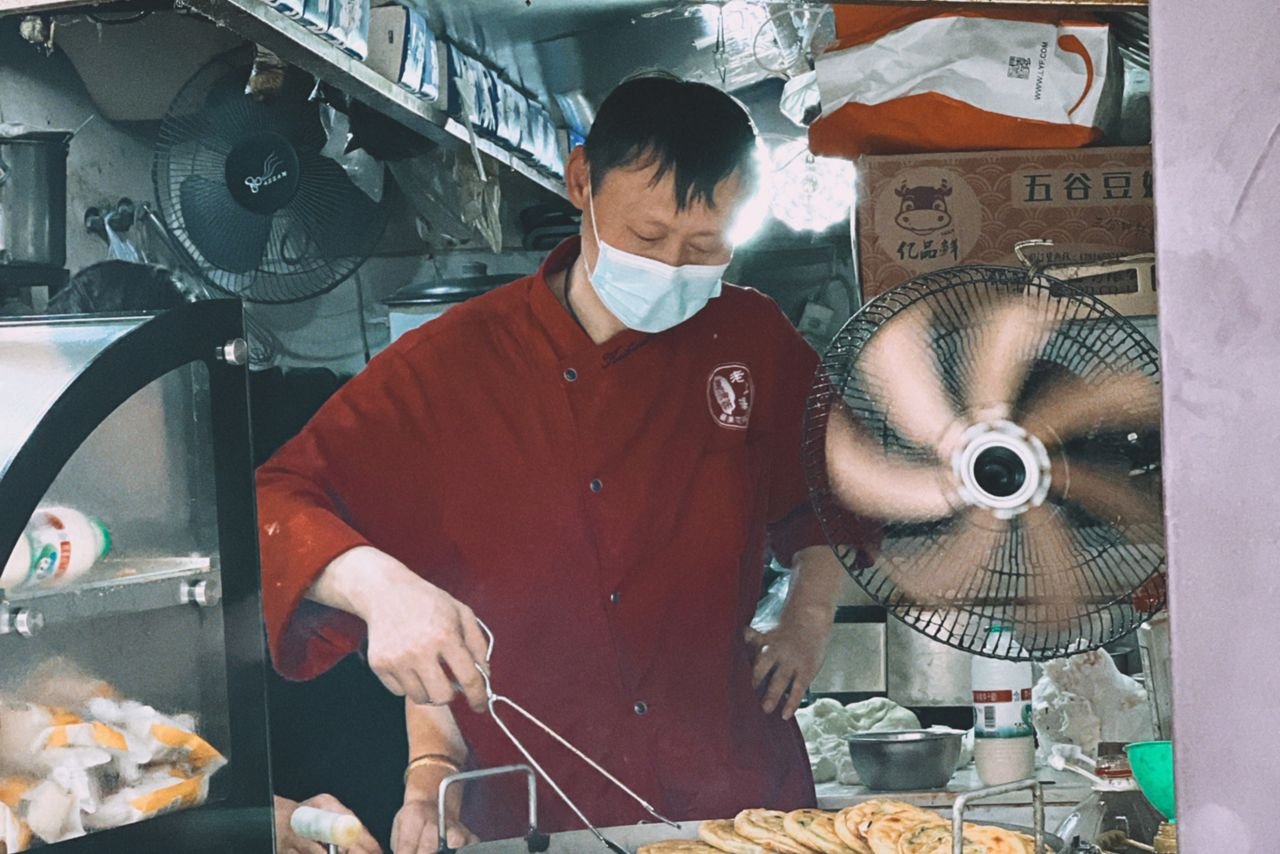
The fastest way to understand this city is to be awake at 7 a.m. Shanghai breakfast culture has a famous quartet known as the *sida jingang*, or “Four Kings”: *dabing* (a large sesame-dusted flatbread, savory or sweet), *youtiao* (fried dough sticks), *cifan* (a sticky rice roll, sometimes wrapped around a youtiao), and *xian doujiang* (salty soy milk). The salty soy milk is the one that converts people. It arrives in a bowl with dried shrimp, seaweed, chopped scallions, a thread of chili oil and broken pieces of youtiao floating on top — creamy, savory and nothing like the sweet version. My usual order is half a dabing wrapped around a youtiao plus a bowl of the salty soy milk, which costs around ¥8 to ¥12 in total. Find a stall outside a wet market with a queue of older residents and you are in the right place.
The noodle counters locals actually queue at
Noodles are where I do most of my eating, and Shanghai has its own vocabulary. *Cong you ban mian* is the essential bowl: thin noodles tossed in scallion oil that has been fried until the scallions are dark and sweet, often with dried shrimp (*kaiyang*) added. It is simple enough that quality is impossible to hide. For soup noodles, look for *huangyu mian*, a yellow croaker broth that tastes of the sea and costs more than you expect, and *dachang mian*, topped with braised pork intestine for anyone who wants the full local experience. *Lurou mian*, with spicy minced pork, is the comfort order on a cold day. Chains such as Laoshengchang and Dafugui are dependable, while older shops like Canglangting lean closer to Suzhou-style clear broths. A solid bowl runs ¥15 to ¥35. One insider habit worth copying: at Suzhou-style shops, ask for *toutang mian*, the first broth of the morning, which is clearer and more aromatic.
Dim sum and sweets beyond the dumpling basket
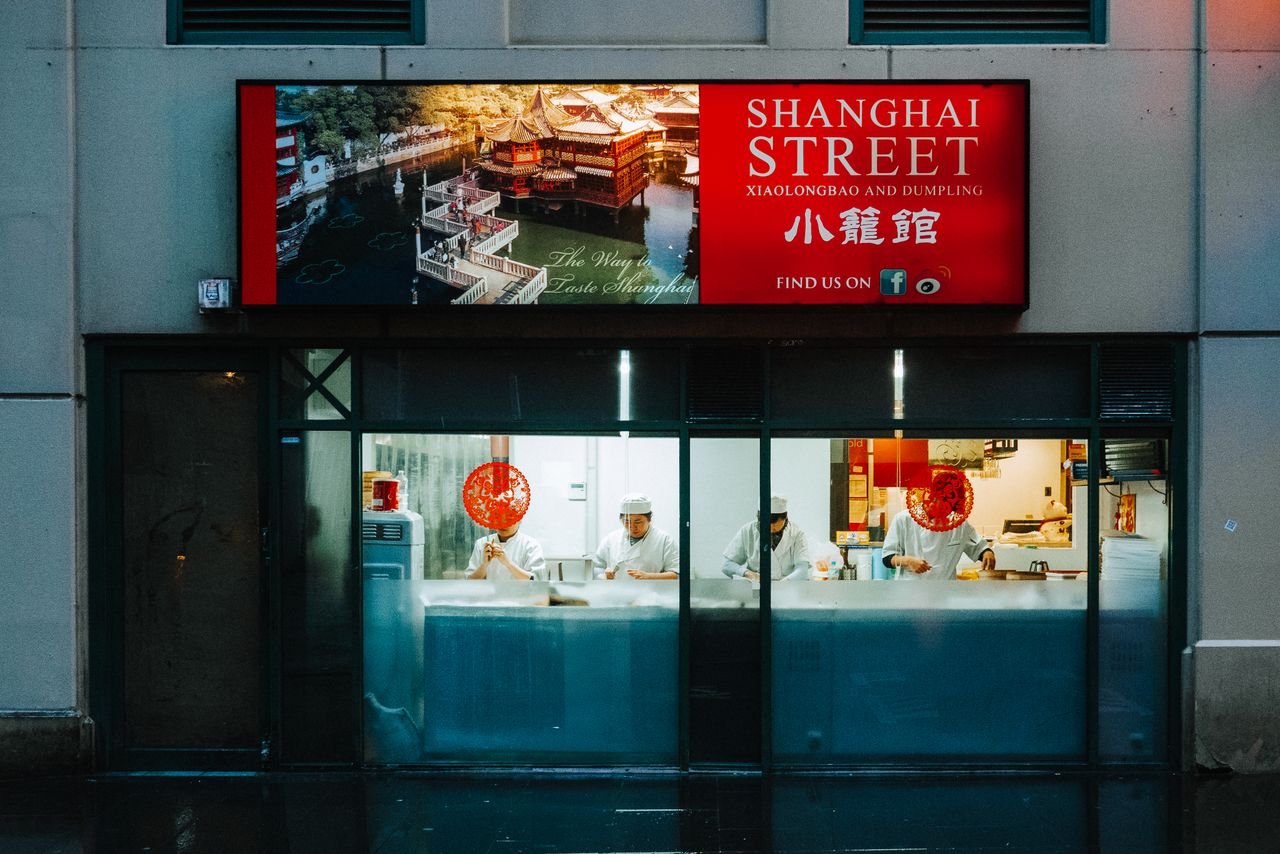
Xiaolongbao deserve their reputation, but they are only the beginning. *Shengjianbao* — pan-fried pork buns with a crisp bottom and a pocket of soup inside — are the city’s true everyday snack. Yang’s Fry Dumplings makes a thin-skinned, soupy version; Da Hu Chun keeps to the old style with a thicker bun and no soup. If you want crab roe with your dumplings, the queues at Jia Jia Tang Bao on Huanghe Road are long for a reason. For something sweet, the neighborhood pastry shops are the real discovery. Shen Dacheng on Nanjing Road sells *tiaotou gao*, a long glutinous rice roll coated in sesame, and *shuangniang tuan*, a rice ball with two different fillings. Guangmingcun on Huaihai Middle Road is famous for *xianrou yuebing*, flaky moon cakes filled with seasoned pork, and the line forms hours before they sell out. The butterfly-shaped biscuits at the International Hotel’s bakery and at Harbin Food Factory are my go-to edible souvenir. If you want to go deeper on this side of the menu, I have a separate roundup of Chinese desserts that covers the wider country, since Shanghai’s pastry tradition is only one branch of it.
When you finally sit down for a proper meal
Street food and noodles will carry you far, but at some point you should take a seat and order from a restaurant menu. This is the moment when Shanghai cuisine shows its heavier, more refined side — dishes glossy with reduced soy sauce and rock sugar, seasonal river seafood, and braises that take hours. I will not go deep into that world here because I have already written a dedicated Shanghai Benbang cuisine guide for readers who want the full story of those dishes and where to order them. For this overview, one practical note is enough: order one rich braised dish, one lighter seasonal vegetable, and a soup, then let the rice do the rest.
A day of eating, mapped out
Here is how I actually structure a day when I want to cover a lot of ground without exhausting myself. It is deliberately loose — Shanghai rewards wandering, and the best stops are often the ones you stumble onto between planned ones.
| Time | What to order | Where I go | Typical cost |
|---|---|---|---|
| 7:30 a.m. | Dabing, youtiao, salty soy milk | Market stall near my hotel | ¥8–12 |
| 10:00 a.m. | Shengjianbao (4–6 pieces) | Da Hu Chun or Yang’s | ¥12–20 |
| 12:30 p.m. | Cong you ban mian or huangyu mian | Noodle counter in Huangpu or Jing’an | ¥15–35 |
| 3:30 p.m. | Tiaotou gao or butterfly biscuit | Shen Dacheng / International Hotel bakery | ¥5–15 |
| 6:30 p.m. | One braise, one vegetable, soup | Benbang restaurant in the former French Concession | ¥80–150 |
| 9:00 p.m. | Gotie or a late bowl of noodles | Neighborhood shop near the metro | ¥15–30 |
Practical notes from eating on the street
A few habits have kept my stomach happy through years of grazing.
- Follow turnover: a stall with a constant queue is safer than a quiet one with pristine countertops.
- Watch the oil — if it looks dark and smells stale, walk away.
- Keep small cash. Alipay and WeChat Pay now work with international cards for most vendors, but the tiniest stalls do not always.
- Moderate spicy and raw cold dishes in summer if you are not used to them.
These are the same rules that apply elsewhere in the country, and I have set them out in more detail in my street food safety tips, which is worth reading before your first night-market crawl anywhere in China. Shanghai itself is a fairly gentle introduction: hygiene standards in the city are high, and the biggest risk is usually over-ordering rather than getting sick.
If Shanghai is only the first stop
Many travelers fly on to the capital after a few days here, and the food logic flips completely. Where Shanghai is about subtlety, braising and seafood, northern cooking leans on wheat noodles, roasted meat and heavier, simpler seasonings. If that contrast interests you, my Beijing food guide covers the duck, the zhajiang noodles and the dishes that locals actually argue about. The two cities make a natural pairing, and understanding one makes the other more interesting.
The best way to eat here is to stop treating the city as a checklist. Pick one neighborhood, walk it twice, and let the same shop become familiar. Shanghai cuisine rewards repetition — the second bowl of scallion oil noodles always tastes better than the first, because by then you know what to ask for. That is the part no guidebook can hand you, but knowing where to start makes it much more likely to happen.
Written by Karl Huang, a travel writer who has lived in and eaten through Shanghai’s neighborhoods and writes practical food and destination guides for independent travelers.