

Yunnan, China does not do one climate per province. It does one climate per valley, and nowhere is that truer than on the Gaoligong range in the far west, where the forest floor can be broadleaf and tropical at 900 metres, rhododendron and birch at 2,800, and alpine dwarf willow on a saddle at 3,600 — all within a single day’s walk. This Gaoligong Mountain guide is written for travellers who want that vertical range on foot, and who are prepared to be wet for most of it.
The range runs north to south along the western edge of Yunnan, China, between the Nujiang (Salween) valley to the east and the Ayeyarwady drainage to the west, above the border corridor into Myanmar. Its highest summit reaches about 5,123 m, and the protected area spans roughly 1,200 square kilometres of forest, most of it primary evergreen and mist forest. Official counts put it near 200 mammal species, more than 700 bird species and something over 5,000 flowering plants, which is why the ridge is treated as one of the important biodiversity reserves in Asia.
Pick your section before you book anything. Tengchong is the base for almost every Gaoligong trek itinerary that a first-time visitor can actually complete, and the dry season from November to April is the only window when the ridge paths are safe. Decide next, whether you want a day walk or the two-day crossing.
Geography: One Mountain, Five Climate Belts
The Gaoligong’s geology is simple to describe and hard to walk. It is a fault-block range, pushed up along a deep crush zone, with steep eastern faces dropping into the Nujiang and gentler western slopes falling toward Tengchong. Rain arrives from the Indian Ocean, climbs the slope, and dumps itself on the forest almost every afternoon between May and October.
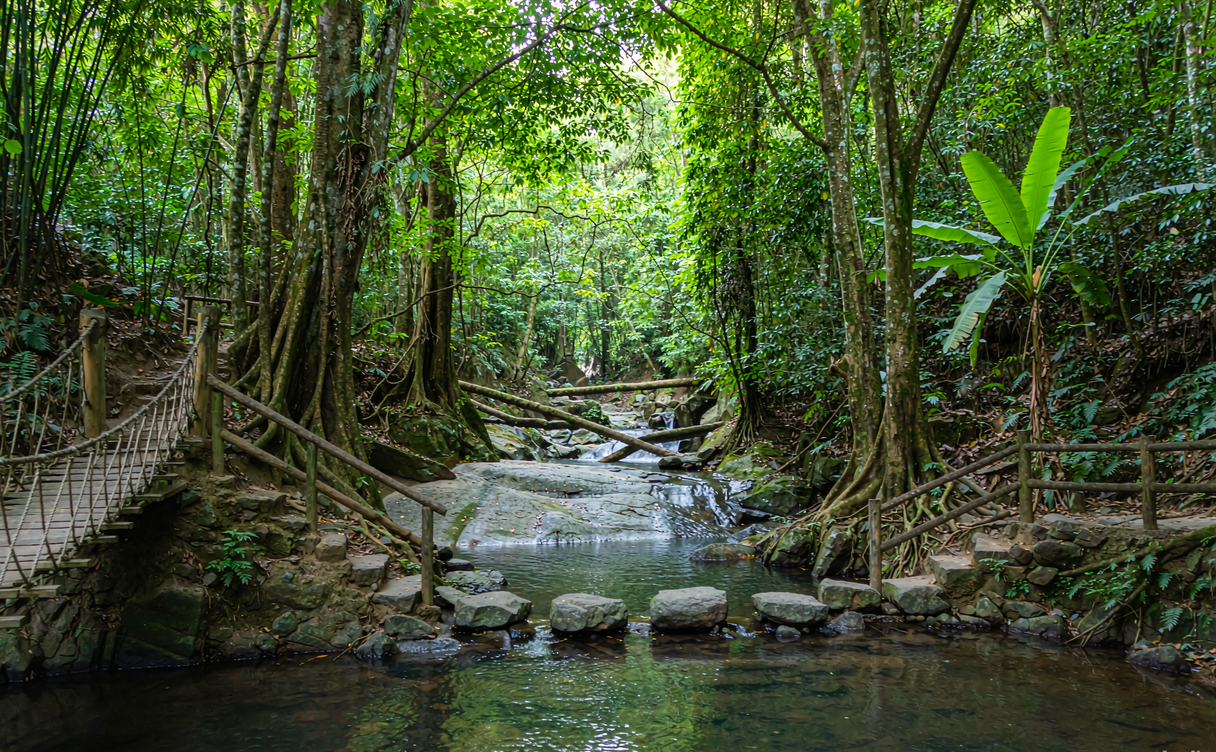
That moisture is the reason the place works. The cloud forest holds water in the canopy, the brooks run all year, and the vegetation zones stack cleanly:
- 900 to 1,400 m. Evergreen broadleaf, fig trees, bamboo, and a lot of leeches in the wet months.
- 1,400 to 2,200 m. The mist-forest belt — this is the one people photograph, with moss hanging off every branch and pale bark lichens on the trunks.
- 2,200 to 3,200 m. Rhododendron, birch, and the big old trees that the local Lisu families still mark with cloth.
- 3,200 m and above. Dwarf willow, rhododendron scrub, and grassy saddles with views west into Myanmar.
How to Get to Gaoligong
There is no station, no airport gate and no proper road into the middle of the range. This is a walking destination approached from a town, and the town you pick changes the whole trip.
Tengchong. The best base by a wide margin. A county-level city on the western flank, with direct flights from Kunming, Beijing and a few southern cities, real hotels, hot springs, and roughly an hour’s drive to the trailheads at Jietou and Baihualing. It is also the end of most cross-range routes.
Baoshan. On the eastern side, on the Dali–Tengchong road. Fewer tourists, more working-city atmosphere, and the start of the classic crossing up the eastern face. It has an airport and good buses from Kunming.
Distances that matter:
- Kunming to Tengchong by air: about 1 hour 40 minutes.
- Kunming to Tengchong by road: roughly 560 km, seven to eight hours, imperfect roads most of the way.
- Dali to Tengchong: about 330 km, five hours on the expressway.
- Tengchong airport to Tengchong city: 15 to 25 km, 30 minutes.
- Tengchong to the Baihualing trailhead: around 60 km north, two hours on mountain road.
The short answer to how to get to Gaoligong is: fly to Tengchong, hire a car and driver for the whole stay, and keep them for the days you hike. Public transport up the valley roads exists but the timetables are built around market days, not hikers.
The Gaoligong Mountain Yunnan range is what gives Tengchong its damp, mild climate. Fog rolls off the ridge most mornings from November to March, and it clears by ten, which is why the city feels different from the dry north of the province.
Best Time to Visit Gaoligong
November through April. That is the working answer to the best time to visit Gaoligong, and the reason is water rather than comfort.
In the dry season the paths are firm, the leech population collapses, the cloud sits low enough to photograph but high enough to walk under, and the ridgelines open up. December and January are the clearest and the coldest — expect near freezing at dawn above 2,500 m and a hard wind on the exposed saddles. February and March are the sweet spot: warm days, still-clear views, and the first rhododendrons pushing out on the eastern slope.
May to October is the monsoon. The forest is greener and greener and the bird activity is higher, but trails turn to slip-slide, landslides close the much narrower valley roads, and guide services raise prices or stop going out at all.
Things to Do at Gaoligong
The list of things to do at Gaoligong runs toward walking, birding and hot water rather than sightseeing.
Do the ridge day walk from Jietou. The most common first day: a village track up to a saddle, a long lunch stop, then back down through second-growth where the forest thins. Six to eight hours with a decent pace and a packed lunch.
Bird the Baihualing valley. Gaoligong is famously rich in endemics — species found nowhere else in the world. A local guide with a scope will get you hornbills, a pintail yuhina, and in spring the particular excitement of a mixed flock moving through.
Cross the range. The two-day route from the Baoshan side down to Tengchong is the reason serious trekkers come. It is long, it has no reliable water on the second day’s descent, and you should not attempt it without a guide and a mule.
Soak afterwards. Tengchong sits on a geothermal field. The volcanic hot springs at the edge of town, and the small public pools in the valley, are the correct way to end a wet day.
Walk the outer amenities. Beihai wetland, the volcanic park, and the Heshun old town are half-day add-ons most visitors miss while they focus on the mountain.
Book the guide and the driver the week you fix your dates, not the week before. Send your fitness honestly to the guide — “I can do eight hours” is one thing and “I have never walked four hours uphill” is another, and the difference decides which route we put you on in this Gaoligong Mountain guide.
A Gaoligong Trek Itinerary for Four Days
Here is a Gaoligong trek itinerary that works for a first visit and does not kill you.
Day 1 — arrive Tengchong. Fly in, collect the hire car, short easy walk around the city or the Heshun canals, early bed.
Day 2 — Jietou ridge day walk. Drive north, start at 8 am, gain about 900 m, eat at the saddle, descend by 4. Hot spring at the end.
Day 3 — Baihualing birding and village walk. Lower valley, gentler, with a Lisu village stop and a long lunch. This is the day most people remember for the people rather than the scenery.
Day 4 — volcanoes and Beihai wetland, then out. The crater fields north of the city in the morning, the wetland boardwalk in the afternoon, flight out in the evening.
If that feels short, bolt on the crossing, or read the Yunnan Pudacuo national park guide and consider another protected area a few hours north before you fly home.
Where to Stay in Tengchong
Tengchong has a good range. At the top end, hotel rooms run 450 to 750 RMB in peak weeks; mid-range clean hotels sit at 250 to 400; and the small guesthouses in and around Baihualing charge 120 to 220, usually with a shared bathroom and a very good breakfast of congee and fried rice.
What matters in practice: a room with a heater if you come between December and February, a balcony or courtyard where you can dry boots, and a guesthouse owner who hikes and can tell you honestly whether the upper trail is open after the last rain.
Book by phone or through a Chinese travel app. The guesthouses in the village do not answer email reliably, and in March and April the good rooms go in about a week.
Eating Well
Tengchong’s cuisine leans on mushrooms in season, river fish, and a wet-market breakfast culture. Order the following when you can find them:
- Suo cha fan, a Tengchong speciality of rice noodles stir-fried with pork and pickled mustard.
- Wild mushrooms from late June into September, and worth eating only where the kitchen knows what it is doing.
- Grilled fish on the Heshun road in the evenings.
- Coupe or thick pea purée with rice noodles, a Tengchong breakfast staple served with chilli oil.
For the province-wide map of what to eat where, the Lijiang travel guide and the Xishuangbanna travel guide cover the north-west and the far south, which is most of Yunnan, China on a plate.
Mistakes to Avoid
Do not go without a guide on the upper trails. The paths are marked but the network is confusing and phone coverage disappears within twenty minutes of leaving the valley.
Do not try to cross the range in two days without a mule. It is a long descent and people consistently underestimate it.
Do not carry only a rain jacket. Carry a packable down layer and proper boots with grip; the wet rock is the hazard, not the rain.
Do not drink stream water without treating it.
If you want the wider context of why this ridge matters, the UNESCO World Heritage listing for the Three Parallel Rivers region describes the collapse of altitude belts in the same corner of Yunnan, China, and it is the closest protected landscape to Gaoligong on the national heritage list.
Fix the dates for November to March, book the guide, and give yourself four nights in Tengchong rather than three. If your flight lands in Kunming or Dali first, read the loop guide for that city, then drive or fly straight through to the ridge.
Gaoligong is not an easy beauty. It is wet and steep, and the best views come at the end of a climb you did not feel ready for. Go in the dry season, hire someone who grew up on the slope, and keep the memory of walking from a tropical ravine into alpine scrub in a single afternoon.