

Dunhuang is a small city with an outsized problem: almost everything worth seeing sits either inside a desert or four kilometres south of the last house. The Singing Sand Dunes (鸣沙山) and the Crescent Lake (月牙泉) are the southern edge of the city itself, and the Mogao Caves are twenty-five kilometres east. The interesting hotel question in Dunhuang is therefore not which brand, but how close to the dunes you are willing to sleep — and whether you want to wake up with the desert outside your window or with a lobby full of seat covers in a chain hotel.
We have stayed here in a sandstorm in April, in a 38°C August, and in the hard blue cold of a December night where the outside thermometer read −11°C and the courtyard pool had a skin of ice on it. This guide is the accumulation of those stays.
Where to stay in Dunhuang: three zones
The dune-edge hotels (鸣月路 / 敦月路). The best location in the city, without argument. A strip of mid-range and upscale hotels runs along the road separating the city from the dunes; from the upper floors and several swimming pools you look across a belt of Tamarix directly at a wall of golden sand. Rooms run ¥400–900 in peak season, ¥180–350 from November to March.
The city-centre hotels. Around 市中心 and the 沙州夜市 (Shazhou Night Market), everything is ten minutes by taxi to the dunes and fifteen to the Mogao digitisation centre. Prices ¥250–600 peak, ¥120–280 off-season. This is where the food is and where the night market and bus station are.
The out-of-town desert properties. A handful of camps and boutique properties 5–15 km out toward 雅丹 (Yardang) or along the Dunhuang–Yumen road. Atmospheric, dark-sky friendly, and expensive: ¥600–1,500. Only worth it if the desert is the whole trip rather than one day of it.
The encyclopaedia entry on Dunhuang explains why this oasis ever mattered — the city held the junction of the northern and southern Silk Road branches for a thousand years, which is also why the Mogao grottoes next door carry paintings from every century in between.
The dune-edge hotels we would book
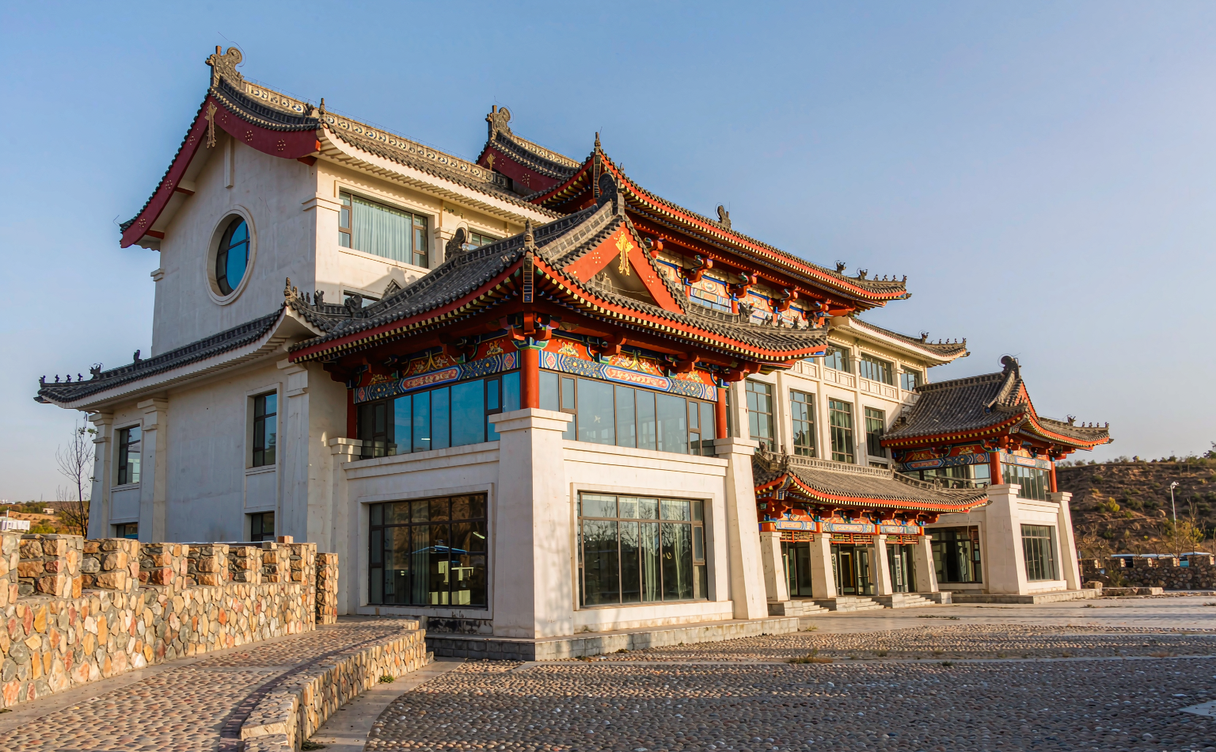
For the best hotels in Dunhuang, we keep coming back to the properties on the dune road rather than the ones on the main street. Their tiled roofs, courtyards with old poplars, and rooms facing the sand are exactly the postcard you came for, and they are usually family-run rather than corporate. Ask specifically for an upper-floor room facing 鸣沙山 — the ground-floor rooms look into a car park.
One of our regulars is a courtyard hotel with a long veranda along the north side, where the owner keeps a thermos of 杏皮茶 (apricot-leaf tea, brewed from dried apricots, ¥8–15 a glass) and a telescope for the clear nights. Another we recommend is a larger Han-style property near the west gate with a swimming pool that catches the last hour of light. Both cost less than the international-brand hotel in town and give you a better first morning.
The genuine luxury tier in Dunhuang is thin — a handful of four-star properties with proper gyms and indoor pools, ¥700–1,400 in July and August. Everything above that is a boutique desert camp, not a hotel.
City-centre options and what they cost
If you are travelling with small children or with a group that needs a lift, the city hotels on the north side near the 沙州 road square are the pragmatic choice: ¥300–550 for a decent four-star in peak, ¥150–280 in winter, and a ten-minute taxi to everything. Dunhuang is a walking-and-taxi city; nothing here is more than 20 minutes away, so an extra 400 metres rarely matters.
Budget travellers have good options. The guesthouse rooms around 莫高窟路 and the night market run ¥100–200 for a clean twin, and several have a kitchen where you can boil an egg and rehydrate your own noodles. We also note that November to March is the quiet window: the same rooms cost about half, and the night market still serves 驴肉黄面 (donkey noodles, ¥20–30) and 羊肉串 (¥5–8 a skewer) with no queue.
Book a room on the dune road with a sand view and plan to walk into the desert an hour before sunset — the dunes go from gold to copper to black in about forty minutes, and no hotel lobby in the city shows you that from a bed.
How the Mogao Caves change your hotel choice
This matters more than it sounds. Entry to the Mogao Caves runs through the 数字展示中心 (Digital Exhibition Centre) on the outskirts, 25 km east, and the standard route is a film-and-bus package before you enter the grottoes. If you did not know that, you can easily find yourself at a hotel desk at 7 p.m. with no ticket for the next morning. Book the ¥238 standard ticket (or the ¥100 emergency ticket on busy days) online several days ahead in May through October; the caves sell out.
Because the exhibition centre and the eastern gate are far from the dunes, we suggest two bases rather than one: two nights in the dune zone, then one night in the centre or out toward 玉门关 if your route continues west. Our Mogao Caves guide details the cave ticket types and the photography rules inside, which are strict.
When to book, and what the seasons do to price
Dunhuang has two seasons and a shoulder. May to October is peak: dune-edge rooms ¥500–900, city rooms ¥300–550, and the temperature hits 38–40°C in July and August — fine at 6 a.m., punishing at 2 p.m., which is exactly when you will be indoors. November to March prices fall by roughly half and the days are crisp and clear, though nights drop below −10°C. April can bring a sandstorm; we have had one blow an umbrella inside a restaurant and turn the sky the colour of a brake light.
The wild card is the Dunhuang Silk Road (敦煌 丝绸之路) cultural events and festival dates in May and September, when rooms go up 30% for two or three nights. Book the hotel first, then plan the days. Our best time to visit China guide covers the national calendar; our hotel guide to Xi’an is the natural next stop if you are doing a northwest loop, and our Chengdu hotel guide if the route continues south.
Where to eat near your hotel
Dunhuang’s food is worth an evening on its own. The 沙州夜市 is the landmark: 驴肉黄面, 烤肉 (lamb skewers, ¥5–8), 杏皮茶, and 敦煌 酿皮 (cold noodle sheets in chilli and vinegar, ¥12–18). A full feed for two is ¥70–120. The dune-road hotels often have a decent 西北菜 restaurant attached — 手抓羊肉 (hand-grabbed lamb, ¥80–120 a portion) and 黄焖鸡 (braised chicken, ¥45–70) — and those are the only sane option after you come back off the dunes at 9 p.m.
Breakfast is 牛肉面 (beef noodles) ¥15–25 with a bowl of 八宝茶 (eight-treasure tea with raisins and dates), which you will want before a dawn climb. Carry water: the dunes are arid, and hotel tap water is not for drinking.
Eat one meal at the 沙州夜市 rather than in your hotel restaurant — donkey noodles, cold noodle sheets in chilli vinegar and a skewer of lamb cost under ¥60 for two and give you the whole evening.
Practical notes from our stays
Bring a mask and goggles for April wind, a head torch for the dusk walk up the dunes, and a warm layer even in summer — the temperature drops 15°C between 6 p.m. and midnight on the sand. Hotels here will lend blankets and sandals; ask at the desk. The dunes are open until about 9 p.m. in peak season and close earlier in winter, and the climb to the top of the near dune takes 25 minutes for most people.
[IMAGE: A Dunhuang hotel courtyard with Han-style tiled roofs and a row of poplars in front of the dunes | alt=”Dunhuang hotel Han-style courtyard tiled roofs near dunes Gansu”]
Final thoughts
Dunhuang rewards the traveller who sleeps near the sand. It is a small, flat, manageable city with one overwhelming sight in the desert and another an hour east, and the hotel you choose is the difference between a stopover and a memory. We would book the dune road for two nights, take the first jeep out to the Mogao Caves the moment they open, and spend the last evening on the veranda with a bowl of donkey noodles and the dunes going copper in the last light.
Reserve a sand-facing room before you plan anything else in Dunhuang, because the dune-edge hotels are the only ones in China where you can fall out of bed and onto a 200-metre dune before breakfast.