

Southern Hunan is where the scenery starts to soften into the karst of Guangxi, and Yongzhou is the last major stop before the border. This Yongzhou travel guide draws on our own reconnaissance and the small-group trips we’ve run for travelers who want culture and mountains without the tour-bus crowds. Yongzhou rewards patience: it holds one of the most remarkable stories in women’s history and a mountain covered in wild azaleas that few outsiders ever see.
The headline reason to come is Nushu, a phonetic script created and used exclusively by women in Jiangyong County for centuries. It is the only known gender-specific writing system in the world, used by sisters and sworn “companions” to exchange poetry and comfort across villages. For background, the Nüshu script is documented in detail on Wikipedia and is listed on the UNESCO Memory of the World register, which tells you how seriously scholars take its preservation.
Who is this trip for? We send Yongzhou to travelers who already have a few Chinese cities behind them and want a story rather than a skyline. It suits slow walkers, culture lovers, and photographers who don’t mind an early start. It is less ideal for those who need English everywhere or a packed nightlife — evenings here are quiet, and that is exactly the point.
Things to do in Yongzhou
The core things to do in Yongzhou split between culture and nature. In Jiangyong, about 90 minutes south of the city, visit the Nushu Museum in Puwei village and the nearby sisters’ wells and old women’s script study houses. Local elders sometimes demonstrate writing; buying a hand-stitched Nushu pouch supports the community directly. Back in the city, the Liuzi Temple honors the Tang poet Liu Zongyuan, who was exiled here and wrote some of his best essays by the riverside. The Xiangjiang and Xiao rivers meet at Pingzhou Island — a calm place for an evening walk, with food stalls selling grilled fish and sweet tofu.
We usually give travelers two full days: one for the Nushu villages, one for Yangming Mountain. A third day lets you simply slow down, which is the whole point of coming here rather than to a headline destination.
Yangming Mountain
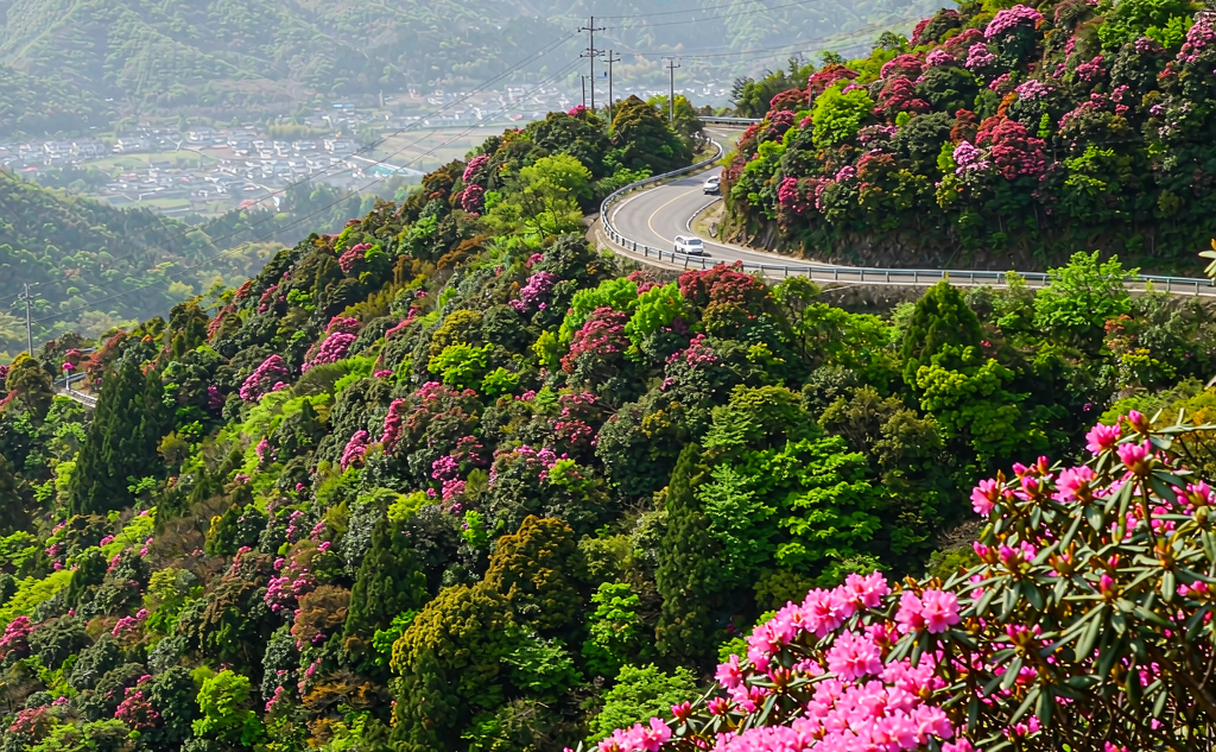
The Yangming Mountain azalea season is the natural draw. Yangmingshan National Forest Park, roughly two hours from Yongzhou city, erupts with wild rhododendrons across tens of thousands of acres from late April to mid-May. The azalea festival draws domestic visitors, but the higher trails stay quiet. Entry is about ¥70–100, with a shuttle bus (¥35) from the gate to the main plateau. We’ve hiked the ridge at sunrise and had whole sections to ourselves. Bring layers — at 1,500 m it’s cool even in May, and cloud can roll in within minutes.
Beyond the flowers, the park has waterfalls, a small Buddhist nunnery, and a wetland boardwalk. Allow half a day if you only want photos, a full day if you want to walk the upper loops. On clear days the views run toward the Guangxi hills.
Nushu script village Jiangyong
The Nushu script village Jiangyong experience is best done slowly. Stay overnight in Jiangyong town and visit Puwei the next morning before tour groups arrive. The museum (¥30) explains the script’s grammar and shows embroidered fan and belt inscriptions, then a short walk takes you to the “sisters’ well” where women once gathered. In our experience, the most moving moment is hearing the “singing” of Nushu — women chant the characters in a high, rhythmic tone that feels closer to music than speech. A local homestay dinner runs ¥60–90 per person and usually includes river fish and pickled vegetables.
Getting there and around
Yongzhou has a high-speed station on the Hengyang–Nanning line. The Yongzhou to Guilin transport question is the one travelers ask most: direct G-trains now reach Guilin in about 2.5–3 hours (¥110–180, second class), making a Hunan–Guangxi combo very practical. From Changsha, allow 2–2.5 hours by train. Within Yongzhou, hire a car with driver (¥400–600/day) — rural sites like Jiangyong are awkward by bus. Our China high-speed train guide for foreigners has the booking steps and the app you’ll need.
Best time to visit
The best time to visit Yongzhou is April–May for azaleas and mild weather, or October–November for clear skies and the autumn rice harvest in Jiangyong. Summers are hot and humid; winters are short and damp. We steer travelers away from the May Day holiday week, when Yangmingshan gets busy and hotel prices in the city climb.
Food and stay
Yongzhou cuisine is bold Hunan flavor. Try 东安鸡 (Dong’an chicken, sour and peppery), 永州血鸭 (Yongzhou blood duck), and Jiangyong’s fragrant pomelo (香柚). A good local meal for two is ¥70–120. City hotels are comfortable and cheap (¥200–360/night); for the villages, choose a clean homestay and book ahead in spring. We’ve found the hosts happy to walk you to the next village if you ask.
A suggested 3-day plan
Day 1: arrive Yongzhou, Liuzi Temple and Pingzhou Island at dusk. Day 2: drive to Jiangyong, Nushu Museum and Puwei village, overnight in the county. Day 3: Yangming Mountain for the plateau and azaleas, return to the city for an evening train.
Costs at a glance
Yongzhou is a budget-friendly destination. The train from Changsha is ¥110–160 one way; a private driver for the Jiangyong and Yangming Mountain loop is ¥500–700/day, which we consider worth it given the scattered sites. The Nushu Museum is ¥30, Yangmingshan entry ¥70–100 plus a ¥35 shuttle, and the Liuzi Temple is free or ¥10. Food is the highlight for the price: Dong’an chicken for two is ¥60–90, a Jiangyong homestay dinner ¥60–90 per person. City hotels run ¥200–360; a county guesthouse in Jiangyong is ¥180–280. Plan ¥350–550 per person per day all-in. We suggest carrying ¥200 cash for village entries, folk crafts, and the occasional roadside pomelo stand where scanning apps fail.
Getting around locally
Outside Yongzhou city, a hired car is effectively mandatory — the Nushu villages and the mountain are 1.5–2 hours apart with limited bus service. DiDi works in the city center for ¥10–20 hops. Mountain roads are paved but winding; if you self-drive, start early and avoid the post-rain fog. We brief every traveler to load offline maps, because mobile signal dips on the higher ridges of Yangmingshan.
Practical notes
English is minimal outside the city. Download offline maps and have your hotel write addresses in Chinese. Carry cash for small village entries. The Nushu museum closes on Mondays, and mountain roads can fog over — leave the descent before dark.