

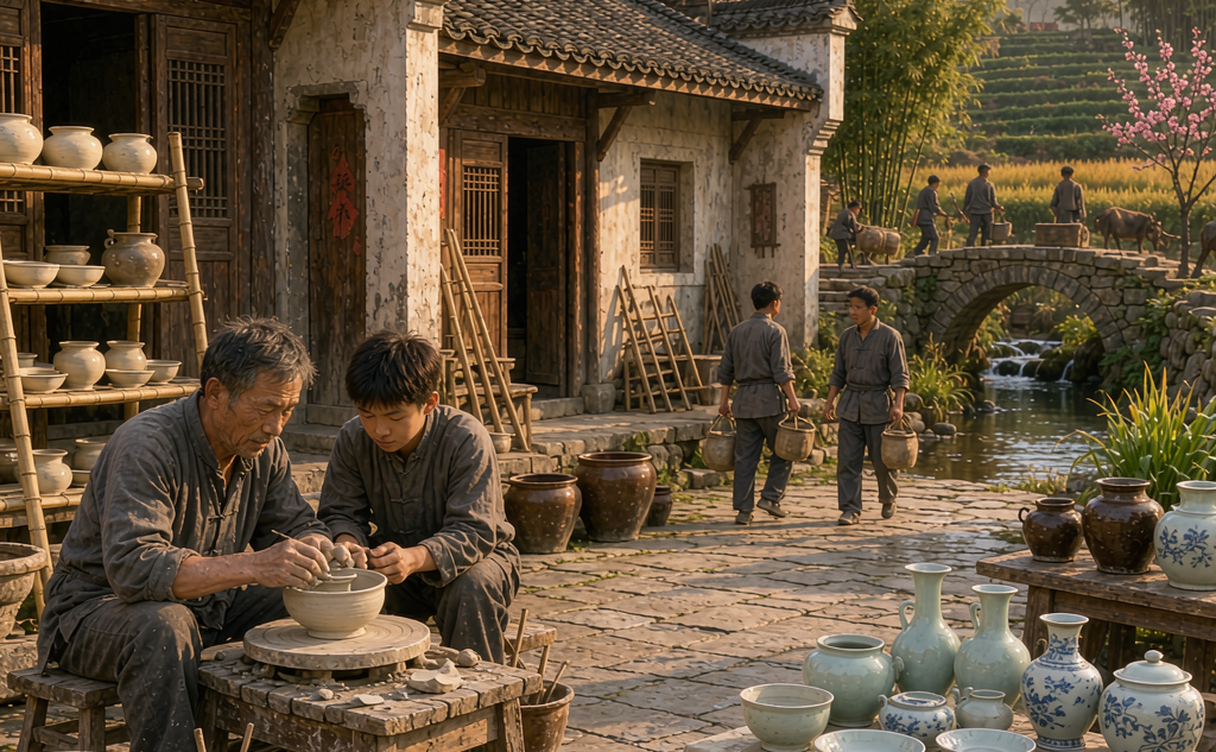
Deep in the mountains of northeastern Jiangxi, where the air smells of pine and damp stone, Yaoli is the quietsource of one of China’s most famous crafts. For centuries, the porcelain clay and the kiln firewood that fed the great kilns of Jingdezhen came from these hills. Today Yaoli is a peaceful village of Ming and Qing bridges, clear streams, and timber houses — a place where the story of Chinese ceramics begins, long before the glaze ever reaches the city.
Yaoli is not on most foreign itineraries, which is precisely its appeal. It pairs beautifully with a Jingdezhen travel guide trip: see the finished masterpieces in the porcelain capital, then drive into the mountains to see where it all started. The combination turns a craft into a landscape.

Yaoli’s Porcelain History
The link between Yaoli and porcelain is older than most visitors expect. During the Tang and Song dynasties, the high-quality kaolin clay found in the surrounding mountains made the area a crucial supplier to the imperial and commercial kilns of Jingdezhen. Timber from these forests fueled the kilns. In effect, Yaoli was the raw-material heart of a global industry centuries before “China” became synonymous with the ware.
That history is still legible in the village. Understanding Yaoli porcelain history helps explain why the settlement looks the way it does today — a working mountain community shaped by its trade rather than a showpiece town. Old water mills that once pulped clay sit beside the stream, and the layout reflects that same commercial purpose. The best ancient towns in China guide includes Yaoli for exactly this authenticity — it feels like a place that grew from its trade rather than one built for tourists.
Things to Do in Yaoli
Yaoli rewards a slow, wandering pace. Key experiences:
- Walk the covered bridges: Several arched and roofed bridges span the Yaoling River; the Ming-era stone bridges are the most photogenic, especially at dawn fog.
- Stroll the riverside lanes: Timber houses with carved brackets line the water. The reflections on a still morning are the town’s signature image.
- Former porcelain workshops and water mills: Scattered sites show how clay was processed; some are signed and easy to find along the stream.
- Huiming tea terraces: The area grows a noted green tea; nearby terraces are lovely to walk in spring.
- Hiking into the hills: Trails lead to waterfalls and forest. The air is a selling point in itself after city travel.
If ceramics interest you beyond Yaoli, our China tea tour guide connects the region’s tea and mountain culture, while Jingdezhen completes the porcelain story.
Best Time to Visit Yaoli
Yaoli’s mountain setting gives it a milder, greener climate than the plains:
- Spring (March–May): The best season — warm, lush, and ideal for tea terraces and wildflowers.
- Autumn (September–November): Cool, clear, and colorful; comfortable for hiking.
- Summer: Warm and occasionally rainy, but the shade and streams keep it pleasant.
- Winter: Cold and very quiet, with few services; only for solitude seekers.
Weekdays and the shoulder months avoid the modest domestic crowds. Combine the trip with the Wuyishan travel guide if you want more mountain scenery in the broader region.
How to Get to Yaoli
Yaoli lies in Fuliang County, about 50 km northeast of Jingdezhen in Jiangxi:
- Fly or train to Jingdezhen: Jingdezhen has an airport and a high-speed station. From there, a taxi or bus covers the mountain drive in roughly an hour.
- From Nanchang: The provincial capital is further west; bullet trains to Jingdezhen take a couple of hours, then transfer. See our Nanchang travel guide for the city.
- By car: Most convenient, letting you stop at scattered kiln and clay sites en route.
- On a Jingdezhen day trip: Many visitors come as a half-day excursion from the porcelain capital, which is the simplest approach.
Foreign travelers booking trains should review the China high-speed train guide for foreigners before traveling, as station names and ID rules differ from home.
The broader heritage of Chinese ceramics, including the Jingdezhen tradition that Yaoli supplied, is documented by UNESCO, which lists related porcelain craftsmanship among humanity’s living traditions.
Practical Tips
- Timing: Spend at least half a day; a full day lets you hike and linger.
- Guides: Local guides near the entrance explain the clay-to-kiln story far better than signs alone.
- Food: Try Jiangxi country cooking — spicy, smoky river fish and mountain vegetables — at small family restaurants.
- Stay: A few guesthouses let you hear the stream at night; the village is at its best after day-trippers leave.
- Payment: Mobile pay is standard; carry cash for tiny rural vendors.
- Signal and transport: Yaoli’s mountain setting means English signage is minimal and card payment at small vendors is unreliable. Download an offline map before you lose signal in the hills, and confirm your return transport in advance, since ride-hailing thins out after dark. A local guide not only explains the clay-and-kiln story but also helps bridge the language gap at restaurants and guesthouses.
Where to Eat and Stay
Yaoli’s kitchens lean on what the mountains provide: fresh stream fish, foraged greens, and the local tea used in cooking. Meals are simple and filling. The village’s restaurants specialize in Fuliang country cooking, which is heartier and spicier than the mild Jiangnan fare to the north. Try the smoked pork with dried vegetables and the river fish steamed with tea leaves — a neat nod to the local crop. A pot of Huiming green tea, grown on the surrounding terraces, is the right way to end a meal and costs almost nothing. For lodging, choose between in-village guesthouses (atmospheric, basic) and the hotels of Jingdezhen if you prefer comfort and a shorter drive the next morning.
A Suggested Yaoli Day
Yaoli suits a slow day built around the water. Begin at the central Ming bridge around 9 a.m., when the light is soft and the tour buses have not yet arrived. Walk upstream along the riverside lane, stopping at the old water mills and clay sites, then cross to the opposite bank for the classic postcard view of houses reflected in the stream. Break for a long lunch of river fish and mountain greens, then spend the afternoon on a short forest hike to a nearby waterfall, or simply linger by the water with a pot of local Huiming tea.
If you are combining Yaoli with Jingdezhen, do the village in the morning and the city’s kilns and museums in the afternoon — the contrast between raw material and finished art is the whole point. An overnight in one of the village guesthouses lets you hear the stream at night and catch the mist over the bridges at dawn, which is when Yaoli is quietest and most itself.
Final Thoughts
Yaoli is for travelers who like their history embedded in landscape. You will not find grand museums or crowds here — you will find a stream, some old bridges, and the quiet origin story of the porcelain the world calls “china.” Stand on a Ming bridge at first light, and the connection between this mountain village and dinner tables three continents away becomes vividly clear.