

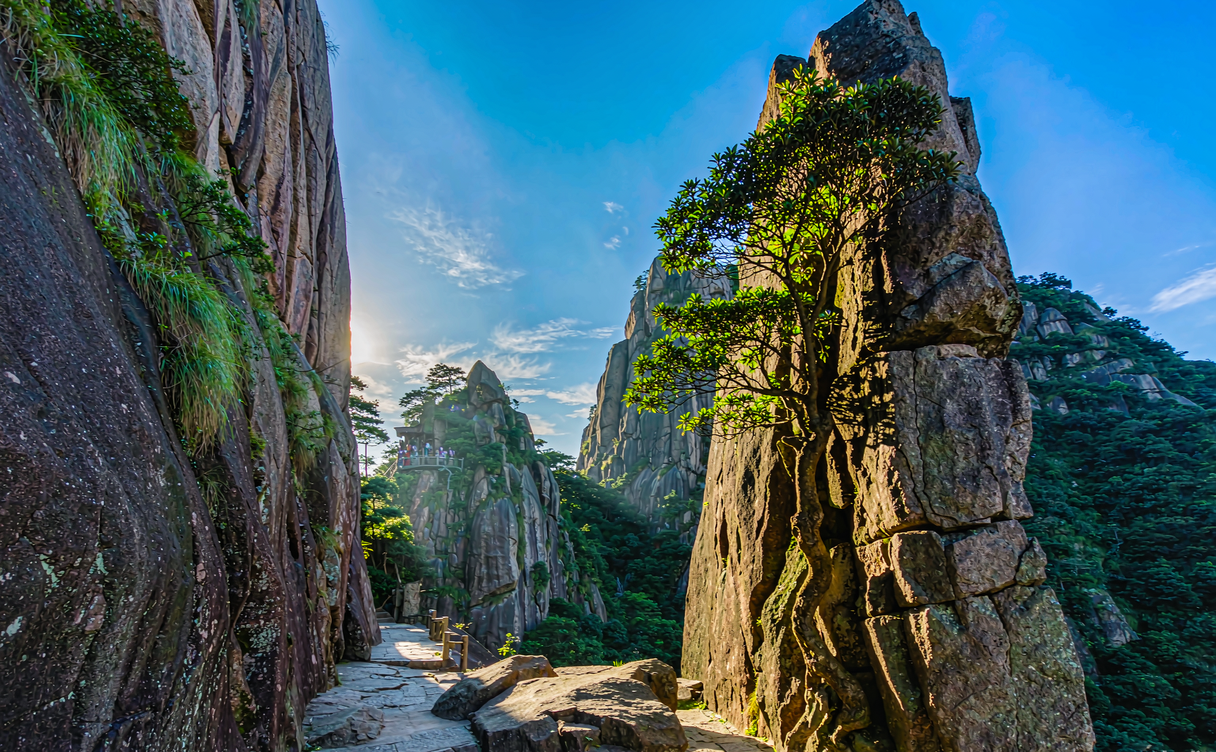
I have taken clients up plenty of Chinese mountains, and Taimu is the only one where I hand out head torches at the trailhead. The reason is simple: much of the walking here happens inside the mountain rather than on top of it. Weathering has split the granite into house-sized boulders piled on one another, and the gaps between them form corridors, ladders and caves that the trail threads directly through. In places the path narrows to shoulder width with rock overhead and a strip of sky visible far above.
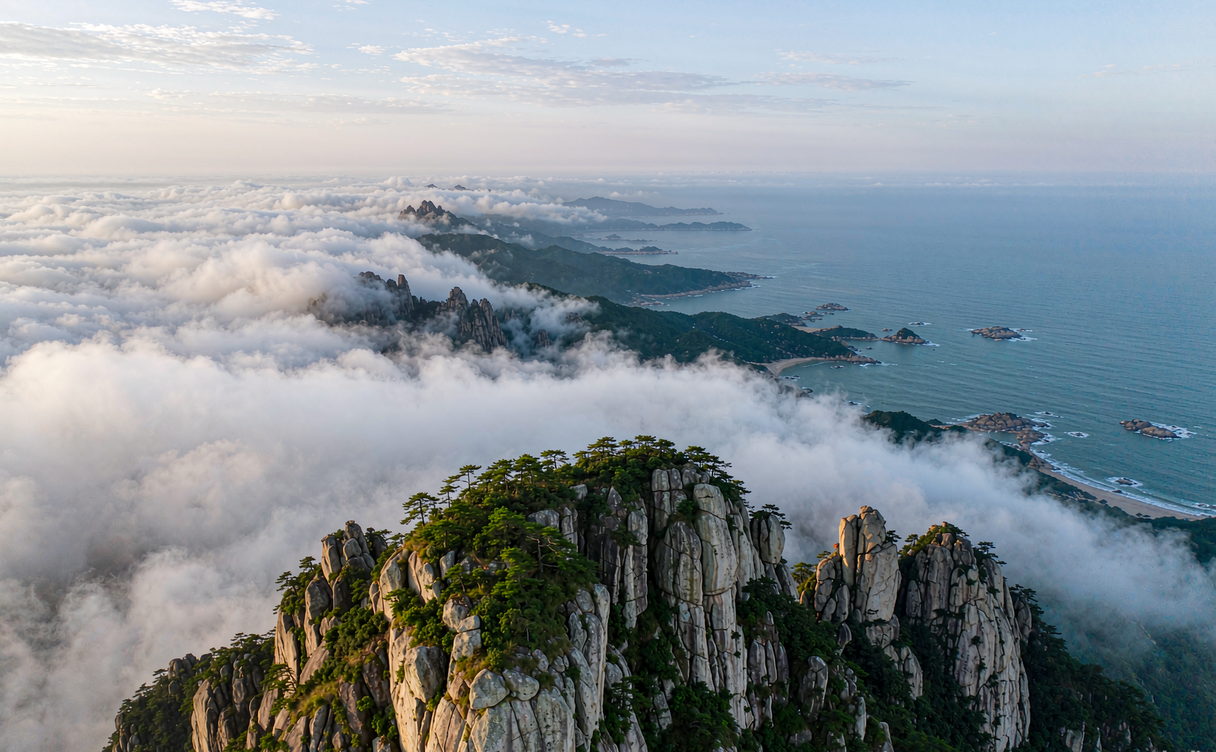
Taimu Mountain sits in Fuding, in the Ningde area of northeast Fujian, close enough to the coast that from the upper viewpoints you look down on the East China Sea and a fretwork of bays and islands. Its highest point is a shade over 900 metres. That combination — sub-tropical coastline, exposed granite domes and a working white-tea landscape on the lower slopes — is what makes this Taimu Mountain guide worth writing. It remains largely a domestic destination; on my last October visit I saw no other foreign travellers in two days.
A Mountain of Stone Eggs
Geologists call the local landform “stone egg” topography. Coarse granite, uplifted and then attacked for millions of years by rain, salt air and temperature swings, weathers along its joints into rounded blocks that shed their outer layers like onion skins. The result is a summit plateau strewn with smooth boulders that look deliberately stacked. The whole range is part of a UNESCO-recognised geopark alongside the volcanic river gorges elsewhere in the Ningde area of Fujian, and once you understand the mechanism, the shapes stop looking random.
At ground level there is also a Tang-dynasty temple site among the trees, reduced mostly to massive stone pillars and platform stones, and a scatter of small monasteries and shrines wedged into rock hollows. Local legend attaches the mountain to a goddess figure known as Lady Taimu, credited with cultivating tea on these slopes long before written record — a story that still shapes how the region markets its tea today.
Taimu Mountain Rock Formations and Caves
The famous Taimu Mountain rock formations come with names, and the naming is half the fun: a pair of leaning pillars called Husband and Wife Peak, a cluster of upturned slabs read as nine carp leaping toward heaven, a row of boulders taken for eighteen Buddhist arhats, a cat pouncing on a mouse. Guides count several hundred named rocks. You will not identify most of them without help, and honestly it does not matter — the mass effect is stronger than any single feature.
The cave system is the real signature. There are said to be more than a hundred passable clefts and grottoes. The one everyone attempts is a slot corridor barely wide enough for one person, where you shuffle sideways for roughly a hundred metres with stone walls brushing both shoulders and a thin line of daylight overhead. Another is a longer gourd-shaped cavern that requires stooping, occasional hands-and-knees work, and a light. A third holds the ancient tea tree from which local white tea traces its origin story.
How to Get to Taimu From Fuzhou
The practical answer to how to get to Taimu from Fuzhou is the high-speed line up the coast. Trains from Fuzhou to Fuding take roughly 1 to 1.5 hours and cost about ¥60–100. Some services also stop at a station named for the mountain itself, which is closer to the scenic area gate than Fuding station — worth checking as you book, because it saves 30 minutes of road time. Our walkthrough of buying tickets and boarding high-speed trains in China covers passport collection at the counter.
From Fuding station, a taxi or ride-hail to the main gate costs ¥70–110 and takes 35–50 minutes; local buses toward the coastal town below the mountain run ¥10–20 and take about an hour. Coming from further south, Xiamen to Fuding is roughly 3 to 3.5 hours by rail, so most travellers based in Xiamen treat this as an overnight rather than a day trip. From Wenzhou in Zhejiang it is about an hour, which makes Taimu a natural stop for anyone travelling the coast between the Yangtze Delta and Fujian.
Inside the gate, a shuttle bus climbs the access road to the main trailhead for ¥25–40 return. Take it. Walking that road adds an hour of tarmac and no scenery.
Taimu Mountain Hiking Difficulty: The Honest Version
On paper, Taimu Mountain hiking difficulty is moderate — the classic circuit runs 6 to 9 km with 500 to 600 metres of ascent, almost entirely on built stone steps, and takes 4 to 6 hours. In practice, three things catch people out.
First, the clefts. If you are broad-shouldered, carrying a large pack, claustrophobic, or travelling with someone who panics in confined spaces, the narrow corridors are genuinely unpleasant. There are bypass routes around every one of them, clearly signed, and no shame in using them. Leave big daypacks at your hotel or the gate lockers; a slim 15-litre bag is the right size.
Second, the light. Several caves are unlit or barely lit, with uneven wet floors. A phone torch works; a proper head torch works better and keeps both hands free for the handrails.
Third, the steps themselves. Thousands of them, granite, polished by boots and slick for hours after rain. I have seen more sprains here than on far higher mountains. Shoes with real tread are non-negotiable, and trekking poles help on the long descent.
Shorter option for less mobile visitors: shuttle to the trailhead, walk the Tang temple site and the lower boulder gardens, then take the gentler upper path to a viewpoint — around two hours with no caves.
Chasing the Taimu Mountain Sea of Clouds
The Taimu Mountain sea of clouds is the image that sells the place, and unlike many mountains, the odds here are decent, because moist sea air pushes inland and pools in the valleys overnight. The pattern I have observed: the day after rain clears, in autumn or winter, with a light onshore breeze. Get to an upper viewpoint 40 minutes before sunrise and you often find cloud filling the coastal lowland with the boulder tops standing clear above it.
That means sleeping on or immediately below the mountain rather than commuting from Fuding. Simple lodges and a mountain guesthouse near the upper trailhead run ¥200–450 a night in the shoulder season, more on holiday weekends; the coastal town below the gate has plainer hotels at ¥150–300. Book ahead in October. Bring a windproof layer whatever the season — the summit plateau is exposed, and a 22°C afternoon becomes a 12°C dawn with wind.
White Tea: The Mountain’s Other Reason to Come
You cannot separate this mountain from tea. The surrounding county is the heartland of Fujian white tea, a minimally processed style that is withered and dried rather than rolled and fired. The premium grade of downy spring buds, the fuller two-leaf grade, and the coarser late-season leaf all come off these slopes, and locals age the compressed cakes for years, claiming the flavour deepens from fresh melon toward dried fruit and honey.
Two things I always build in. First, a tasting: shops in the town below the gate will brew three or four grades side by side for free or a nominal ¥20–50, and a decent cake of aged leaf costs ¥120–400. Second, an early walk through the tea terraces on the lower slopes, which in April are full of pickers working before the heat. If someone offers a “collector’s” cake for ¥2,000, smile and leave; the honest ceiling for a visitor buying without expertise is a few hundred yuan.
Best Time to Visit Taimu Mountain
The best time to visit Taimu Mountain is October to early December, with late March to April a strong second. Autumn brings 18–26°C days, the year’s clearest air, and the highest chance of dawn cloud seas. Spring is green and atmospheric with tea picking underway, but expect frequent drizzle and 15–24°C.
Avoid July through September if you can: this stretch of coast takes direct typhoon hits, the scenic area closes outright during warnings, and midsummer otherwise means 30–35°C with brutal humidity inside the airless rock corridors. Winter is quiet and often beautiful at 8–16°C, though cold rain can settle in for days. Skip the first three days of the October national holiday and the early-May break, when domestic crowds turn the narrow clefts into a standing queue — I once waited 25 minutes to enter a passage that takes four minutes to cross. Our overview of seasonal timing across China’s regions helps if this is one leg of a longer trip.
Tickets, Budget and Common Mistakes
Admission has run in the ¥95–120 range in recent high seasons, with discounts outside peak months, plus the ¥25–40 shuttle. Gates open around 06:00 in summer and 07:00 in winter; if you want sunrise from the upper viewpoints, you need to be staying inside the area or at the gate. Budget for two people over one night: ¥230–320 tickets and shuttle, ¥300–500 accommodation, ¥150–250 for meals of seafood and mountain vegetables, ¥150–220 in local transport.
The mistakes I see most: treating Taimu as a three-hour stop between trains, which means rushing the best section; wearing smooth-soled shoes; carrying no water, since stalls thin out badly on the upper circuit; and skipping the coast entirely. The bays below the mountain are excellent — grass-topped islands reachable by ferry, oyster rafts, and quiet beaches — and a second day there balances the stair climbing nicely.
For sequencing, I like arriving from the north, spending two nights here, then continuing south to Fuzhou for its old lanes and hot springs before pushing on to Quanzhou or the coast. That gives you geology, tea and port cities in one clean line down the Fujian shore.