

The first time I climbed the narrow stone path up Tiger Hill (Huqiu), I expected a small hillock with a nice view. What I found instead was a 250-foot leaning pagoda tilting over the rooftops of Suzhou, a buried king, and more than two thousand years of stories packed into a single green mound. If you only have one day in Suzhou, this is the sight I would send you to first — and I say that after visiting every major garden in the city.
Tiger Hill is small in footprint but huge in reputation. Local people call it “the mountain of Wu,” and the Song-dynasty poet Su Shi supposedly said that a visit to Suzhou is not complete without seeing Huqiu. After my own trip, I understood why. It is the one spot where Suzhou’s garden art, its river-town history, and a genuinely odd piece of engineering all meet in one walkable loop.
Getting There
Tiger Hill sits in the northwest of Suzhou, about 5 kilometers from the old city center and the Humble Administrator’s Garden. I took a Didi (Chinese ride-hailing app) from Guanqian Street and it took roughly 20 minutes in light traffic. A taxi from the train station is just as easy and costs very little by Western standards.
If you prefer public transport, Suzhou’s metro is clean and bilingual. Take Line 2 to Shantang Jie or transfer toward Suzhan Lu, then a short bus or walk gets you to the north gate. Buses 游1 (Tourist Line 1) and 32 also stop near the entrance. I actually paired my visit with a morning stroll along Shantang Street, which feeds you straight toward the hill along a classic canal scene.
There are two gates: the main south gate and a quieter north gate. I entered from the south and left from the north, which kept my walking route logical and let me catch a boat on the canal afterward. Buy your ticket online through the official WeChat mini-program or at the window — the line moves fast in the off-season but can back up on weekends.
What to See
The hill is only about 36 meters high, so you never really “hike” it — you stroll. But almost every few steps has a plaque, a rock, or a pavilion with a story. Here are the stops I found worth slowing down for.
Sword Pool (Jian Chi). Just past the entrance, a narrow cleft of dark water sits framed by cliffs. Legend says King Helü of Wu was buried here with thousands of swords, and that Qin Shi Huang and Sun Quan later dug for them and found nothing. The water really is striking — a deep, green stillness between two walls of stone. I stood there longer than I planned.
The Thousand People Rock (Qian Ren Shi). A flat stone platform where, the story goes, a monk once preached to a thousand listeners. Look up and you’ll see why locals love this kind of theatrical history.
Spring of Simplicity and Honesty (Yong Cui Shan Fang). A small scholar’s garden tucked into the hillside. If you’ve come to Suzhou for its gardens, this is a free preview of the style before you pay for the big ones.
The Tomb of King Helü. At the very base of the pagoda, the mound is said to hold the Wu king who ruled here in the 6th century BC. You can’t enter, but the sense of standing above a 2,500-year-old royal tomb is the real draw.
The Leaning Pagoda
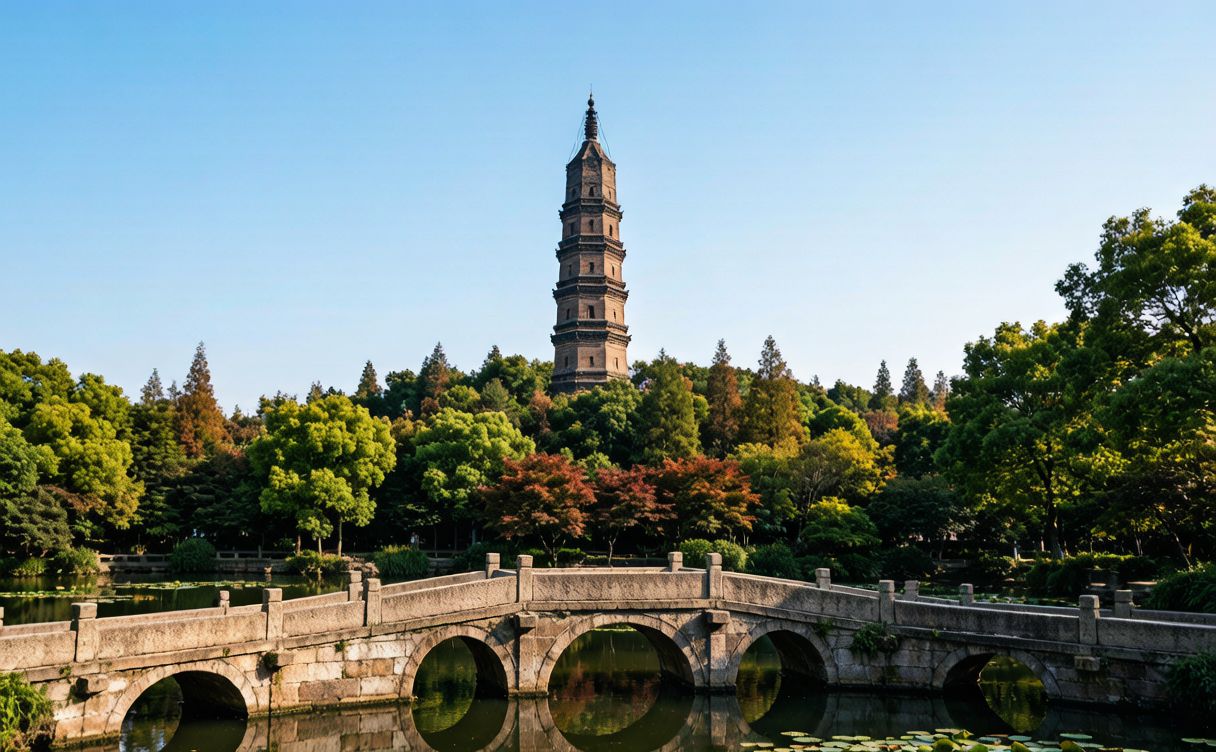
This is the headline act, and it deserves the hype. The Yunyan Pagoda (云岩寺塔) was built around 961 AD during the Five Dynasties period, roughly 1,000 years before the Leaning Tower of Pisa was finished. It stands about 48 meters tall and leans by more than 2 meters at the top — a tilt you can clearly see with your own eyes, no optical trick.
I’ll be honest: the first time I saw it, I expected a roped-off ruin. Instead, the pagoda is a seven-story brick tower, octagonal, weathered to a soft grey, rising out of a small temple platform. Because of foundation settling on one side, it now leans noticeably to the northwest. Engineers have stabilized it with underground supports, so it is safe to walk the grounds, but you can no longer climb inside — which is probably wise given the lean.
What makes it special for a traveler is the setting. The pagoda sits at the very crown of the hill, framed by pines and the rooftops of the temple below. Photograph it from the mid-hill path looking up, or from the open plaza where the tilt reads most dramatically against the sky. Locals call Tiger Hill “the leaning pagoda of the South,” and standing there, the nickname feels exactly right.
Tips
A few practical things I wish someone had told me before my first visit.
Go early. The gates open around 7:30 a.m. I arrived at 8 and had the Sword Pool nearly to myself. By 10:30 the tour groups arrive and the narrow paths get crowded.
Wear flat shoes. The paths are stone, uneven, and can be slick after rain. There are steps everywhere, but nothing strenuous.
Budget 2–3 hours. You can rush it in an hour, but the pleasure is in the slow walk. I spent about two and a half hours, including tea at a hillside stall.
Combine it with a canal or garden day. Tiger Hill pairs naturally with Shantang Street, the Humble Administrator’s Garden, or a boat ride. Don’t try to see all of Suzhou’s gardens on the same day you do Huqiu — you’ll burn out.
Bring cash for small stalls. Most places take mobile pay, but the older tea ladies sometimes prefer cash for a cup of local green tea.
Best Time
Suzhou has four clear seasons, and Tiger Hill changes with them. I’ve been in spring and late autumn, and both were excellent.
March to May brings mild weather, new green on the hill, and peonies in the nearby gardens. This is my favorite window — comfortable, not too hot, and the light on the pagoda in the morning is soft and photogenic.
September to November is the other sweet spot. The air is crisp, the crowds thin after the summer holidays, and the temple grounds take on a golden tone. I’d avoid the peak of summer (July–August), when Suzhou gets hot, humid, and crowded with domestic tourists.
If you’re building a longer Yangtze Delta trip, Tiger Hill works beautifully as a day trip from Shanghai or as a stop between water towns. It also sits naturally on a route that includes Hangzhou’s West Lake and its own famous tower.
Good to Know
Tiger Hill is managed as part of Suzhou’s cultural heritage, and the Yunyan Pagoda is recognized among China’s significant ancient structures. For official opening hours, ticket prices, and seasonal events, I recommend checking the Suzhou municipal tourism information before you go, since schedules shift around public holidays: Suzhou Tourism Official Site. I also found the on-site English signage helpful but limited, so downloading an offline map beforehand saved me a wrong turn.
If you want to extend your trip beyond Suzhou, the nearby ancient towns are a natural next step, and Hangzhou is an easy high-speed train ride away.
For a different kind of pagoda experience, the Leifeng Pagoda in Hangzhou makes a great comparison, and if you drift north into Jiangsu, the Xuanwu Lake in Nanjing is an easy half-day add-on.