

I still remember the moment I stepped through the gate of Suzhou Museum for the first time. After two weeks of temples, train stations, and crowded city squares, I expected another hushed, dimly lit hall of glass cases. What I found instead stopped me in my tracks: a building of clean white walls, grey slate, and shafts of natural light that seemed to fall straight out of a scroll painting. I had read that the architect I.M. Pei was born in nearby Guangzhou and raised in Suzhou, but nothing prepared me for how personal this place felt. Standing there, I understood that this was not just a museum—it was a love letter from a Chinese-American master to his ancestral home.
If you are a foreign traveler planning a trip to China and want one stop that captures both classical Chinese art and bold modern design, Suzhou Museum should be near the top of your list. It sits in the heart of the old city, right beside the Humble Administrator’s Garden, and it holds one of the finest collections of Suzhou-and-region art anywhere in the country.
Getting There
Suzhou is an easy day trip or overnight stop from Shanghai, and getting there is half the fun. I took the high-speed train from Shanghai Hongqiao to Suzhou Railway Station, a ride of roughly 25 minutes on a bullet train that felt smoother than a city bus. From the station, a taxi or ride-hailing car got me to the museum in about 15 minutes, depending on traffic. If you prefer the metro, Line 4 will drop you within walking distance, though I found a short taxi ride simpler with luggage.
The museum is located at 204 Dongbei Street, in the same historic quarter as the famous gardens. Because it sits directly next to the Humble Administrator’s Garden, most visitors combine the two in a single morning. I arrived right at the 9:00 opening and was glad I did—the lanes around the museum fill up quickly, and the early light through the skylights is worth the early wake-up.
Before you go, I recommend reading our broader Suzhou Travel Guide for transport tips, hotel areas, and how to string together a multi-day itinerary in this canal city.
What to See
Inside, the collection focuses on the art of the Jiangnan region—the “south of the Yangtze” cultural heartland. The paintings gallery is where I lingered longest. Ink landscapes by Ming and Qing dynasty masters hang in rooms designed so that daylight, filtered through frosted glass, lands gently on the paper without harming it. There is something magical about seeing a 400-year-old brushstroke lit the way the artist intended.
The ceramics section surprised me. I expected blue-and-white porcelain, and there is plenty, but the true gems are the Song dynasty wares—pale celadon bowls with a glaze the color of rain on jade. The craft section shows local Suzhou specialties: intricate embroidery, scholar’s rocks (those twisted limestone chunks that Chinese collectors have treasured for a thousand years), and lacquerware.
One small hall near the back displays ancient artifacts from the Wu kingdom period, reminding visitors that Suzhou’s story reaches back more than 2,500 years. I spent a quiet ten minutes alone with a single Tang dynasty camel figurine and felt the centuries collapse.
If you enjoy gardens as much as galleries, do not miss the chance to walk next door afterward through the Humble Administrator’s Garden, the largest and most celebrated classical garden in Suzhou.
The Architecture
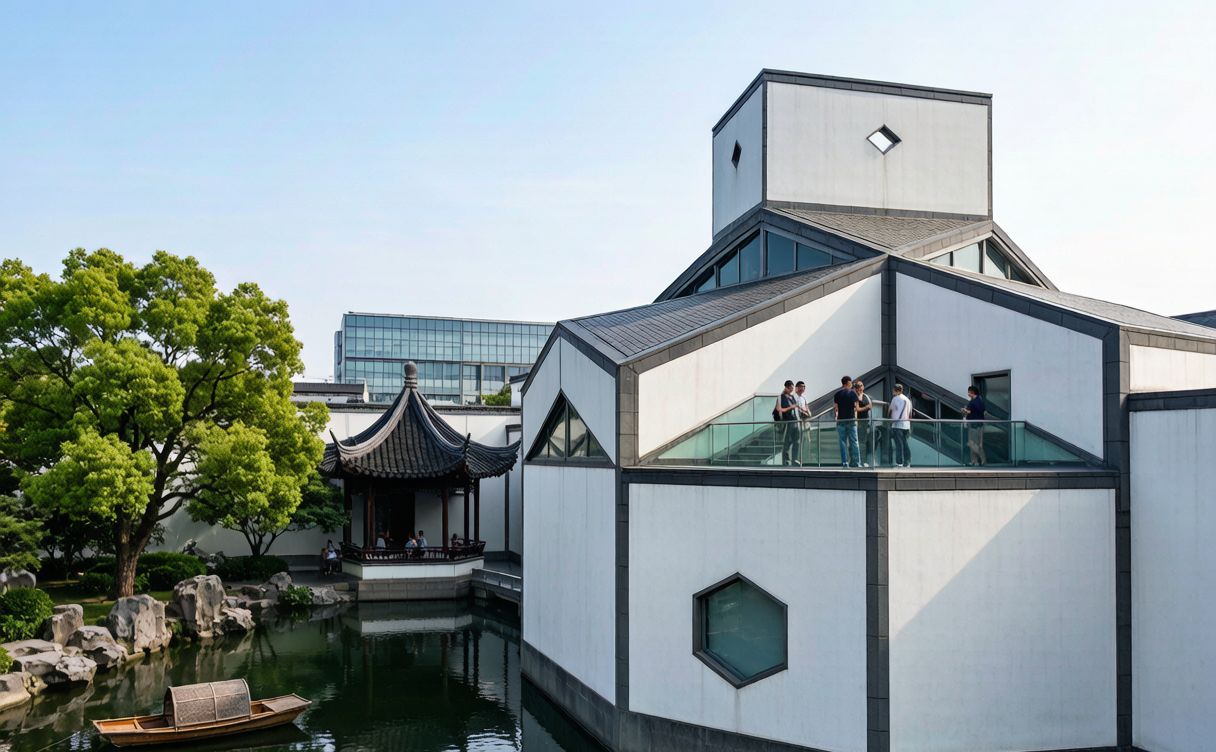
This is the reason I came, and it did not disappoint. I.M. Pei, who also designed the Louvre Pyramid, returned to his family’s roots to create this building in 2006, when he was nearly 90. He refused to copy either Western modernism or traditional Suzhou rooftops wholesale. Instead, he invented a new language: geometric white volumes, triangular skylights, and a restrained palette of white walls and grey Anhui slate that echoes the old city without imitating it.
My favorite space is the central courtyard, where Pei placed a handful of scholar’s rocks and a thin sheet of water that mirrors the sky. Standing on the wooden bridge, I watched light move across the stone as clouds passed—a building that behaves like a garden. The famous “wall of mountains” behind the pond, made from layered slate, is his abstract tribute to the painted peaks of Chinese landscape art. It is the single most photographed spot in the museum, and for once the photo does it justice.
What struck me most was how the architecture teaches you to slow down. There are no grand staircases or marble halls. Instead, Pei uses compression and release—narrow passages opening suddenly into bright courts—to guide your breathing as much as your footsteps. I left feeling calmer than when I entered, which is rare for any attraction.
Tips
A few things I learned that will make your visit smoother. First, admission is free, but you must reserve a timed slot in advance through the museum’s system, especially on weekends and holidays. I booked three days ahead and still saw walk-up visitors turned away.
Second, bring a light layer. The galleries are cooled in summer and the stone floors stay cool, so I was glad for a long-sleeve shirt. Third, photography is allowed in most areas without flash, but the staff will gently remind you in the painting rooms. Respect that—these works are fragile.
Fourth, go clockwise from the entrance and save the architecture courtyards for last, when the afternoon light is best. I made the mistake of rushing the gardens inside the museum and had to loop back. Finally, wear comfortable shoes; the paths are flat but you will walk a lot if you also visit the adjoining garden.
For more ideas on what else to pair with this stop, our Best Things to Do in China guide has a full rundown of must-see sights across the country.
Best Time
Suzhou has four clear seasons, and each changes the museum experience. I visited in late spring, when the courtyard’s new bamboo was at its greenest and the light was soft. Spring (April to May) and autumn (September to November) are my top picks—comfortable temperatures, fewer extremes, and gardens at their prettiest.
Summer is hot and humid, and the nearby gardens get crowded, though the museum’s air-conditioned galleries offer a welcome escape. Winter is cold but wonderfully quiet; I returned once in January and nearly had the place to myself, with pale sunlight raking across the slate walls. If you can travel in the shoulder months, you will enjoy both the art and the calm.
Whenever you come, aim for a weekday morning. The difference between a Tuesday at 9:15 and a Saturday at noon is the difference between a meditation and a queue.
Good to Know
The museum is closed on Mondays, so plan around that. Allow at least two hours, and closer to three if you add the adjacent garden. English signage is good but not exhaustive, so downloading an audio guide or joining a tour helps. The on-site gift shop sells tasteful books and replicas, and there is a small café for a tea break.
Suzhou pairs beautifully with nearby Hangzhou, another canal-and-garden city, and our Hangzhou Travel Guide explains how to link the two by high-speed rail. If this is your first big trip to the country, start with our China Travel Guide for First-Timers for visas, payments, and etiquette basics.
For official hours, exhibition updates, and reservation details, check the museum’s own site: Suzhou Museum