

In Taiyuan the cook doesn’t measure anything. He holds a loaf of dough the size of a rugby ball against a wooden board, lifts a thin curved blade, and begins shaving — short, rhythmic flicks that send pale ribbons arcing into a pot of boiling water. Each strip slaps the surface and uncurls. Three minutes later the pot is full, the noodles float, and a bowl is sliding across the counter before you have finished counting your change.
That motion is the dish. Knife-cut noodles, dao xiao mian, are one of the few Chinese foods where technique is the flavour: the blade leaves each strand thick through the middle, paper-thin at the edges, with a rough, rippled surface that grabs sauce in a way a smooth machine noodle never will. You can taste the method in every bite.
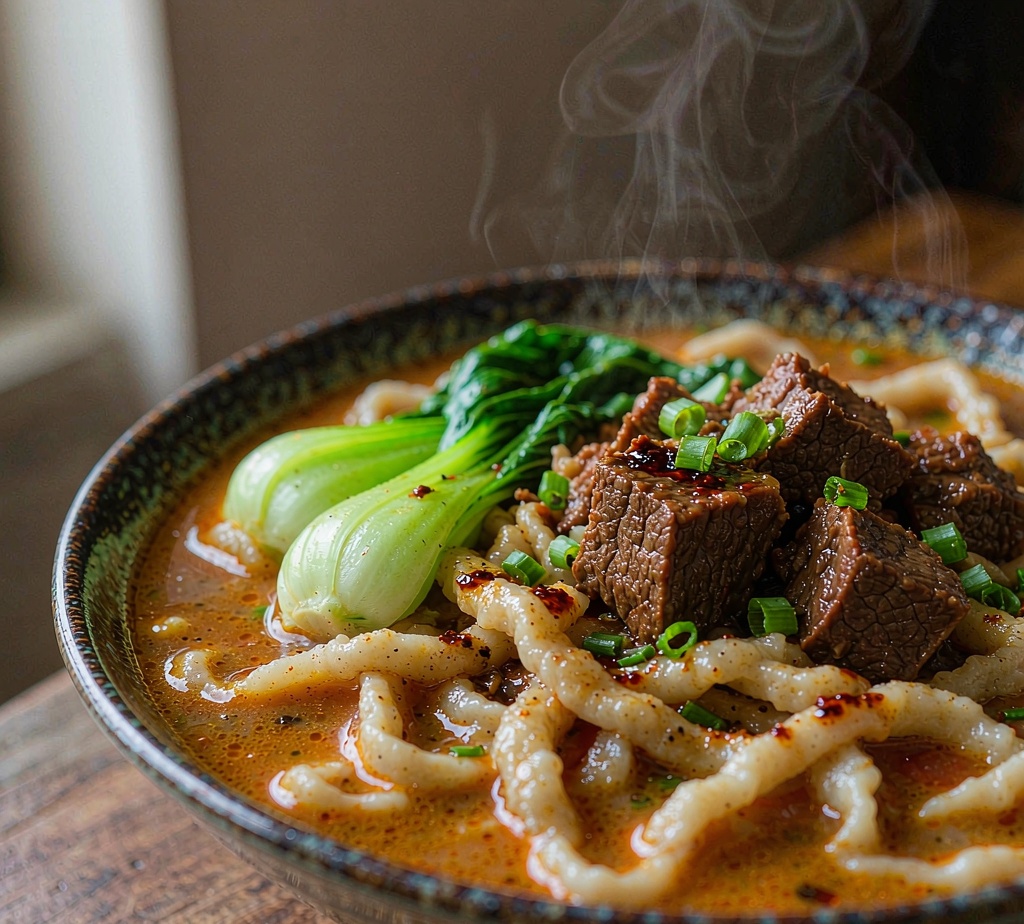
What Knife-Cut Noodles Are, and Why the Shape Does the Work
Dao xiao mian is the signature bowl of Shanxi, the northern province that claims more wheat-noodle forms than any other part of China. The noodles are not rolled, stretched, or extruded. A block of stiff dough is held in one hand or on a small board, and strips are shaved straight off its face with a blade, falling directly into the cooking water.
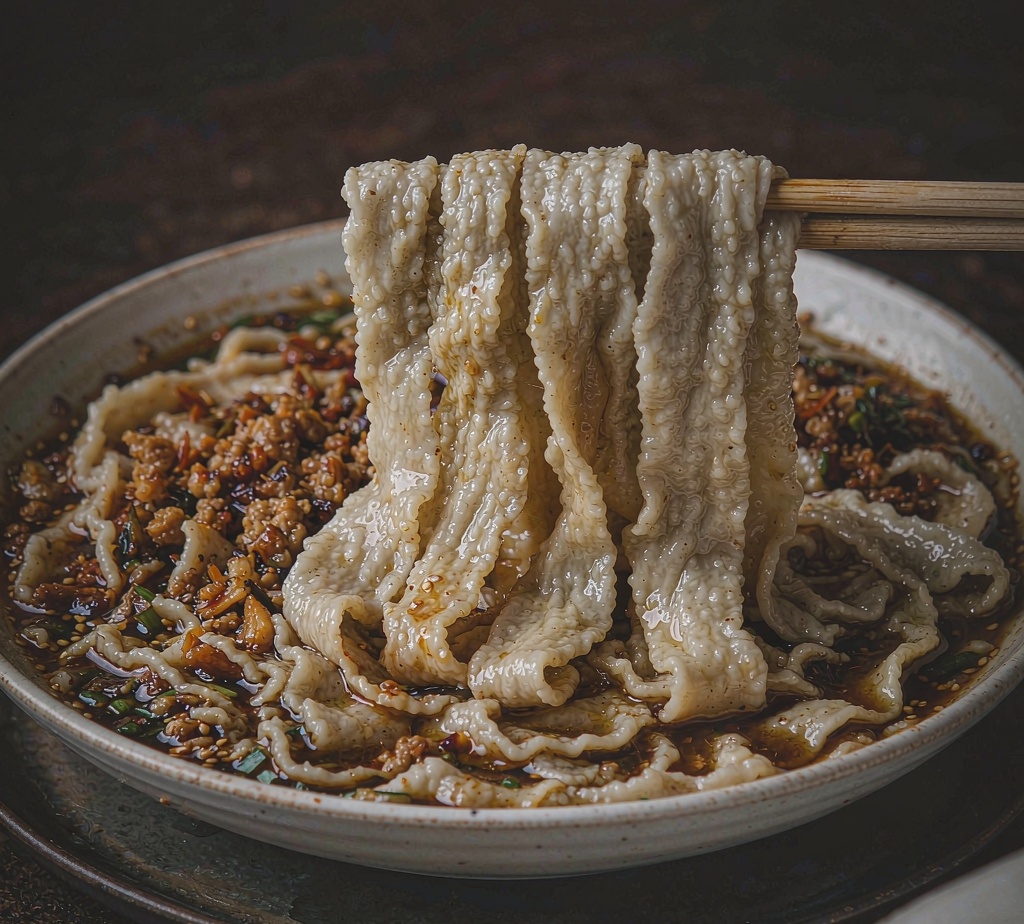
The result is a strand that looks like a willow leaf: a thicker spine, feathered edges, and a surface covered in tiny ridges and folds. That unevenness is not a flaw. The thin edges go silky in the mouth while the spine stays firm and chewy, so a single mouthful moves through several textures. The rough face also holds broth and sauce far better than a slick, uniform noodle — which is why a proper bowl tastes seasoned all the way through, not just on the surface.
In taste terms, the noodle itself is mild: wheaty, faintly sweet, with a clean chew and a slight spring. Most of the flavour comes from what you put on it — a spoon of minced-pork sauce, a ladle of beef broth, a slick of chili oil, and always, in Shanxi, black vinegar.
The Ingredients: A Stiff Dough and Almost Nothing Else
The dough is deliberately dry. Softer dough is easier to handle but turns gluey when shaved; a stiff mix holds its shape long enough for the blade to cut cleanly. For two generous servings you need:
- 300 g wheat flour — plain all-purpose works, but a 50/50 blend with bread flour gives a chewier spine
- 120–130 ml cold water — roughly 40–43% hydration, noticeably stiffer than dumpling dough
- 3 g fine salt — for structure, not for saltiness
- A pinch of baking soda or a few drops of alkaline water — optional, but it firms the dough and gives the noodles a faint yellow cast and extra bounce
For the topping, the two classic directions are a minced-pork sauce (150 g pork, 1 tbsp dark soy, 1 tbsp aged vinegar, ginger, scallion, a spoon of chili oil) or a beef broth bowl (500 ml beef stock, braised beef, blanched bok choy). A home-style tomato-and-egg version is just as common on Shanxi tables and takes ten minutes. Whichever you choose, keep it concentrated — the noodles are bland on purpose and need a strong partner.
Who Knife-Cut Noodles Suit — and Who Might Want to Pass
This is cold-weather, working-day food, and it suits anyone who likes a serious chew. A bowl is filling in a way a bowl of rice noodles never is; one serving will carry most adults through an afternoon of walking. It is also cheap, which makes it a reliable fallback for budget travellers who want a real regional meal rather than a chain restaurant.
There are fair reasons to skip it. The noodles are pure wheat, so anyone with coeliac disease or a genuine gluten intolerance should avoid them — there is no rice-flour substitute that behaves the same way. They are carbohydrate-dense, so they sit awkwardly in a low-carb routine. The broth versions are salty, and the vinegar-and-chili finish can be harsh on an sensitive stomach or reflux. None of this is a reason to avoid the dish outright; it is a reason to order a smaller bowl, ask for less salt, and go easy on the chili oil.
How to Make Knife-Cut Noodles at Home, Step by Step
You do not need a specialist knife, though a thin, slightly curved blade makes the motion far easier. A sturdy chef’s knife with a fine edge will do. The one thing you cannot skip is the rest — relaxed gluten shaves; tight gluten tears.
- Mix. Combine the flour and salt, then add the water a little at a time, stirring until the mixture looks like coarse crumbs. Add the baking soda now if using.
- Knead. Bring it together and knead for 10–12 minutes until the surface is smooth and the dough feels firm, almost like clay. It should not stick to your palm.
- Rest. Cover and leave for 30 minutes. Knead again for two minutes, then rest another 10.
- Shape. Form the dough into an oval loaf about 15 cm long and 6 cm thick, with a flat face to shave from.
- Boil. Bring a large pot of water to a rolling boil. Hold the loaf on a board or in your palm, tilted slightly toward the pot.
- Shave. With the blade nearly parallel to the dough, cut thin strips off the front edge in one confident downward flick, letting each one fall into the water. Aim for 3–4 mm at the centre, tapering at the ends.
- Cook. Stir gently once to stop the strips sticking, then cook for 2–3 minutes. They are done when they float and taste tender but still springy.
- Dress. Lift out with a slotted spoon, drain briefly, and toss with your sauce or ladle over hot broth. Finish with vinegar, chili oil, and sliced scallion.
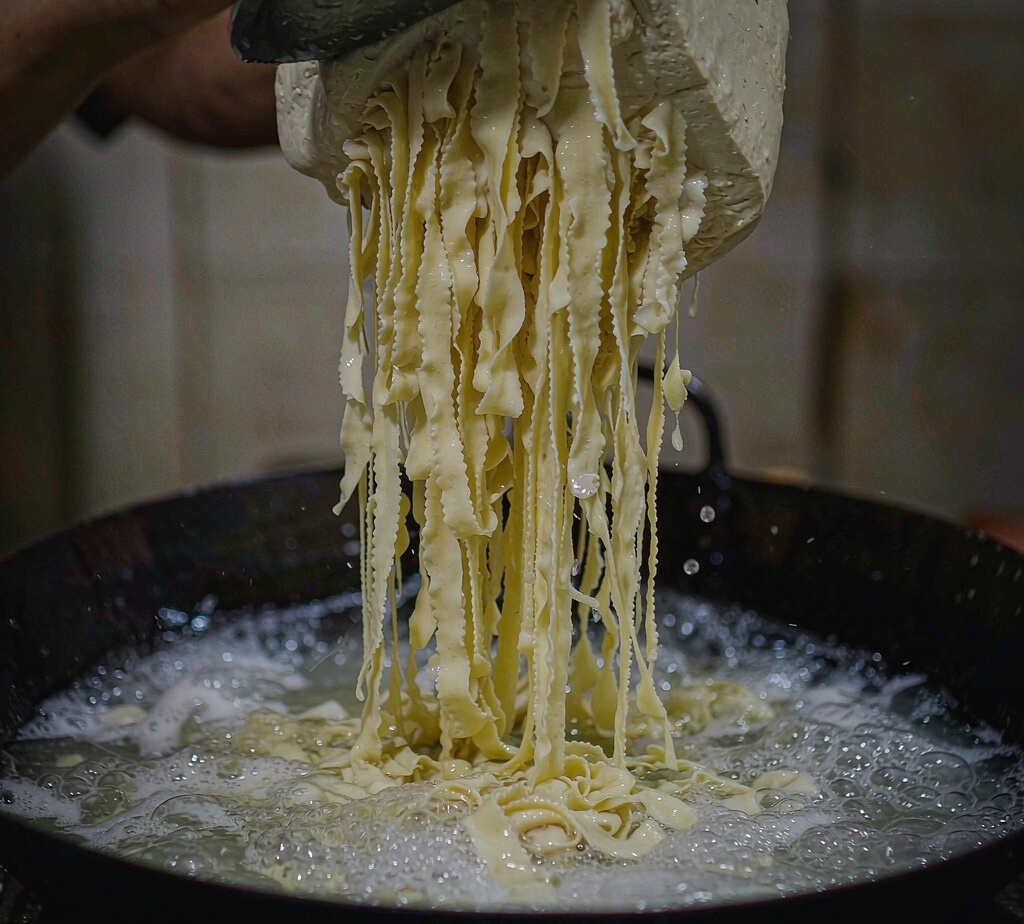
If the shaving motion defeats you on the first attempt — and it defeats most people — roll the dough into a thick sheet and cut it into broad ribbons instead. The shape will be more regular and the texture slightly less varied, but the dough is the same and the bowl still tastes like Shanxi.
Regional Variations, and Why Vinegar Is Not Optional
Shanxi is a province of micro-regional bowls, and the topping changes every few dozen kilometres. In Taiyuan the default is shaozi, a glossy minced-pork sauce sharpened with the local aged vinegar. Around Datong, lamb and mutton appear more often, reflecting the region’s northern, pastoral edge. Home cooks across the province make a tomato-and-egg version in summer, when tomatoes are sweet enough to carry the dish alone.
The vinegar is the through-line. Shanxi aged vinegar is dark, malty, and almost balsamic in its depth, and a spoonful stirred into the bowl at the table lifts the whole thing. If you want the wider picture of how it fits with the province’s other bowls, my Shanxi noodles and vinegar guide goes deeper into the vinegar culture and the noodle families around it.
It is worth knowing what this dish is not. Lanzhou beef noodles are pulled by hand into hair-fine strands and served in a clear broth; knife-cut noodles are shaved, thick, and usually dressed with a heavier sauce. Both are wheat noodles, and that is roughly where the similarity ends. If you want to place the bowl among the country’s other great strands, this regional noodles guide maps twenty of them.
Practical Tips From the Noodle Bench
- Keep the dough stiff. If it feels soft and pillowy, work in another tablespoon of flour. Wet dough is the single most common failure.
- Flour the blade, not the dough. A dry blade slices; a sticky one drags and tears.
- Shave in one motion. Sawing back and forth produces ragged, fuzzy edges that cook unevenly.
- Cook in batches. Overcrowding drops the water temperature and leaves the noodles starchy and stuck together.
- Toss with a little oil if you are not serving immediately. They clump within a minute of draining.
- Season at the table. Vinegar, chili oil, and a pinch of salt added by the eater are part of the ritual, not an afterthought.
On price and practicality: a plain bowl in Shanxi runs roughly 10–20 yuan, and 25–35 yuan in larger coastal cities or tourist districts. A bowl with beef and vegetables lands around 350–600 calories depending on the topping — the noodles alone are closer to 350. It is a cheap, sturdy meal rather than a light one.
Knife-Cut Noodles FAQ
How do you make knife-cut noodles at home without a special knife?
Use the longest, thinnest blade you own — a chef’s knife or even a sturdy cleaver held at a shallow angle. The key is a stiff dough, a flat face to shave from, and a single confident downward flick rather than a sawing motion. If the strips come out ragged, the dough is usually too wet or under-rested.
What do knife-cut noodles taste like?
The noodle itself is mild and wheaty, with a firm, springy chew and a slightly silky edge where the strip thins out. Most of the flavour comes from the sauce or broth: savoury, often a little sour from aged vinegar, and as spicy as you make it with chili oil.
Are knife-cut noodles the same as hand-pulled noodles?
No. Hand-pulled noodles are stretched and folded repeatedly into long, even strands, usually in a clear broth. Knife-cut noodles are shaved off a block of stiff dough, so they are shorter, thicker, and irregular, with a rough surface designed to hold a heavier sauce. The dough is also drier and firmer.
How many calories are in a bowl of knife-cut noodles?
A plain bowl of the noodles is roughly 350 calories. Add a minced-pork sauce or braised beef and broth and it climbs to about 500–600. The bulk comes from wheat, so portion size matters more than the toppings if you are counting.
How much do knife-cut noodles cost in China?
In Shanxi, a standard bowl costs about 10–20 yuan. In Beijing, Shanghai, or a tourist-heavy district expect 25–35 yuan. It remains one of the cheapest substantial meals you can buy in northern China.
Where can I eat the best knife-cut noodles in Shanxi?
Taiyuan is the safest bet, with noodle shops on almost every block and a strong concentration around the older food streets. Datong runs it close, especially for lamb-based versions. If you are planning a trip around the bowl, the Taiyuan food guide covers where to eat and what else to order alongside it.
What stays with you after a bowl of dao xiao mian is not the recipe — it is the sound. The blade against the dough, the slap of each ribbon hitting the water, the cook already reaching for the next loaf before the first bowl is served. It is a dish built on repetition, and the repetition is the point. Make it once at home and you will understand why Shanxi cooks have never seen a reason to invent a machine for it.