

Two hours south of Xining the road drops off the loess plateau and the colour changes completely. Rust-red sandstone pillars stack up in ranks several hundred metres high, weathered into fins, towers and blunt cathedral shapes, and beneath them the Yellow River — the actual Yellow River, the one that carries a billion tonnes of silt past Zhengzhou — sits dammed into a reservoir the colour of bottle glass. Red rock, turquoise water, deep blue high-altitude sky. Very few foreign visitors make it here. This Kanbula National Park travel guide explains how to change that.
Why Visit Kanbula National Park
Kanbula sits in Jianzha County, in Huangnan Tibetan Autonomous Prefecture, Qinghai Province, China, about 130 kilometres southwest of the provincial capital. It is a Danxia landform reserve — the same soft red sandstone that produces the sculpted cliffs of Guizhou and Gansu — but at altitudes between roughly 2,100 and 4,000 metres, and with an enormous body of water at its feet. The Lijiaxia Reservoir, backed up behind a hydroelectric dam on the Yellow River, floods the base of the cliffs and produces the colour contrast that makes the place famous among Chinese landscape photographers.
There are three reasons to give it a day. The geology is genuinely unusual: nowhere else in China do Danxia pillars rise directly out of an emerald river gorge at this scale. The forest cover — spruce, juniper, birch and larch on the shaded slopes — makes it far greener than most of arid Qinghai. And it is quiet. Even in peak season Kanbula sees a small fraction of the traffic at Qinghai Lake, which is two hours in the other direction and on every domestic tour itinerary. It slots neatly into a Qinghai loop alongside our Qinghai Lake travel guide and the mirror flats covered in our Chaka Salt Lake guide.
Best Time to Visit Kanbula National Park
Late September to late October — the standout. The best time to visit Kanbula National Park without much argument. Birch and larch turn gold and copper against the red rock, the air is dry and startlingly clear, and daytime temperatures sit around 10–20°C. Nights drop near freezing.
June to August. Warmest and greenest, 15–25°C by day. This is also Qinghai’s short rainy season, so expect cloud and afternoon showers that flatten the colour. Reservoir levels are usually high, which is good for boat trips.
May and early June. Cool, dry, thin crowds, and the last snow still visible on distant ridges. Good value.
November to April. Cold, with daytime highs often below 5°C. Some park services run reduced schedules and boat operations stop when water levels drop. Check ahead.
Whatever the season, the light is best in the first two hours after sunrise and the last two before sunset — the rock goes from brick to fire.
How to Get to Kanbula National Park
There is no railway to Jianzha, so every route ends in a road journey. Xining is the obvious base: it is on the Lanzhou–Urumqi high-speed line and has the region’s only significant airport.
| From | Mode | Typical duration | Approx. cost |
|—|—|—|—|
| Lanzhou West → Xining | High-speed rail | 1 hr – 1 hr 20 min | ¥65–95 (US$9–13) |
| Xining Caojiabao Airport → Xining city | Airport rail / bus | 30–40 min | ¥20–30 (US$3–4) |
| Xining → Kanbula park gate | Private car / chartered driver | 2 hr – 2 hr 30 min | ¥600–900 per day (US$85–126) |
| Xining (Bayi Road bus station) → Jianzha town | Public coach | around 3 hr | ¥45–60 (US$6–8) |
| Jianzha town → Kanbula park gate | Taxi | 35–45 min | ¥60–100 (US$8–14) |
A Kanbula National Park day trip from Xining works well: leave at 07:00, arrive by 09:30, spend five hours inside, and be back for dinner. The chartered car is worth the money — public coaches to Jianzha are infrequent, drop you well short of the gate, and make the return timing tight. Rail tickets require your passport number, and your driver will need your passport details at the park entrance too.
What to See at Kanbula
The Red Pillar Viewpoints
The core of the park is a series of platforms strung along the ridge road above the reservoir, each looking out over a different formation. Denta (德洪), Xiaoshan and the platforms above Nanzong Valley are the main three. From these you look down several hundred metres onto the water and across at pillar clusters that local guides have named after everything from stacked scriptures to a row of standing sentries. The compulsory shuttle bus links them, and you can get off and reboard freely.
Nanzong Valley and its Monasteries
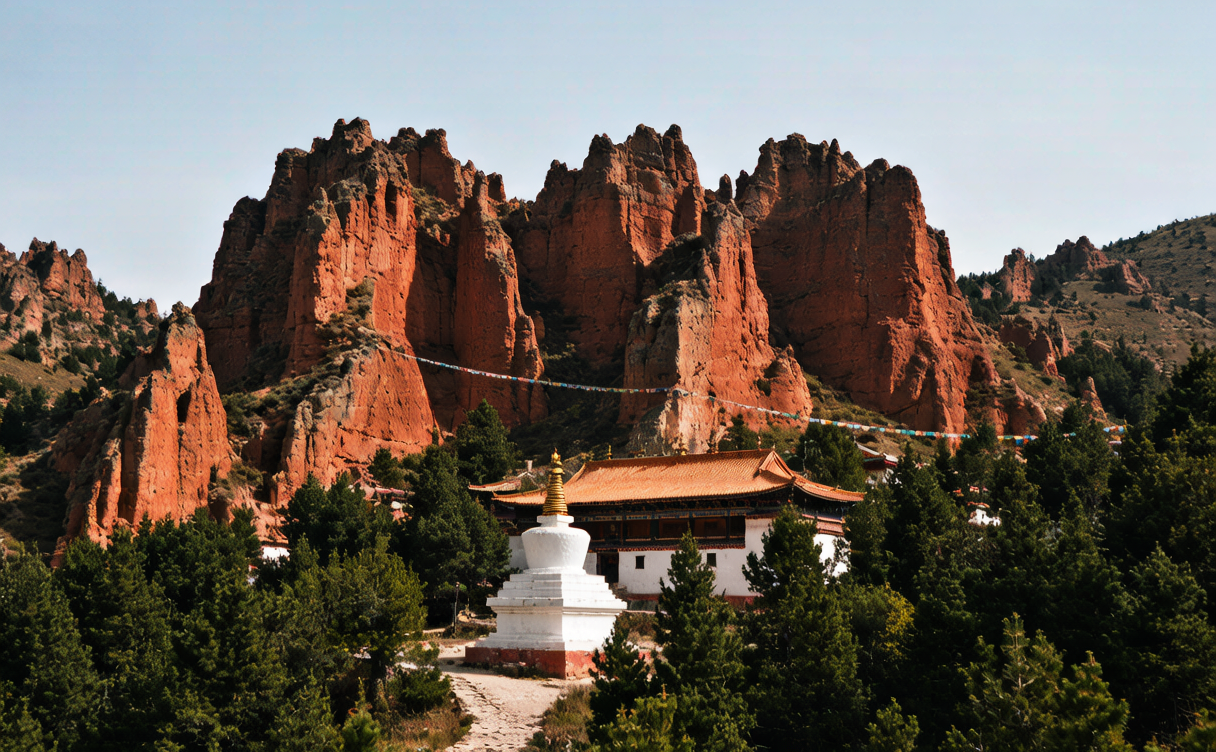
The wooded side valley of Nanzong (南宗沟) holds several small religious buildings that have stood on this rock for centuries, including a long-established nunnery. Architecturally they are modest: whitewashed walls, red-brown timber, gilt roof ornaments, prayer flags strung between the pines. These are working places of worship, so visit quietly and keep shoulders and knees covered. The valley walk between them is the most pleasant hour in the park.
Lijiaxia Reservoir and the Dam Road
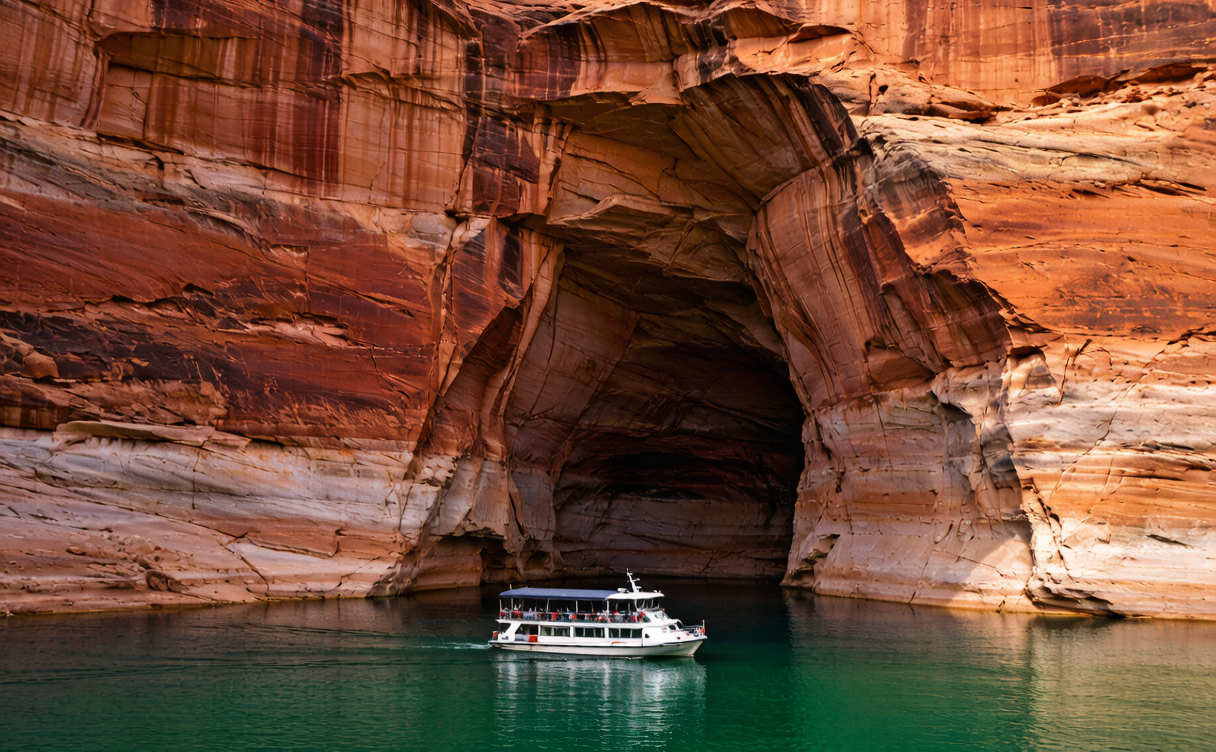
The water is the other half of the picture. Boat trips run in season from a jetty below the cliffs, taking you along the flooded gorge and giving the low-angle view that ridge platforms cannot; allow 40–90 minutes. The approach road along the Lijiaxia dam is a sight in itself, with the Yellow River squeezed between rock walls. Ask your driver to stop.
Kanbula National Park Hiking Trails and Routes
Nothing here requires mountaineering, but you are at 2,300–2,900 metres and everything feels harder than the map suggests. The main Kanbula National Park hiking trails and routes:
- Nanzong Valley walk. 4–6 km along a forested valley floor past the monastic buildings, mostly gentle, 2–3 hours. The best all-round option.
- Ridge viewpoint chain. Hop off the shuttle and walk between adjacent platforms, 1–3 km sections on paved paths with railings. Suitable for anyone.
- Nanzong Peak ascent. A steeper climb of several hundred metres to a high overlook, 3–4 hours return. Ask at the gate about current access before committing.
- Reservoir shoreline path. Short, level, and the best place to be for late-afternoon reflections.
A realistic full day: shuttle to the far viewpoints on arrival, work back along the ridge, walk Nanzong Valley late morning, lunch at the visitor centre, boat trip in the early afternoon, and one last viewpoint for the light. Travellers assembling a wider route through China’s protected landscapes should read our China national parks guide alongside this.
Where to Stay Nearby
Xining — ¥180–600 (US$25–84). Most people base here and day-trip. The city has international-standard hotels, the best food in the province, and reliable passport registration. See our Xining travel guide for neighbourhoods.
Jianzha county town — ¥130–320 (US$18–45). Forty minutes from the gate. Simple Chinese business hotels, adequate and cheap, and they put you in position for sunrise. Confirm foreign registration in advance.
Park-area guesthouses — ¥150–350 (US$21–49). A handful of family-run places and small lodges near the entrance and around the reservoir. Basic rooms, home cooking, sporadic hot water and heating that matters from September.
Staying overnight near the park is the only way to catch first light on the cliffs, which is when the place earns its reputation.
Kanbula National Park Tickets and Opening Hours
Kanbula National Park tickets and opening hours vary between the peak and low seasons, and the internal shuttle is compulsory rather than optional.
| Item | Peak (approx. Apr–Oct) | Low (approx. Nov–Mar) |
|—|—|—|
| Park entrance | ¥100 (US$14) | ¥50–60 (US$7–8) |
| Compulsory shuttle bus | ¥60–70 (US$8–10) | Reduced service |
| Reservoir boat trip | ¥100–180 (US$14–25) | Often suspended |
Gates generally open 08:00–08:30 and stop admitting visitors around 16:00–16:30, with the park clearing by 18:00. Winter hours are shorter. Students and travellers over 60 receive discounts on production of ID — bring your passport, which is also required at the ticket window. Prices are adjusted periodically, so confirm current rates with your hotel or through a reputable operator such as China Discovery’s Qinghai pages before you set out.
Practical Tips
- Altitude. You will be walking between roughly 2,100 and 2,900 metres. Most people feel only mild breathlessness, but if you flew straight into Xining, give yourself a day there first.
- Sun protection is not optional. Thin air, high UV, reflective water. High-factor sunscreen, sunglasses and a brimmed hat.
- Layers. A 15°C swing between dawn and midday is normal. Fleece plus windproof shell, even in July.
- Food. The visitor centre serves simple meals but choice is thin. Carry snacks and two litres of water.
- Payment. Alipay and WeChat Pay cover tickets, shuttles and boats and accept foreign cards. Keep ¥300 cash.
- Language. Almost no English. Save the park name in Chinese characters.
- Respect at religious sites. Quiet voices, ask before photographing people, walk clockwise around stupas.
- Drones. Restricted in parts of the park and near the dam. Ask at the gate.
FAQ
Is Kanbula worth a full day?
Yes. Half a day gets you two or three viewpoints and feels rushed once you factor in five hours of driving. A full day lets you add the valley walk and a boat trip, which is where the trip becomes memorable rather than merely scenic.
Can I visit Kanbula and Qinghai Lake on the same day?
No — they lie in opposite directions from Xining, each about two hours away. Give them separate days, ideally with a night in Xining between.
How difficult is the walking?
Easy to moderate. Paved paths and railings at the viewpoints, a gentle valley trail, and one optional steep climb. Altitude, not gradient, is the limiting factor.
Do I need a permit?
No special permit is required for Kanbula. You need your passport for the entrance ticket, and your driver will register the vehicle at the gate.
What else can I combine it with?
Tongren is 90 minutes south, Xining two hours north, and the Yellow River valley road makes a good scenic link. For travellers hunting destinations most itineraries skip, this belongs firmly in our off-the-beaten-path China guide.
Written by Karl, China Travel Places — updated August 2026.