

This Jinzhou travel guide covers a city most foreign visitors skip — and that is exactly why it rewards the curious. Jinzhou sits in the Liaoxi corridor of Liaoning province, where Northeast China narrows toward the Bohai Sea, and it guards the land route between Beijing and the Manchurian plains. The headline draw is Bijia Mountain, a small island you can literally walk to across a stone causeway that the tide swallows and reveals twice a day. Add a layered military history and some of the best cheap seafood in the province, and Jinzhou makes a satisfying stop on a northeast China circuit.
Where Jinzhou Sits
Jinzhou is in southwest Liaoning, about 200 kilometers from Shenyang and roughly 400 kilometers from Beijing. The city spreads along the Liaodong Bay, with the older urban core a few kilometers inland and the coast to the south. Two geographic facts shape your trip: the sea is shallow and breezy rather than tropical, and the surrounding Liaoxi plain is flat, making the nearby hills and the odd volcanic plug of Bijia Mountain stand out sharply.
How to Get to Jinzhou
High-speed rail is the easy answer. Trains from Shenyang to Jinzhou take about 1.5 to 2 hours, and services from Beijing run roughly 3 to 3.5 hours, making Jinzhou a realistic day-trip or overnight stop if you are already in the capital. Jinzhou South Railway Station is where the fast trains arrive; a taxi or local bus gets you into the city center in 20 to 30 minutes. For a wider Northeast plan, our Shenyang travel guide is the natural hub, with connections onward to Dalian’s coastline and the Russian-flavored border cities.
If you are flying, the nearest major international gateways are Shenyang Taoxian and Beijing; there is also a small Jinzhou Bay Airport with limited domestic routes. Driving the Jingha (Beijing–Harbin) expressway is straightforward if you have a car and want to combine Jinzhou with the coast down to Tianjin.
Best Time to Visit Jinzhou
The best time to visit Jinzhou is late spring (May to June) and early autumn (September to October). Summers are warm and good for the beach, though July and August bring occasional humid spells and domestic holiday crowds. Winters are cold, windy, and clear — fine if you are heading north afterward to the Harbin Ice Festival, but less pleasant for coastal walking. The tidal causeway at Bijia Mountain is walkable year-round as long as you respect the tide tables.
Check the lunar tide schedule before you go; the causeway is only exposed for a few hours around low tide, and getting stranded on the island until the next low tide is a common (if not dangerous) tourist mistake.
Things to Do in Jinzhou
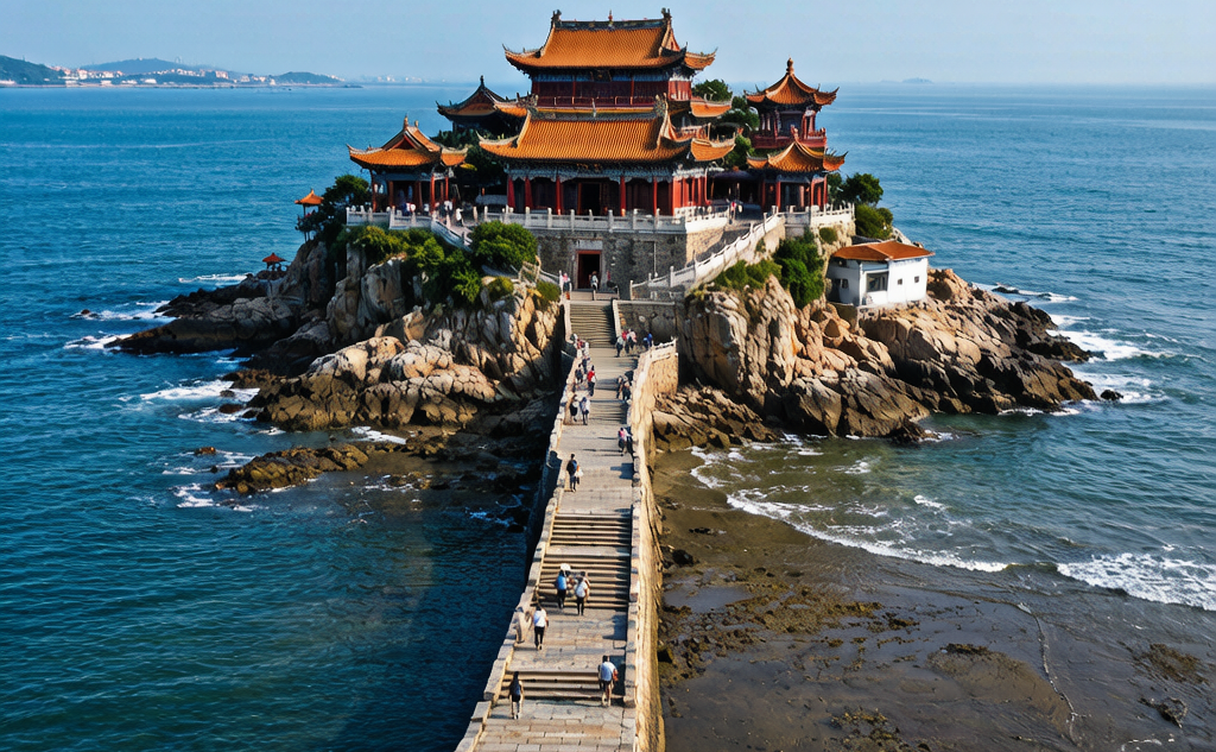
Bijia Mountain (Bijia Shan). The must-see. At low tide a 1.6-kilometer stone path rises from the surf and lets you walk dry-shod to the temple-crowned islet; at high tide the same path vanishes under a meter or two of water and you take a small boat back. Arrive about two hours before low tide, walk out, explore the hilltop temples and the odd rock formations, then walk back before the water returns. Go on a weekday if you can — weekends draw coach tours from Shenyang and Beijing.
Guangji Temple and the Liao-era pagoda. In the old city, Guangji Si preserves a square, multi-eased pagoda from the Liao dynasty (roughly 1,000 years old) alongside active halls where locals burn incense. It is free, quiet, and a good counterpoint to the seaside spectacle.
Liaoshen Campaign Memorial. Jinzhou was the hinge of the 1948 Liaoshen Campaign, the first of the major civil-war battles in the northeast. The museum and the nearby memorial park lay out the campaign with vehicles, maps, and dioramas. It is dense with context and takes a focused hour or two.
Yiwulu Mountain (Yiwulü Shan). North of the city, this sacred Manchu and Tibetan-Buddhist mountain has a cable car, a hilltop temple complex, and good views over the plain. It is less crowded than the coast and a pleasant half-day in autumn when the slopes turn color.
A Jinzhou Itinerary
A tight Jinzhou itinerary looks like this:
- Day 1: Arrive by high-speed rail, drop bags, visit Guangji Temple and the old city, eat seafood hot pot at night.
- Day 2: Morning at Bijia Mountain timed to low tide, afternoon at the Liaoshen Campaign Memorial, sunset along the Bohai embankment.
- Day 3 (optional): Yiwulu Mountain north of the city, then train on to Shenyang or Dalian.
If you only have a day, prioritize Bijia Mountain at the correct tide and skip the mountain. The tidal walk is the single thing you cannot replicate elsewhere nearby.
Food and What to Eat
Jinzhou cooks in the Liaoning coastal style: generous, savory, and seafood-forward. The signature is Jinzhou xiaochao (small stir-fries) and grilled shellfish at the night market near the old city. Try the steamed clams, the sea snails with chili, and the local variety of salt-baked shrimp. Inland, the Liaoxi plain produces good melons and pears in late summer. A seafood dinner for two runs 80 to 150 yuan, and the night-market stalls are cheaper still.
Pairing Jinzhou With the Region
Jinzhou is a natural hinge between the capital and the northeast. South, a Beijing first-time travel guide helps you plan the imperial-core days before you head north, while Tianjin — an hour or two beyond Beijing by rail — adds European-architecture walks and riverside food streets. North and east, Shenyang and Dalian round out a classic Liaoning loop.
Jinzhou Travel Tips
A handful of Jinzhou travel tips worth knowing: download a tide-table app or ask your hotel for the day’s low-tide times before heading to Bijia Mountain, because the window is short; carry a light windbreaker even in summer, as the Bohai breeze is persistent; book accommodation near Jinzhou South Station only if you have an early train, otherwise stay in the old-city area where the food is; and expect minimal English, so a translation app is essential for menus and taxi addresses.
For a factual overview of the city’s history and layout before you arrive, Wikipedia’s Jinzhou page is a reliable, free starting point.
Getting Around
Within Jinzhou, buses and taxis are cheap and adequate; ride-hailing apps work once you have a Chinese SIM or roaming data. The Bijia Mountain scenic area is south of the city, reachable by tourist bus from the central station or a 40-minute taxi. The old city, Guangji Temple, and the Liaoshen memorial are all close together and walkable.
Where to base yourself matters in Jinzhou. The old-city district puts Guangji Temple, the night market, and the Liaoshen memorial within walking distance, which is ideal if you want atmosphere over convenience. Jinzhou South Station is the choice for an early departure, with chain hotels and a handful of malls, but it is quiet after dark. Rooms are cheap by Chinese standards — a clean mid-range hotel runs 200 to 350 yuan — and the night market near the old city is the best evening move, with grilled clams, sea snails, and the local pear cider drawing a lively local crowd. If your goal is the tidal causeway at first light, ask your hotel to book a taxi the night before, because the earliest low tides sometimes fall before the first tourist bus runs.
Jinzhou will not make every traveler’s list, and that is the appeal. Stand on the tidal path as it emerges from the sea, temple bells drifting down from the island, and you get a small, unscripted moment that the headline cities rarely deliver.