

Our Fugong travel guide follows the Nujiang, the wild Salween, as it roars through a gorge in northwest Yunnan between walls of green mountain. If you are searching for a Fugong travel guide, the honest summary is this: Fugong is the heart of the Nujiang Grand Canyon, a place of Lisu and Nu villages, a church on a cloud, an abandoned 1980s town, and a sacred stone arch in the cliff. We have sent travelers here who wanted Yunnan without the tour buses of Lijiang, and Fugong answered with silence, terraces, and a river that never stops talking.
Fugong is a county in the Nujiang Lisu Autonomous Prefecture, strung along the river between the prefecture seat at Liuku to the south and the Tibetan-leaning county of Gongshan to the north. The valley floor is narrow and the mountains rise almost straight up, so the road and the river share the bottom and the villages cling to the slopes. On our last visit the morning fog had not yet lifted from the water, a Lisu woman was driving her goats up a terrace path, and the only engine sound was a single motorcycle crossing the new bridge.
Why Fugong is the real Nujiang
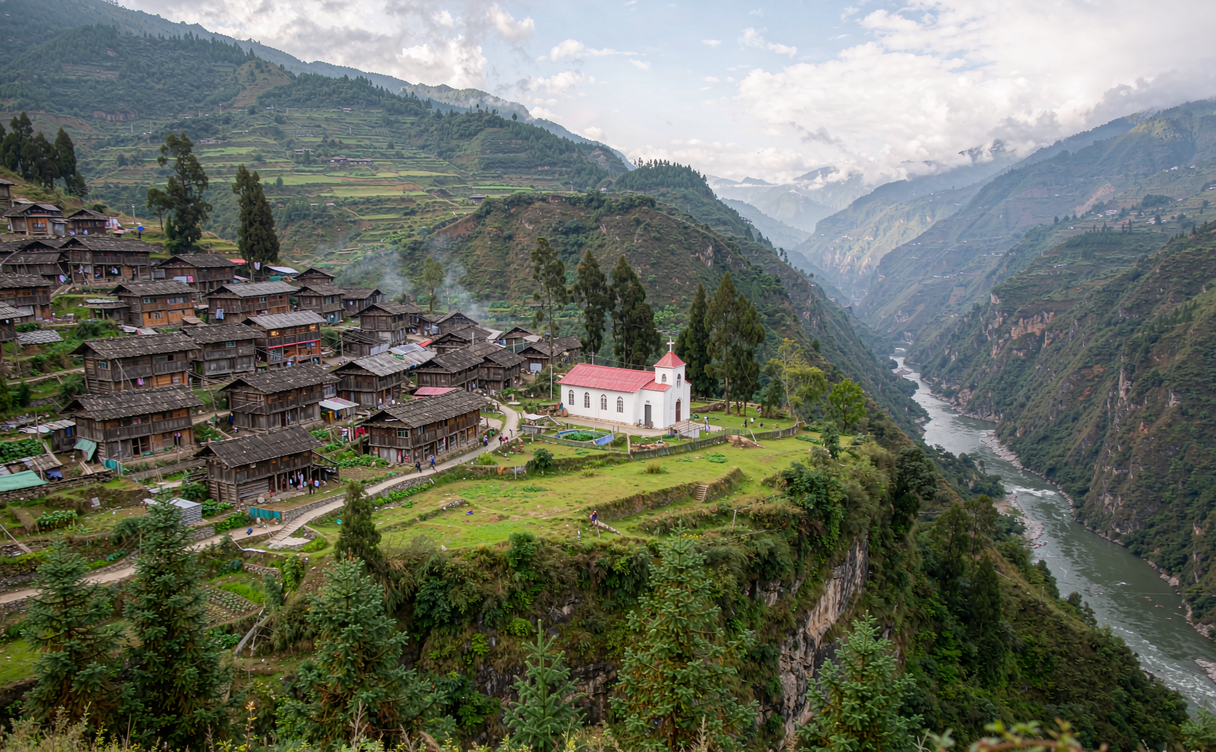
The first stop is Laomudeng village, a Lisu settlement perched above the river with a small Christian church that frames the gorge like a postcard. Sunday services still sing in the Lisu language, and visitors are welcomed to stand at the back. Below the village, the road continues to Zhiziluo, the “city in the clouds” that was the old Bijiang county seat until 1986, when the ground was judged too unstable and the administration moved away. The town froze: a 1980s library, a cinema, and row upon row of empty concrete blocks now softened by moss and wildflowers. Walking it is eerie and beautiful, and it is free.
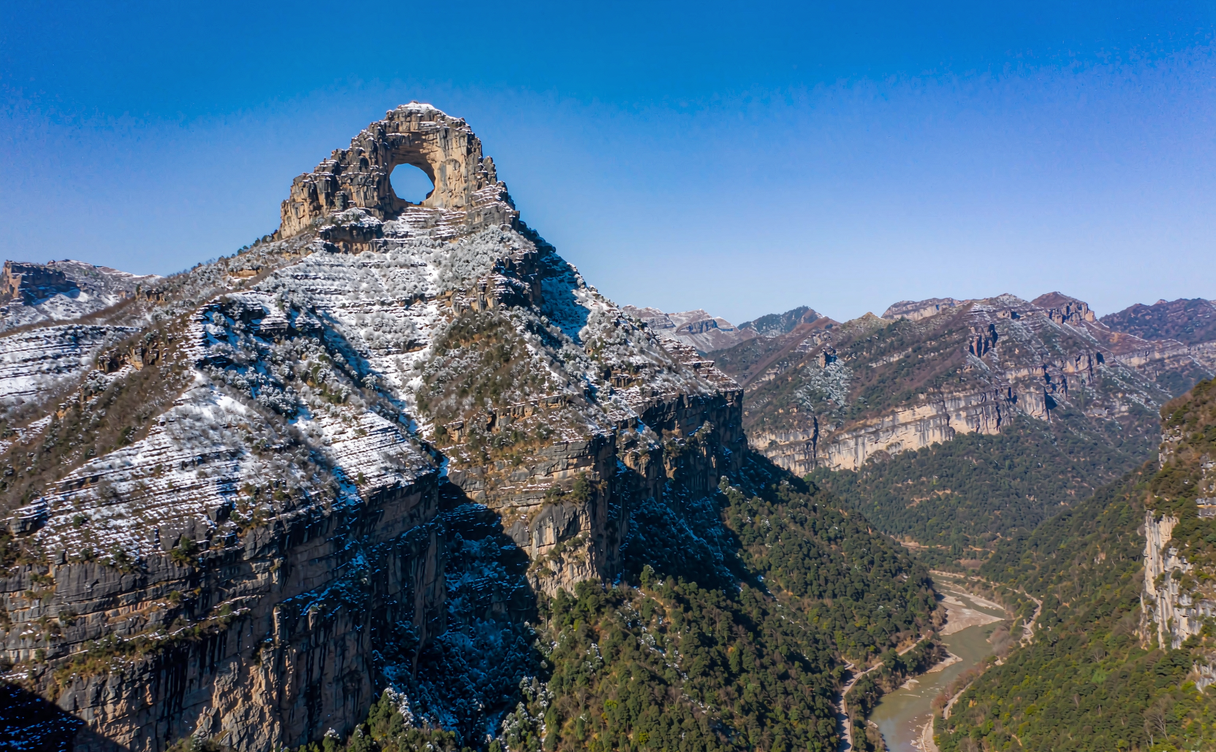
The second icon is the Stone Moon, a natural limestone arch punched through the cliff face high above the west bank. To the Lisu it is sacred; to travelers it is a half-day hike up from the road, steep but rewarded by the view back down the gorge. A local guide costs 80 to 150 RMB and knows the safe line. We have done it in the dry season and would not attempt the upper trail in rain.
Fugong also keeps a surprise in the county town: the Flying Stone, a multi-ton boulder that dropped into a schoolyard courtyard one night and simply stayed, now fenced and honored with incense. It is the kind of local oddity that tells you how this valley thinks about luck.
Best time to visit Fugong
The best time to visit Fugong is October to November and March to May, the dry windows when the road is reliable and the views are clear. The rainy season from June to September brings landslides that can close the gorge road for hours or days, and we actively advise against tight schedules then. Winter is cold but dry and strikingly beautiful, with frost on the terraces and few visitors.
The whole valley sits inside the Three Parallel Rivers protected region, a UNESCO World Heritage area where the Nujiang, Lancang, and Jinsha run roughly parallel through deep gorges. The UNESCO Three Parallel Rivers listing explains the scale of what you are standing in, and it is worth a read before you come so the silence feels earned rather than empty.
How to get to Fugong
How to get to Fugong is the part to plan carefully, because there is no airport and no railway this far up the gorge. The practical route is to reach Liuku, the prefecture seat, by long-distance bus from Kunming, a ride of about eight to nine hours, or by a shorter hop from Baoshan or Dali. From Liuku, frequent buses run north along the Nujiang Beautiful Highway to Fugong in two and a half to three hours for 50 to 70 RMB.
The road itself, rebuilt and widened in 2020, is the scenic event: it traces the river past terraced villages and hot-spring outlets. Buses also connect Fugong north to Gongshan in another three to four hours. For the longer rail and flight picture into Yunnan, our China high-speed train guide for foreigners covers how to reach Kunming and Baoshan, and our Kunming travel guide explains the gateway city where most journeys begin.
Where to stay and what it costs
Fugong is about as cheap as travel in China gets. A county-town hotel runs 80 to 160 RMB a night, a guesthouse in Laomudeng or Zhiziluo costs 100 to 200 RMB with simple meals, and there is no upscale tier. Food is river fish, corn cakes, and bitter greens: a bowl of rice noodles is 8 to 12 RMB, and a shared dinner for two is 50 to 90 RMB. With free villages and low transport, a couple can spend a day here for under 250 RMB all in.
We usually book the Laomudeng guesthouse over the town hotel, because the sunrise over the gorge from there is the memory travelers keep. Reserve ahead only for the October holiday, when Yunnan residents flood the valley and the few rooms fill.
Things to do in Fugong beyond the headlines
Things to do in Fugong extend past the famous stops. The riverside hot springs, a short van ride north of town, let you soak for 30 to 60 RMB while the gorge walls close in. The Nu and Lisu festivals, especially the nu year in the cold months, bring singing, archery, and feasts that visitors are welcome to watch. And the daily river crossings by footbridge, where schoolchildren and grandmothers move with a calm that city people lose, are themselves a kind of show.
A day we like starts with the dawn at Laomudeng, a slow walk down to Zhiziluo, then an afternoon at the Stone Moon trailhead with a guide, and dinner back in town. Travelers who try to rush Fugong in a single bus pass see none of it; give it a night and the gorge opens.
If your route covers the region, our China ethnic minorities travel guide frames the Lisu, Nu, and Dulong cultures you will meet, and our Yunnan 10-day itinerary shows how Fugong fits a longer loop through the northwest. For the gorge itself, our Nujiang Grand Canyon guide goes deeper on the northern reaches toward Gongshan.
Our honest take
We rate Fugong as a two-night stop for travelers who like roads less traveled and cultures encountered rather than performed. On our last visit the high point was not a sight but a grandmother in Zhiziluo who pressed a cup of corn wine into our hands and walked us through the empty cinema, explaining the town she had left. That generosity is Fugong’s real product, and no entrance fee captures it.
Ready to plan your trip? Tell us your Yunnan dates and we will build Fugong into a safe dry-season Nujiang loop.
Practical notes before you go
Carry cash, because rural guesthouses and vans rarely take cards and mobile pay can fail on the slope. Bring a rain layer even in the dry season, since gorge weather turns fast. The county tourist desk near the bridge hands out a basic map, and the bus station is signed in both scripts. If you hike the Stone Moon, hire a guide in town and start before 9:00 to be down before afternoon cloud.
Want a custom Yunnan itinerary? Share your route and we will link Fugong with Kunming and the high northwest.
A final word on rhythm
The mistake is treating Fugong as a drive-through on the way to somewhere else. It rewards travelers who stay, who listen, and who let the river set the pace. Build in a buffer day in case the road surprises you, and you will likely call it the best surprise of the trip.
Book your Fugong stay with us and we will pre-arrange the Laomudeng guesthouse and a Stone Moon guide.