

Our Erhai Lake guide begins with a claim we make to every first-time visitor: this is not a lake you tick off a list and leave. Erhai Lake, Yunnan sits at 1,972 meters above sea level, pinned between the Cangshan range and the old trade routes of the Bai people, and on our last trip the light at 6:40 a.m. turned the whole surface into a sheet of hammered silver. If you only read one thing before booking, read this: the best things to do at Erhai Lake are slow, and the lake rewards anyone willing to give it two full days rather than a rushed afternoon.
How to get to Erhai Lake
Dali is the gateway, and it is easier to reach than most foreigners expect. The fastest route is to fly into Dali Fengyi Airport (DLU), which has daily connections from Kunming, Chengdu, and Guangzhou; a taxi from the airport to Dali Old Town runs about RMB 80–120 and takes 40 minutes. Most of our clients, though, take the high-speed train to Dali Railway Station from Kunming (about 2 hours, RMB 145 second class) or from Lijiang (about 1.5 hours, RMB 80). From the station, a DiDi ride to the lake’s western shore is RMB 25–40.
If you are building a longer Yunnan loop, pair this stop with our Yunnan first-timer planning overview before you lock dates. We’ve sent clients who tried to do Erhai as a day trip from Lijiang and regretted it; the lake deserves an overnight, and the morning is when it is quiet.
Things to do at Erhai Lake
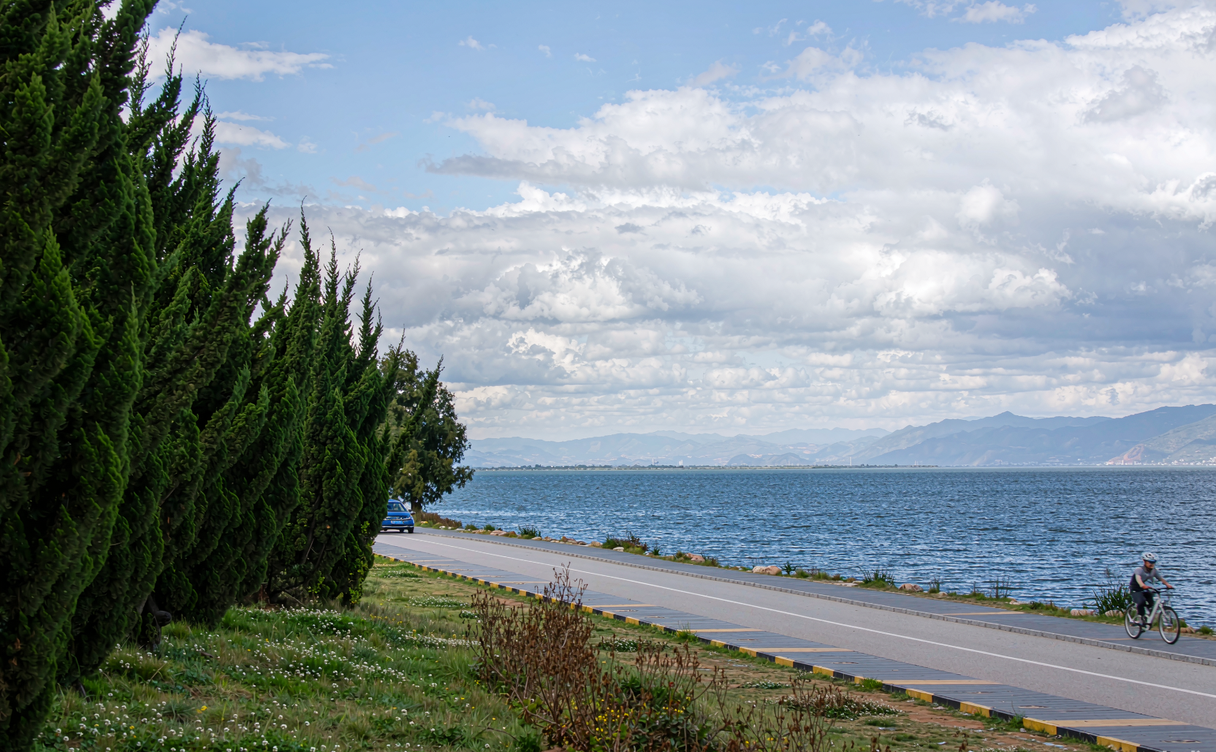
The classic move is the 140-kilometer ring road loop by e-bike or car. We rent e-bikes in Dali Old Town for RMB 60–100 per day, and the flat eastern shore is gentle enough for casual riders. Shuanglang, on the northeast corner, is the most photographed village, with cafes built right over the water; expect to pay RMB 40–80 for a lakeside coffee. Xizhou, to the north, is where you find the best-preserved Bai courtyards and the famous Xizhou baba flatbread (RMB 10–15 a piece, freshly grilled over charcoal).
Boat trips leave from Longkan Pier and Caicun Pier; a shared sunset cruise costs RMB 120–180 per person, while a private wooden fishing boat for two runs RMB 400–600. On our last trip we chartered one at Caicun and the boatman, a third-generation fisherman, pulled up a cage of local crayfish and grilled them on a portable stove — that is the kind of moment no group tour delivers. The water near the eastern shore is shallow and clear enough that you can see the lakebed weeds sway, and in autumn the reeds turn the color of strong tea.
For culture, the Three Pagodas of Chongsheng Temple sit just north of the old town and make an easy half-day add-on; the ticket is RMB 75 including the museum. If you want to go deeper into rural Bai life, the village of Nuodeng is covered in our Nuodeng Yunnan guide, about three hours’ drive east, famous for thousand-year-old salt wells and a ham that locals age for three years before slicing it thin over hot rice.
Best time to visit Erhai Lake
Spring (March to May) and autumn (September to November) are the sweet spots. In March the lakeside rapeseed fields turn gold and the Cangshan snow is still visible; in October the air is crisp and the water the clearest. Summer (June to August) is warm but busy with domestic tourists and afternoon rains; winter brings cold winds but also the chance to see migratory black-headed gulls that arrive from Siberia, flocking around the piers from November to February.
We always check the seasonal window against our best time to visit China overview because Yunnan’s climate runs a month or two ahead of the north and the lake can be chilly even when Beijing is hot. If you hate crowds, avoid the first week of May (Labor Day) and the first week of October (National Day), when room rates near Shuanglang double and the loop road jams with rental cars.
Erhai Lake itinerary
Here is the two-day plan we hand most clients:
Day 1 — Arrive Dali, check in near the west shore, cycle south to Caicun Pier for a late-afternoon boat, dinner of Bai-style fish hotpot (RMB 60–90 per person) in the old town.
Day 2 — E-bike north along the east shore: Xizhou for baba and courtyards, Shuanglang for lunch and a lakeside cafe, then continue to the northern tip for the views back down the lake. If you have a third day, add the Meili Snow Mountain route further northwest, though that needs a flight or a long drive from Shangri-La and is best saved for a separate trip.
The loop is well signed and the bike lanes are separated from traffic for most of the eastern shore, so even nervous riders manage it. We usually tell clients to start at 8 a.m. to beat both the heat and the tour buses that roll in after ten.
Where to stay and what’s bookable today
The western shore (near Dali Old Town) has the widest range: guesthouses from RMB 200 a night, design hotels from RMB 600. The eastern shore around Shuanglang is pricier and more resort-like, RMB 800–2,000 for lake-view rooms. We book most clients through Ctrip or directly with the hotels; availability is real-time and you can confirm a room for tomorrow if you are already in Yunnan. Note that since 2017 the local government removed lakeside restaurants and some hotels within the ecological protection belt to protect water quality, so the very closest waterfront rooms are limited — book the ones that remain early, especially for the October high season.
A few loop-road notes we give every rider
The eastern shore has the smoothest surface and the best cafes, but the northern tip gets windy by midday, so we tell clients to ride the exposed stretch before noon and save the sheltered southern bays for the afternoon. E-bike batteries cover about 50–70 kilometers on a full charge at this altitude, which is plenty for the Shuanglang–Xizhou hop but not the whole 140-kilometer ring, so plan a swap or a charge stop at a village teahouse (most will top you up for RMB 10). We carry a paper map as backup because signal drops behind the Cangshan ridges, and the few unpaved sections near the north are easiest in the dry months from October to April.
Photography is the other reason to start early. The light on the water is softest between 7 and 9 a.m., and the fishing boats with their upright nets make the classic silhouette shot near Caicun before the tour crowds arrive. We’ve sent a client who shot the same bend at noon and again at dawn and could not believe it was the same lake.

Food you should not skip
Beyond baba, try the Dali erkuai (rice cakes, RMB 15–25 in a stir-fry), and sour fish stewed with local pickled vegetables. The night market behind the old town gates sells grilled rushan cheese for RMB 10 a sheet, and the small hotpot joints near the south gate do a mushroom broth in August that we send people back for. We’ve sent vegetarians here without worry — the Bai kitchen leans heavily on wild mushrooms in summer and preserved vegetables year round, and most hosts will happily cook a meat-free version of any dish if you ask.
Before you go
Bring a windbreaker even in summer; the lake breeze drops the temperature fast after sunset, and mornings on the bike can be near freezing in March. Tickets for boats and the Three Pagodas are sold at the piers and gate, and most cafes take Alipay or WeChat Pay rather than international cards, so carry some cash for the small village stalls. For background on the lake’s ecology and history, see Erhai Lake on Wikipedia.