

I still remember the moment I stepped off the shuttle at the Qixingzhai entrance of the Enshi Grand Canyon and looked up: a wall of pale limestone, striated like a frozen tide, dropping somewhere past 1,000 metres into a valley already filling with cloud. Nothing I had read prepared me for the scale. This is not Zhangjiajie’s forest of freestanding spires, and it is not the gentle gorges of the Li River. The Enshi Grand Canyon, in western Hubei near the city of Enshi, is a long, raw cut through the earth where the rock itself seems to be the main character. If you want a full Enshi Grand Canyon guide to pair with your trip, start here, but the notes below are the ones I wish someone had handed me before I went.
Why the canyon hooked me
Most travellers hit Enshi as a stop between the better-known Hubei sights, or as an add-on to a Wuhan–Shennongjia loop. That is a mistake. The canyon is split into two main walking zones — Qixingzhai (the cliff-edge trail) and Yunlong Ground Fissure (a vertical cleft you descend into) — and together they show two completely different faces of the same karst landscape. I spent a full day and still felt I had only skimmed it.
How to get to Enshi Grand Canyon
The nearest city is Enshi (恩施), the prefectural capital, served by Xujiaping Airport with direct flights from Wuhan, Chongqing, Xi’an and a handful of other hubs. From Enshi city it is roughly 65 km to the canyon scenic area, about 90 minutes by road. You have three realistic options:
- Scenic-area bus: Departures leave Enshi bus station (and the tourist centre near the railway station) for the canyon most mornings around 07:00–08:00. Round trip is about ¥60 (US$8). This is the budget choice and the one I used.
- Didi / private car: A round-trip charter from a city hotel runs ¥400–600 (US$55–85) for the day. Worth it if you want to linger at the viewpoints without chasing a return bus.
- Train to Enshi, then taxi: The high-speed line from Wuhan reaches Enshi in about 4 hours. From the station, negotiate a taxi to the canyon.
Inside the park, electric shuttles connect the two zones and the cable-car stations; they are included in the through-ticket, so don’t pay separately for them.
Enshi Grand Canyon cable car and tickets
Tickets are sold as a combined pass. As of my last visit the through-ticket covering both Qixingzhai and the Yunlong Fissure was around ¥200 (US$28), with the Qixingzhai cable car (downhill) an extra ¥105 (US$15) and the vertical sightseeing elevator at the fissure another ¥30 (US$4). Buy at the official window or, better, through the park’s WeChat mini-program a day ahead in peak season — July and August queues at the elevator can be 40 minutes long. The cable car is genuinely worth it: it drops you along the cliff face with a view that, on a clear morning, folds the whole ridgeline into one frame.
My advice: ride the cable car down, then walk the cliff plank path. Walking up the stairs instead is brutal, and I watched several fit travellers regret it.
The Enshi Grand Canyon Qixingzhai hike
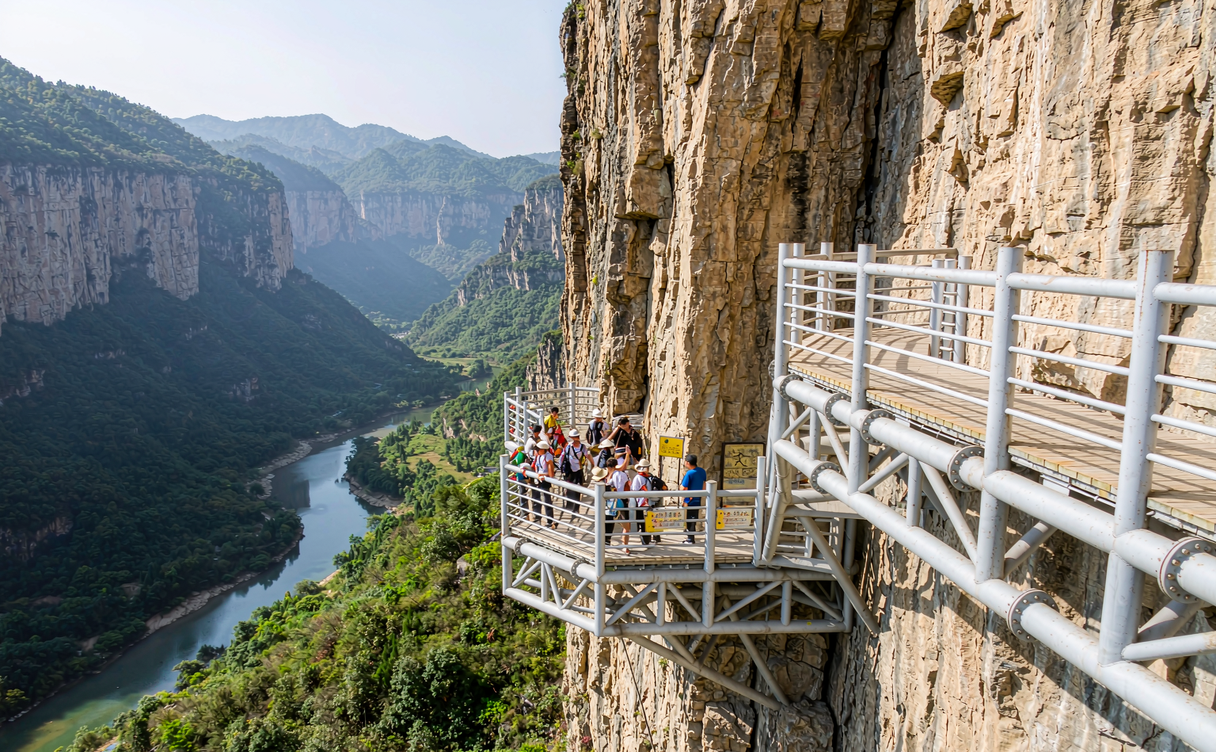
This is the heart of the visit. The Qixingzhai trail is about 8 km of undulating ridge walk, much of it on a steel plankway bolted directly into the rock. There are moments where the floor is a single plank and the drop is everything. I am not afraid of heights, but I slowed down at the “One Line of Sky” section, where two walls lean so close the sky becomes a slit.
Plan 3.5–4.5 hours for Qixingzhai if you stop for photos, which you will. There is almost no shade, so carry 1.5 litres of water per person in summer; vendors inside sell overpriced drinks but the spacing is unpredictable. The trail ends at the elevator or a long stair descent to the fissure zone.
The Yizhuxiang stone pillar Enshi
The single most photographed feature is the Yizhuxiang (一炷香, “a stick of incense”) — a freestanding limestone pillar barely 6 metres wide at its base and roughly 150 metres tall, balanced with uncanny precision. I reached it about two-thirds into the Qixingzhai walk, just as the light turned sideways and the whole column glowed. Locals call it a natural incense stick left burning for the mountain gods. Stand back: a telephoto lens flatters it, but the human-scale view is what hits you. It is the one image from Enshi that everyone who sees my photos asks about.
Best time to visit Enshi Grand Canyon
Spring (April–May) and autumn (September–October) are the sweet spots. Summer brings lush green and dramatic cloud inversions but also the heaviest crowds and frequent afternoon downpours — I got caught in a 20-minute squall and the plankways got slick. Winter is cold and sometimes icy on the north-facing sections, but the canyon empties out and the bare rock reads beautifully against a grey sky.
The best time to visit Enshi Grand Canyon for photography is late September to mid-October: dry air, comfortable 18–24°C days, and morning fog that lifts off the valley around 09:30. Avoid the first week of May and the National Day holiday (early October) unless you like shoulder-to-shoulder walking.
Where to eat and stay
Inside the park, food is basic — noodles, corn cakes, grilled sausage — at ¥15–25 (US$2–3.5) a serve. In Enshi city, make time for Tujia and Miao highland cooking: hezha (a sour soybean mash), tudou fan (potato noodles), and the smoky lanhua cai. A solid local dinner for two runs ¥120–180 (US$17–25).
For lodging, I stayed in Enshi city and commuted out. The Enshi travel guide covers hotels well, but in short: riverside boutique stays near Wuyanghe start at ¥300 (US$42) a night, and the city is pleasant to wander after dark. If you want to be first at the gate, a few guesthouses sit at the canyon entrance village charging ¥200–350 (US$28–48).
Insider tips I learned the hard way
- Arrive before 08:30. Buses of domestic tourists roll in from 09:30 and the plankways clog.
- Wear real grippy shoes. The steel walkways are fine when dry but treacherous when wet.
- Download offline maps. Mobile signal dies in the fissure.
- Combine wisely. Pair the canyon with Shennongjia or Wudang Mountain for a rounded Hubei trip, both reachable by road within a day.
- If you loved the vertical scenery, the Zhangjiajie National Forest Park guide is the natural next stop for more sandstone theatre.
For the broader geography and geology of the region, the background on Enshi Grand Canyon at Wikipedia is a useful read before you go, especially the notes on how the karst formed.
Two more ways to plan this trip
If you want to extend the walking, our China hiking treks guide lists ridge routes across the country, and the China national parks guide puts Enshi in the context of the wider protected-landscape system. The canyon deserves a full day; don’t try to bolt it onto a half-day transfer.