

More than thirteen centuries after her death, Wu Zetian remains the most remarkable woman in Chinese imperial history. She is the only female monarch to sit on the throne in her own right during the long span of China’s dynasties. For travelers interested in the Tang dynasty, her story turns dusty chronology into something vivid: a former palace concubine who became empress consort, then regent, and finally emperor of a short-lived Zhou state that interrupted the Tang. You can still walk the ground she shaped, from the stone avenues of her tomb to the cave-temples she patronized. This empress wu zetian guide explains who she was and how to visit the sites that keep her memory alive.
Who Was Wu Zetian
Wu Zetian was born in 624, during the early Tang dynasty, into a family of moderate official rank. As a young woman she entered the palace of Emperor Taizong as a low-ranking concubine. When Taizong died, court custom sent his surviving concubines to a Buddhist monastery, and for a time Wu lived as a novice nun. Her path back to power began when the new emperor, Gaozong, brought her into his court. Through a combination of political skill, alliances, and decisive action, she rose from concubine to empress consort, becoming the most influential figure beside the ailing Gaozong.
After Gaozong suffered a stroke, Wu governed in all but name. She cultivated support among officials, sponsored scholars, and built a network loyal to her. In 690 she took the final, unprecedented step: she founded her own dynasty, the Zhou, and declared herself emperor, ruling under the reign name Shengshen. Her reign as China’s female emperor lasted until 705, when a court coup restored her sons and the Tang line. She died later that year, around the age of eighty, and was buried with imperial honors.
From Concubine to Empress to Emperor
The journey of empress wu from palace woman to sovereign is the core of her fascination. Tang society was patriarchal and Confucian, and no woman before her had claimed the title of emperor. Wu managed it through patient consolidation of power and a careful command of symbolism. She promoted officials based on merit, expanded the examination system, and reduced the dominance of the old aristocratic families. She also used religion to legitimize her rule, most notably by presenting herself as a protector and incarnation of Buddhist teaching.
Her reign is often debated by historians, but for the traveler the facts are clear and worthwhile. She moved the center of gravity of the empire toward the eastern capital, Luoyang, where she built a magnificent new palace and court. She commissioned monumental Buddhist art. And, uniquely, she arranged for her tomb to be shared with her husband, Gaozong, a double burial that stands to this day.
Luoyang: The Eastern Capital
Luoyang was the city Wu Zetian loved best. She expanded it into a grand imperial capital and spent much of her reign there rather than in Chang’an. The city had been a capital for many dynasties, but under Wu it gained new monuments, including a vast palace complex and ceremonial spaces. Today Luoyang is a comfortable, modern city in Henan province with excellent transport links, and it makes an ideal base for anyone following the trail of queen wu zetian.
While in Luoyang, visitors should plan at least two full days. The Longmen Grottoes sit about thirteen kilometers south of the city center along the Yi River and are easily reached by bus or taxi. The White Horse Temple, said to be the first Buddhist monastery in China, is another rewarding half-day. The city is also famous for its peony festival in spring, when the parks blaze with color. If you are planning a broader route, our best things to do in China covers the country’s standout sights and helps you fit Luoyang into a wider itinerary.
The Qianling Mausoleum
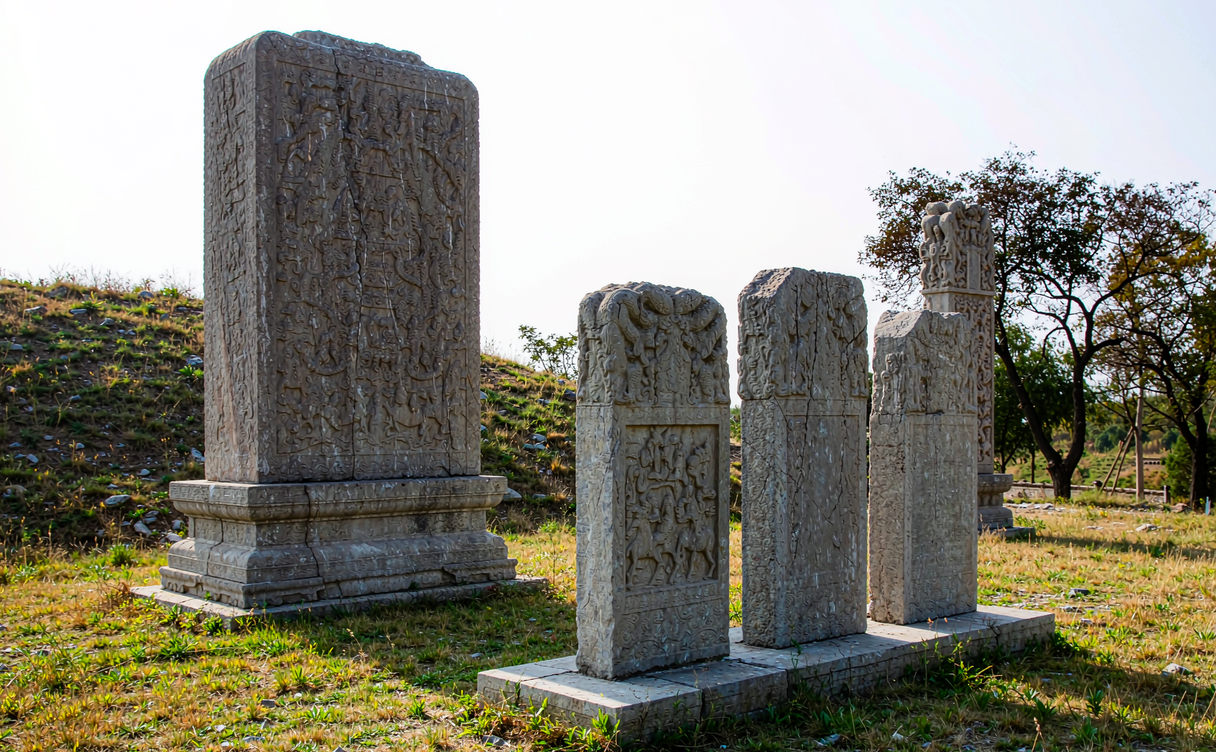
The single most important Wu Zetian site is the Qianling Mausoleum, located in Qianxian county, about eighty kilometers northwest of Xi’an in Shaanxi province. What makes it extraordinary is that it is a joint tomb shared by Emperor Gaozong and Wu Zetian herself. The burial mounds sit against the Liangshan hills, and the approach is guarded by a long spirit way lined with stone statues of officials, horses, winged creatures, and paired columns.
The most famous feature is the wordless stele, a towering stone slab erected before the tomb that carries no inscription. Tradition holds that Wu Zetian left it blank so that her achievements and faults might be judged by later generations rather than by herself. Whether that is the true reason or a later embellishment, the blank monument has become the enduring symbol of her complex legacy. Visitors walk the spirit way, photograph the weathered statues, and climb toward the mound for wide views of the surrounding plain. Wear sturdy shoes, as the site is spread out and partly on a hillside.
The Qianling Mausoleum is best visited as a day trip from Xi’an. Guided tours and private drivers are easy to arrange, and the drive passes through classic North China farmland. Combining Qianling with the nearby Tomb of Princess Yongtai and other Tang burial sites makes for a rewarding historical loop. For background on the regional treasures, the Shaanxi History Museum in Xi’an holds artifacts from the Tang court and is the perfect place to see the material culture of Wu Zetian’s era before you head into the field.

Buddhism and the Longmen Grottoes
Wu Zetian was a devoted patron of Buddhism, and her faith left a permanent mark on the landscape. The most spectacular result is at the Longmen Grottoes near Luoyang, a UNESCO World Heritage Site where thousands of Buddhist statues are carved into limestone cliffs along the river. Under Wu’s sponsorship, the great Fengxian Temple was completed, centered on a colossal carved image of Vairocana Buddha. Tradition links the serene face of that Buddha to Wu Zetian herself, a reflection of how she wove spiritual authority into her public image.
A visit to Longmen is unforgettable. The cliffs are honeycombed with niches, and the scale of the central Buddha is best appreciated by standing at the base and looking up. Arrive early to avoid crowds, and allow time to walk both banks of the river via the bridge. The site is well interpreted with signs, though a guide greatly enriches the experience by pointing out which caves date to Wu’s reign. According to Encyclopaedia Britannica’s overview of her reign, her use of Buddhist texts helped justify a woman’s rule in a Confucian world, a detail that makes the grottoes more than just beautiful stone.
Her Legacy
The legacy of China’s female emperor is layered. She strengthened the state examination system, opened government service to talented men from humble families, and presided over a prosperous, cosmopolitan age that set the stage for the later glory of the Tang. Critics in her own time and after accused her of cruelty in seizing and holding power. Modern historians tend to view her as a pragmatic and capable ruler whose gender made her a lightning rod.
For the traveler, the value of her story is that it is written into places you can stand in today. Luoyang, the Longmen cliffs, and the silent stele at Qianling are not abstractions; they are physical traces of a woman who bent the rules of an entire civilization. Understanding her adds a human dimension to any Tang dynasty visit.
Planning Your Visit
Timing and logistics matter for a smooth trip. Northern China has four distinct seasons, and the sites around Xi’an and Luoyang are most comfortable in spring and autumn. Our best time to visit China explains regional weather patterns so you can avoid both summer heat and winter cold on the plains. Luoyang and Xi’an are connected by high-speed rail, making it simple to see both the Longmen Grottoes and the Qianling Mausoleum on one journey.
Budget a half day for Longmen, a full day for the Qianling round trip from Xi’an, and at least two hours for the Shaanxi History Museum. Buy tickets in advance where possible, since popular sites limit daily entries. Local guides at each location are inexpensive and worth hiring.
Frequently Asked Questions
Who was Wu Zetian?
Wu Zetian was a Tang dynasty woman who rose from imperial concubine to empress consort and then founded her own short-lived Zhou dynasty, ruling as China’s only female emperor from 690 to 705. She is remembered for strengthening the examination system, patronizing Buddhism, and building monuments you can still visit in Luoyang and near Xi’an.
Where is the wu zetian tomb?
The wu zetian tomb is the Qianling Mausoleum in Qianxian county, Shaanxi province, about eighty kilometers northwest of Xi’an. It is a joint burial she shares with her husband Emperor Gaozong, and it is famous for its spirit-way stone statues and the wordless stele that bears no inscription.
Why is the empress wu zetian guide useful for travelers?
The empress wu zetian guide is useful because it connects a dramatic historical figure to real, visitable places: the Longmen Grottoes she patronized in Luoyang and the Qianling Mausoleum near Xi’an. Knowing her story turns a sightseeing stop into a meaningful encounter with Tang dynasty history.
What makes China’s female emperor unique?
China’s female emperor is unique because no other woman in more than two thousand years of Chinese monarchy ever ruled in her own name. Her reign bridges the early and high Tang and left behind some of the era’s greatest art and architecture.