

Walk through an old town in China during the winter holidays and you will see them everywhere: red cords twisted into intricate shapes, hanging from doorframes, car mirrors, and temple eaves. They look purely decorative at first glance, but every Chinese knot carries a layer of meaning woven into it over centuries. This Chinese knot guide is written for travelers who want to look past the bright red surface and understand what these small works of craft actually say. We will trace where the tradition came from, read the symbolism behind the most common forms, and look at how a simple length of cord becomes something worth hanging in your own home.
A Chinese knot, in its classic form, is made from a single continuous cord. The maker loops, crosses, and tightens that cord into a symmetrical pattern, and the finished piece is meant to be read as a whole rather than taken apart. That idea of continuity is the key to everything that follows. Nothing is cut short, nothing is borrowed from elsewhere, and the pattern folds back on itself in a way that suggests a life with no broken thread.
Where the Chinese Knot Tradition Began
The roots of the Chinese knot lie in a practice that predates written records in many parts of the world: tying knots to remember things. Long before silk cords became art, communities in ancient China used knotted ropes to keep counts, mark agreements, and record events. Over time this practical act took on ritual and decorative weight, and the cord became a carrier of meaning as much as information.
By the Tang dynasty, knotting had moved firmly into the world of ornament and ceremony. Fine silk cords were worked into hair decorations, garment fastenings, and gifts exchanged at court, and paintings from the period show knotted tassels on robes and ceremonial objects. The Song dynasty added a more scholarly, understated elegance, and knotwork appeared alongside other decorative arts in homes and temples.
The tradition reached its mature form in the Ming and Qing dynasties, when the complex, symmetrical patterns we now call the classic Chinese knot fully took shape. Knotted panels decorated screens, fans, and jewelry, and the craft became a recognized skill with its own vocabulary of forms. The red knot hanging by a doorway today is a direct descendant of those pieces, and many shapes have changed very little in several hundred years. A museum visit makes this evolution easy to see, and the China museum route guide can help you find collections where historic examples are displayed.
Chinese Knot Meanings and Symbolism
At the center of Chinese knot meanings and symbolism is the idea of connection. The single unbroken cord stands for continuity, for relationships that hold, and for a life that flows without a break. Because the cord loops back on itself, the knot also suggests return and reunion: people who are apart will find their way back to one another. This is why knots are so common at moments that bring families together or mark a new beginning.
Good fortune is the other great theme. The word for knot is tied to phrases about joining and binding, so a finished knot is read as something that gathers luck and keeps it close. A knot hung in the home is not just a wish for happiness; it is a small, tangible argument that happiness can be held. For broader context on Chinese customs and everyday traditions, the background on China.org.cn offers a useful and accessible introduction.
The shape matters as much as the sentiment. A balanced, symmetrical knot is considered visually harmonious, and the knot is also a quiet emblem of Chinese craftsmanship that turns a humble material into something refined through patience alone. For many travelers, understanding this symbolism is what turns a souvenir into a story they can tell when they get home.
Types of Chinese Knots and What They Stand For
There are dozens of named patterns, but a handful appear again and again in homes, shops, and temples. Learning to recognize the types of Chinese knots is the quickest way to read what a piece is “saying.”
The Pan Chang knot, or endless knot, is the most iconic of all. Its crisscrossing square pattern has no clear beginning or end, so it stands for longevity and the endless flow of life. You will see it on everything from car charms to temple hangings.
The Ruyi knot takes its name from a curved scepter associated with good fortune. Its rounded, cloud-like lobes are meant to smooth away obstacles, making it a popular gift for a new venture.
The Double Happiness knot is built around the character for double happiness and is almost reserved for weddings, where it announces joy and the joining of two families.
The Peace knot, sometimes called the safety knot, is worn or hung as a protection charm. Drivers often place one in a car, and travelers carry a small one on long journeys.
The Butterfly knot uses paired loops to suggest wings and is linked to love, beauty, and a carefree life, which makes it a favorite between partners.
The Language of Color
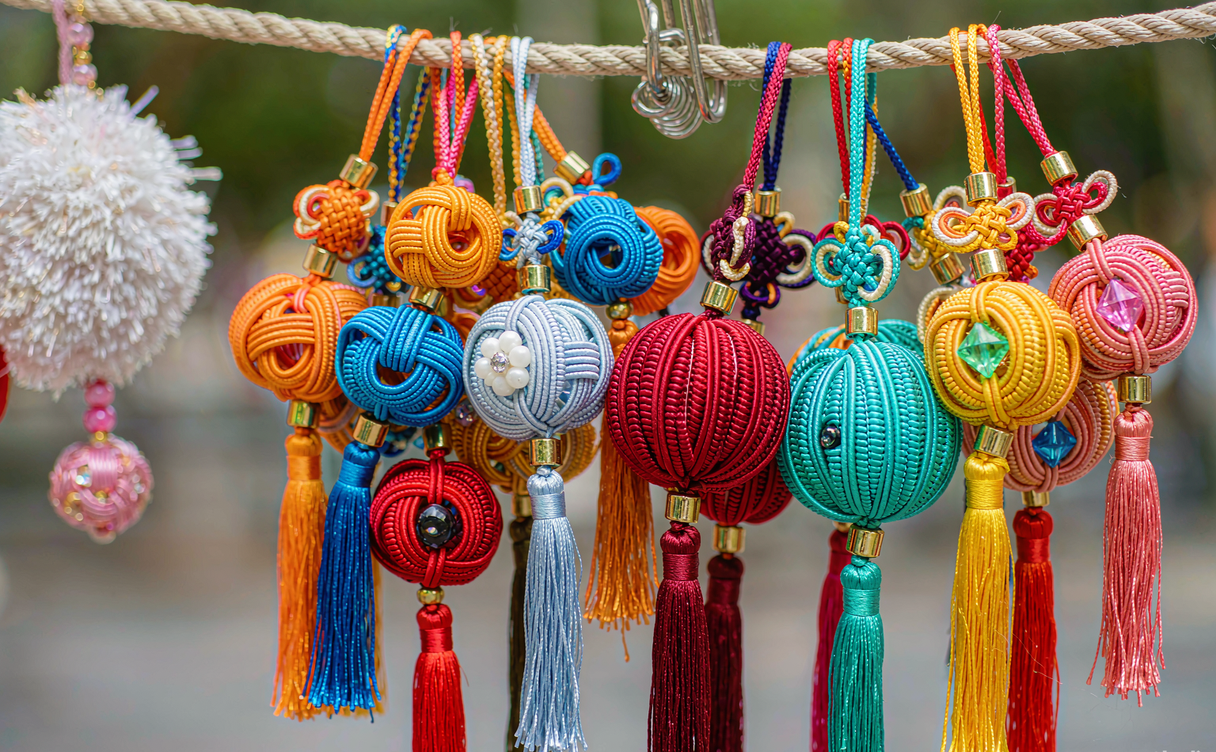
Color is never an afterthought in a Chinese knot. The cord is chosen as deliberately as the pattern, and the two work together to set the mood.
Red is the classic and by far the most common color. It stands for luck, joy, vitality, and celebration, and is believed to keep misfortune at bay. This is why red knots dominate the holiday season.
Gold speaks of wealth, prosperity, and honor. Gold-threaded knots or those finished with gold tassels are common in shops and businesses, where they invite good fortune. A red-and-gold combination is the most auspicious pairing of all.
Five colors — red, yellow, blue, white, and black — refer to the five elements of traditional Chinese thought. A multicolored knot is read as balanced and complete, drawing on the harmony of wood, fire, earth, metal, and water. These pieces are less common than plain red but carry a deeper meaning for those who know the philosophy behind them.
The Craft Behind the Knot
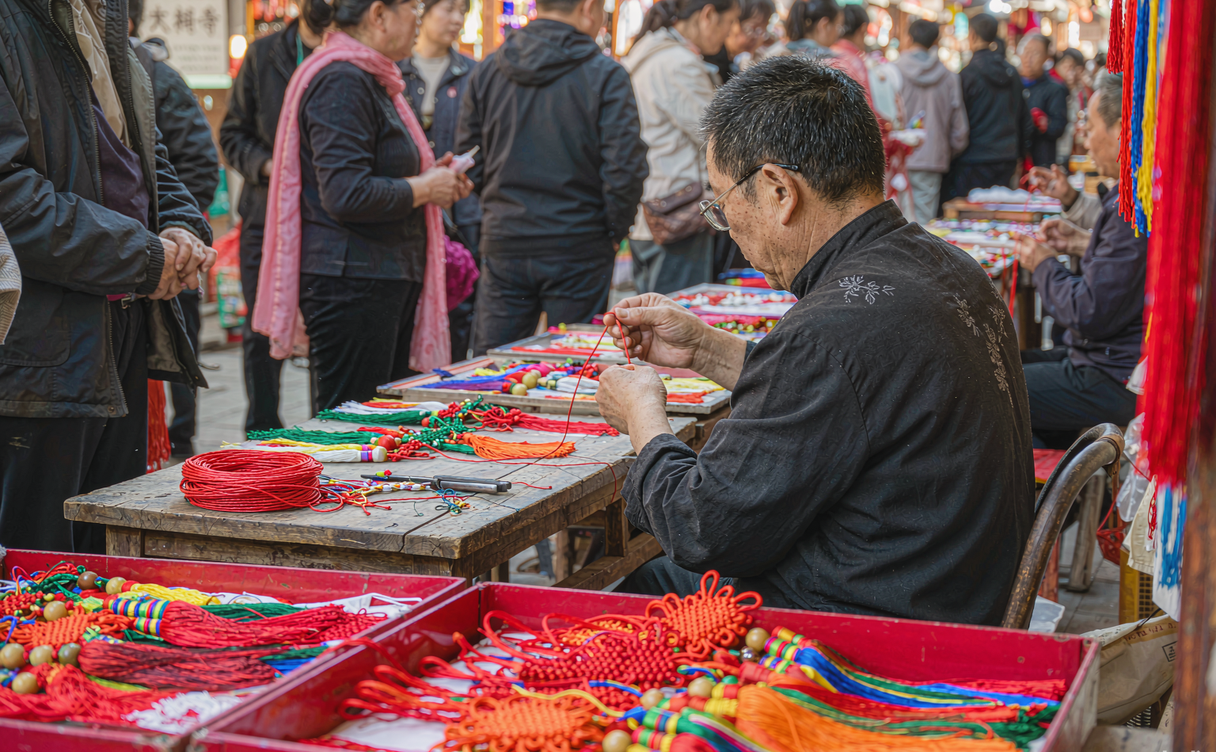
Learning how to make a Chinese knot looks intimidating, but the basic method is surprisingly orderly. A maker starts with a single cord, finds its midpoint, and forms a series of loops and crossings. Each step is tightened carefully so the pattern stays even, and the cord is fed through previous loops in a fixed sequence. The secret is patience: the same crossing repeated with consistent tension produces the symmetry the craft is known for.
Most traditional knots use one continuous piece of cord, so the finished object has no loose ends except where a tassel is added. The tassel weights the piece so it hangs straight and adds a finishing flourish. Beginners start with simpler flat knots before attempting the dense Pan Chang pattern, which can involve dozens of careful passes. If you enjoy hands-on traditions, a China calligraphy experience guide points to similar workshops where the emphasis is on slow, deliberate craft.
Chinese Knot Decorations for Festivals
Chinese knot decorations for festivals are everywhere once you know to look. During the Spring Festival, red knots go up alongside couplets and lanterns on doorframes, windows, and the walls of the family home. The knot marks the threshold between the old year and the new, and its unbroken cord is a wish for a year without misfortune. Streets and shopping areas take on a unified red-and-gold look that is one of the season’s most photographed sights.
The Lantern Festival keeps the decorations up a little longer. As families head out to view lantern displays, knots appear on the lanterns and on the cords that carry them. If you are planning a trip around this time, the Chinese New Year travel guide and the China festivals guide cover timing, custom, and what to expect in different cities. Knots also appear in classical settings, and the China classical gardens guide shows how decorative details are woven into traditional spaces.
Where to Buy Chinese Knots in China
If you are wondering where to buy Chinese knots in China, the short answer is almost anywhere, but the quality varies widely. Tourist streets and souvenir markets carry small knots at low prices, fine as gifts but often machine-made. For something better, look for craft markets, museum shops, and specialist stores where hand-knotted pieces are sold with the maker’s method explained.
Many cities also offer short workshops where you can try knotting yourself. These sessions provide the cord, a pattern, and an instructor who guides you through the crossing sequence, making a calm, screen-free afternoon. A knot you tied yourself is far more memorable than one you bought ready-made. When choosing a piece, look at the back: even, consistent crossings and a tight center are the signs of careful handwork.
Frequently Asked Questions
What does a Chinese knot mean? At its simplest, it means connection and good fortune. The single unbroken cord stands for continuity and reunion, while the symmetrical shape suggests harmony. Different forms add their own layers, so a Double Happiness knot speaks of marriage and a Pan Chang knot of longevity.
How to make a Chinese knot? Begin with one cord and find its center. Form a sequence of loops, passing the working end through earlier loops in a set order and tightening each crossing evenly. Simple patterns can be learned in an afternoon, but the dense traditional knots take real patience. A workshop is the fastest way to get the tension and sequence right.
Where to buy Chinese knots in China? Visit craft markets, museum shops, or specialist stores in major cities for hand-knotted pieces, or pick up inexpensive versions at souvenir stalls. Workshops are another good option because you leave with a knot you made yourself.
Are all Chinese knots red? No. Red is the most common and the most auspicious, but gold, multicolored five-element knots, and other colors all carry their own meanings.
Final Thoughts
A Chinese knot is a small object with a long memory. It began as a way to remember, grew into a courtly craft, and became a decoration that still marks the most important moments of the year. Once you can read the patterns and colors, a knot stops being just a red shape and becomes a compact statement about what people value: connection, luck, family, and the hope that good things will keep coming.