

China is a cyclist’s sleeper hit. The terrain runs from flat rice-country lanes to high plateau passes, and the roads are generally well paved and surprisingly bike-friendly once you leave the city centers. This China cycling routes guide covers the best multi-day rides, how tourists actually get a bike, and the logistics, trains, gear, and timing, that separate a great trip from a miserable one.
Best multi day cycling routes China
Let me lead with the routes, because that is what you came for. The standouts for visitors are the Qinghai Lake loop, the Hainan island circuit, the karst backroads around Yangshuo, and the high Duku Highway across Xinjiang, China. Each demands a different fitness level and season, so pick by where you are and what you can handle.
The Qinghai Lake loop is the classic introduction to serious bike touring in China. It is roughly 360 kilometers around the lake on a paved ring road, mostly rolling with one or two real climbs, and the scenery, turquoise water, Tibetan monasteries, and endless grassland, is unreal. Our Qinghai Lake travel guide covers the loop direction, where to sleep, and the altitude notes you need before you commit.

Cycling around Qinghai Lake
“Cycling around Qinghai Lake” deserves its own note because it is the route most travelers actually finish. The standard plan is three to four days, starting from Xining and riding out to the lake, then circling clockwise so the wind is at your back on the long western shore. July is the peak, when the rapeseed flowers frame the blue water, but that also means crowds and higher guesthouse prices.
Altitude is the real consideration. The loop sits around 3,200 meters, so if you arrive from sea level and hammer the first day, you will suffer. Spend a night in Xining to acclimatize, ride easy the first day, and drink more water than feels natural. The road is busy with tourist cars in peak season, so start early and finish before the afternoon wind picks up.
Hainan island cycling loop
For a flatter, warmer option, the “Hainan island cycling loop” is the gentle giant of Chinese bike tours. The coastal ring road is about 600 to 800 kilometers depending on how much you cut across, mostly low elevation, and you can ride it in a week or stretch it to ten days with beach rests.
The appeal is the variety: coconut coast one day, rubber plantations the next, then a stretch past Sanya’s resort bays. Winter is the best season, when the north is freezing and Hainan sits at a perfect 20-something degrees. The trade-off is less dramatic scenery than Qinghai, but for a first multi-day ride in China, flat and warm beats spectacular and thin-aired.
Yangshuo countryside and the karst lanes
Not every great ride is a big loop. The countryside around Yangshuo in Guangxi is pure joy on two wheels: quiet paved lanes weaving between karst peaks and rice paddies, with village teahouses every few kilometers. Our Yangshuo countryside guide maps the easy half-day loops versus the longer rides toward the Li River bends.
This is the best place to test bike touring if you are unsure. Rent for a day, ride the flat lanes, and decide later whether a week-long loop is for you. The traffic is light off the main road, and getting lost just means another pretty valley.
The Duku Highway
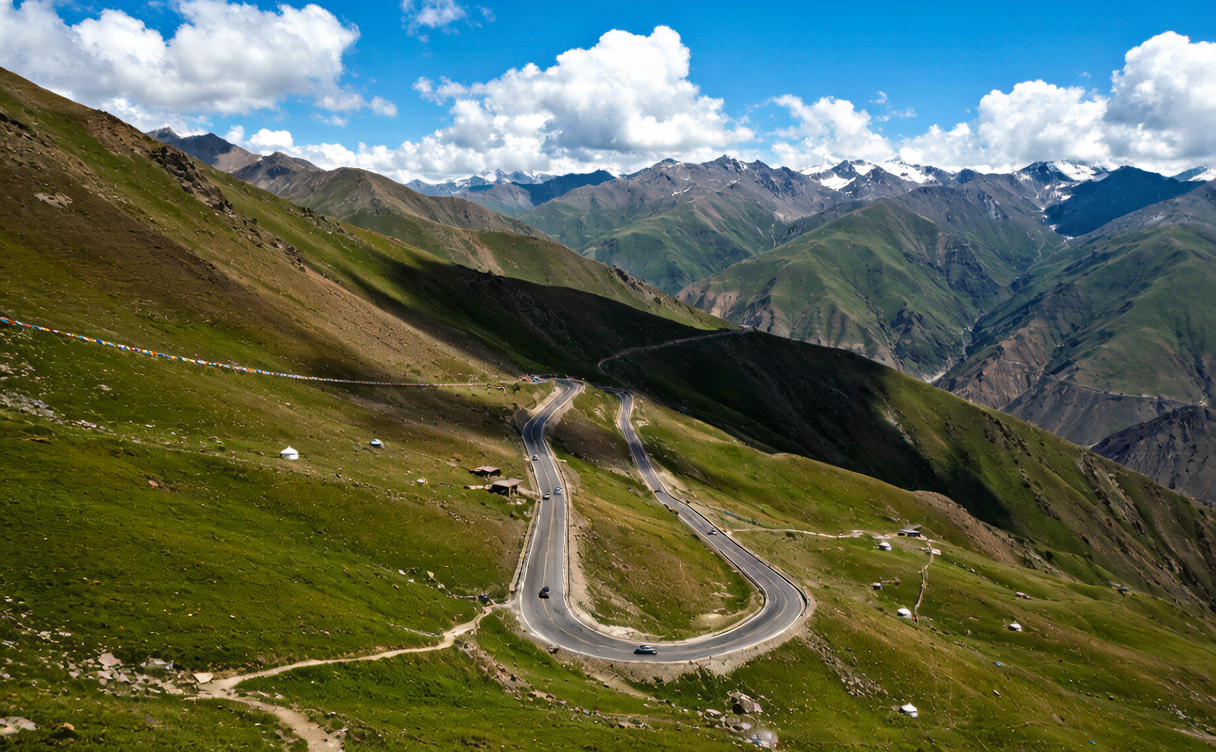
For strong riders wanting the trip of a lifetime, the Duku Highway across the Tianshan in Xinjiang, China, is a high alpine pass road opening only in summer, roughly June to September, and closed in winter by snow. It climbs through switchbacks, alpine meadows, and cloud-shadowed valleys over about 560 kilometers, and the views are unlike anywhere else in the country.
It is not for beginners. The passes top 3,000 meters, weather turns fast, and services are sparse, so you need self-sufficiency and a support plan. But if you have the legs and the timing, it is the ride people talk about for years. Our Duku Highway guide lays out the open season, the climb profile, and the supply points.
Bike rental for tourists in China
Now the practical half. “Bike rental for tourists in China” splits into two worlds: the shared dockless bikes in cities, and proper touring rentals in ride towns.
In any Chinese city, the shared bikes are everywhere and cost almost nothing for a short hop, but they are locked to urban areas and useless for a multi-day ride. For touring, you need a real shop. The good news: ride towns like Xining (for Qinghai Lake), Haikou (for Hainan), and Yangshuo all have bike shops that rent road and hybrid bikes by the day or week, often with helmets and basic repair kits.
The shared-city bikes are still worth having even if your main plan is a touring rental, because you will use them for errands in town. Download the app, link a payment method, and you have wheels for any spare hour.
Taking a bicycle on Chinese trains
The question that stops most plans: “can I take a bicycle on Chinese trains?” The answer is yes, with rules. High-speed trains generally do not allow full-size bikes unless boxed, but the slower conventional trains have a luggage area near the doors where a dismantled or front-wheel-off bike can travel, and some even allow boxed bikes in the baggage car.
The cleanest approach is to box your bike at a shop and use the checked-luggage service, or rent at the destination and skip the train-bike puzzle entirely. The train rules shift and station-staff interpretation shifts more, so confirm at the counter when you buy the ticket.
For travelers who would rather drive the support car than box a bike, renting a car and following your own ride with wheels is a common workaround on the flat loops.
Logistics that actually matter
A few things from experience. Carry a patch kit and a spare tube even if you rent, because shops thin out fast outside town. Download offline maps, the signal dies on remote passes. Bring a rear light and wear the vest, Chinese drivers do not expect bikes on rural roads and visibility is your friend. And book guesthouses a day ahead in peak season, because the lake and island loops fill up.
If you love the slow-travel side of China, swapping to trekking legs in the mountains once the legs tire pairs naturally with cycling, and many riders mix the two in a single trip.
The official word
For road conditions, seasonal closures, and tourist-standard information on the major scenic routes, the Ministry of Culture and Tourism of China is the official government portal and the safest place to confirm open seasons, especially for high-altitude roads like the Duku Highway that close on short notice with weather.
Wrapping up
A China cycling routes guide could list a hundred rides, but the truth is four or five are worth your limited days: Qinghai Lake for the intro tour, Hainan for the warm flat loop, Yangshuo for the easy joy ride, and the Duku Highway for the ambitious. Rent at the destination, respect the altitude, and let the trains handle the long hauls. Ride the right route for your legs and the trip will stick with you long after the saddle soreness fades.