

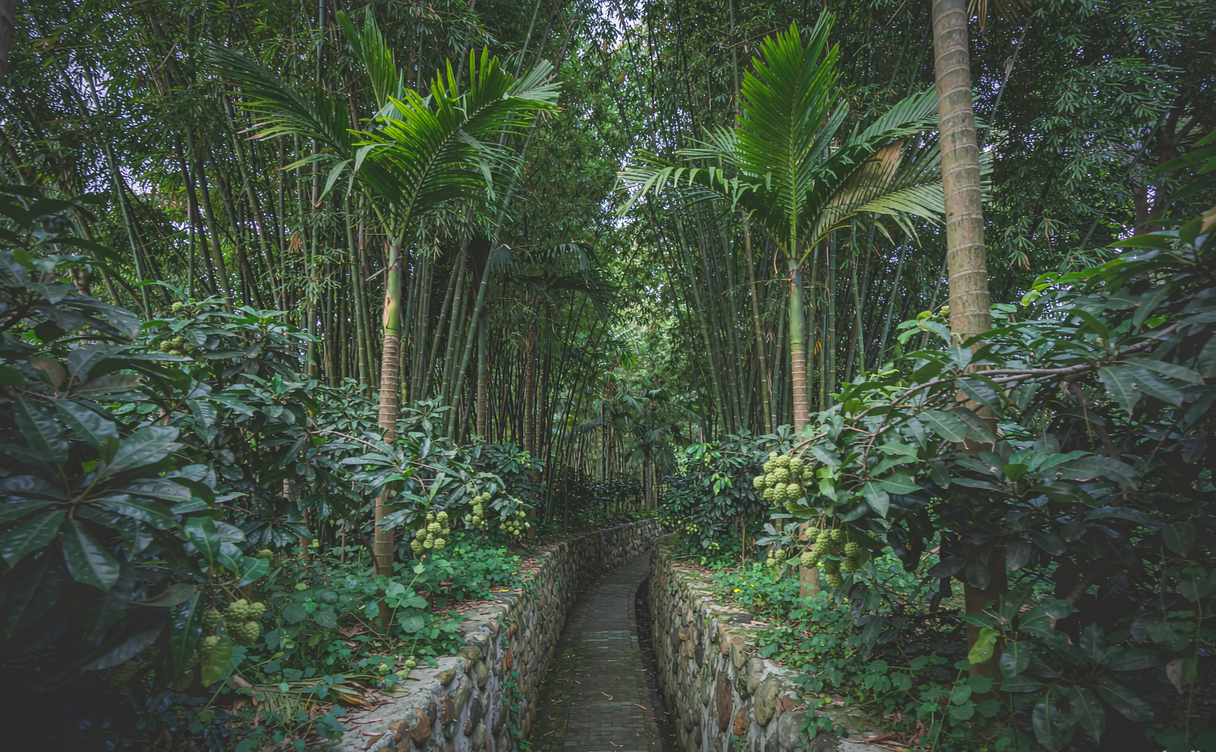
Binglanggu (槟榔谷) sits in the hills of Baoting Li and Miao Autonomous County, about 28 km northwest of Sanya on Hainan’s southern coast. Unlike the resort strips of Yalong Bay or the packaged temples closer to town, this valley is built around living Li and Miao communities, and that is exactly why we keep sending clients here when they want something deeper than a beach photo. The name literally means “Betel Nut Valley,” after the tall areca palms that still shade the paths, but the real draw is the culture. It is one of the few places in China where you can watch a Li woman spin cotton on a waist loom that has not changed in a thousand years, hear the Miao lusheng reed pipe in a hillside stockade, and eat a mountain meal cooked the way the villages actually cook it.
How to Get to Binglanggu
Most visitors arrive from Sanya. A standard taxi or Didi from Sanya city center runs 120–180 RMB one way and takes 40–60 minutes, depending on traffic on the G224 national road. We normally book a private car through our local operator for 380–450 RMB round trip with a two-hour wait, which removes the headache of finding a return ride in the late afternoon when drivers thin out. Public buses exist — the Sanya tourist line 27 and local routes toward Baoting — but they set you down at the highway entrance and you still tuk-tuk or walk the last 2 km, so we do not put first-timers with kids or camera bags on them.
If you are basing in Haikou instead, it is a longer haul: a high-speed train to Sanya (about 100–130 RMB, 1.5–2 hours) plus the transfer above. In our experience most people pair Binglanggu with a Sanya stay rather than a Haikou one, because the valley is a natural half-day add-on to a beach trip.
Binglanggu Tickets and What Is Bookable Now
As of this writing, the standard adult entry is 165 RMB, and it covers the main valley walk, the Li village houses, the Miao stockade, and the two scheduled indoor performances. Children under 1.2 m enter free; kids 1.2–1.4 m pay 95 RMB. There is a combined ticket with the off-road vehicle ride or the evening show that we have booked clients into for 238–268 RMB, and it is usually worth it if you plan to stay past 4 p.m.
You can buy at the gate, but we strongly recommend booking online through the official WeChat mini-program or major Chinese travel apps the night before. Same-day tickets sometimes hit a quota cap on holiday weekends — Spring Festival, May Day, and National Day — and a walk-up “sold out” is a real risk in peak season. Online tickets are typically 10–20 RMB cheaper than the counter and arrive as a QR code you scan at the turnstile.
Best Time to Visit Binglanggu
Hainan is tropical, so the valley stays green year-round, but the experience shifts by season. November through March is the sweet spot: daytime temperatures sit at a comfortable 22–28°C, humidity drops, and the outdoor weaving and dance demonstrations run on the full schedule. This is also high season for Sanya generally, so expect more coach tours mid-morning.
April to June gets hot (30–34°C) and sticky, with afternoon thunderstorms that can wash out the open-air shows. July to September is typhoon season; we have had to reroute two client groups in August when a storm closed the mountain road for half a day. If you come in summer, aim for a morning arrival before 10 a.m. For a quieter visit, we tell clients to arrive right at the 8:30 a.m. opening and be through the first Li village by 10, beating the bus groups that roll in around 10:30.
The Li Minority Experience
The Li (黎族) are Hainan’s largest indigenous group, and Binglanggu’s Gupan Li Village is the heart of the visit. The standout is the waist loom: a Li woman ties one end of the cotton thread to a post and the other around her back, then beats the weft with a wooden knife, leaning back to tension the cloth. The indigo-dyed brocade they produce, with its totemic patterns, is on national intangible heritage lists, and the technique has changed little in a thousand years. We have watched clients spend 30 minutes just watching one weaver’s hands.
There is also a long-house reconstruction where elders demonstrate rice-wine brewing, and a small museum of Li bronze drums and facial-tattoo photographs. The last tattooed Li women have mostly passed, which makes these images historically significant rather than decorative. A note on respect: photography of the elders is allowed in the demonstration areas but not in private family quarters — our guides remind clients of this before we enter.
For background on the people and their history, the Li people overview on Wikipedia is a useful primer before you go, and it helps you read the totems and patterns once you are inside the village.
The Miao Village and Performances
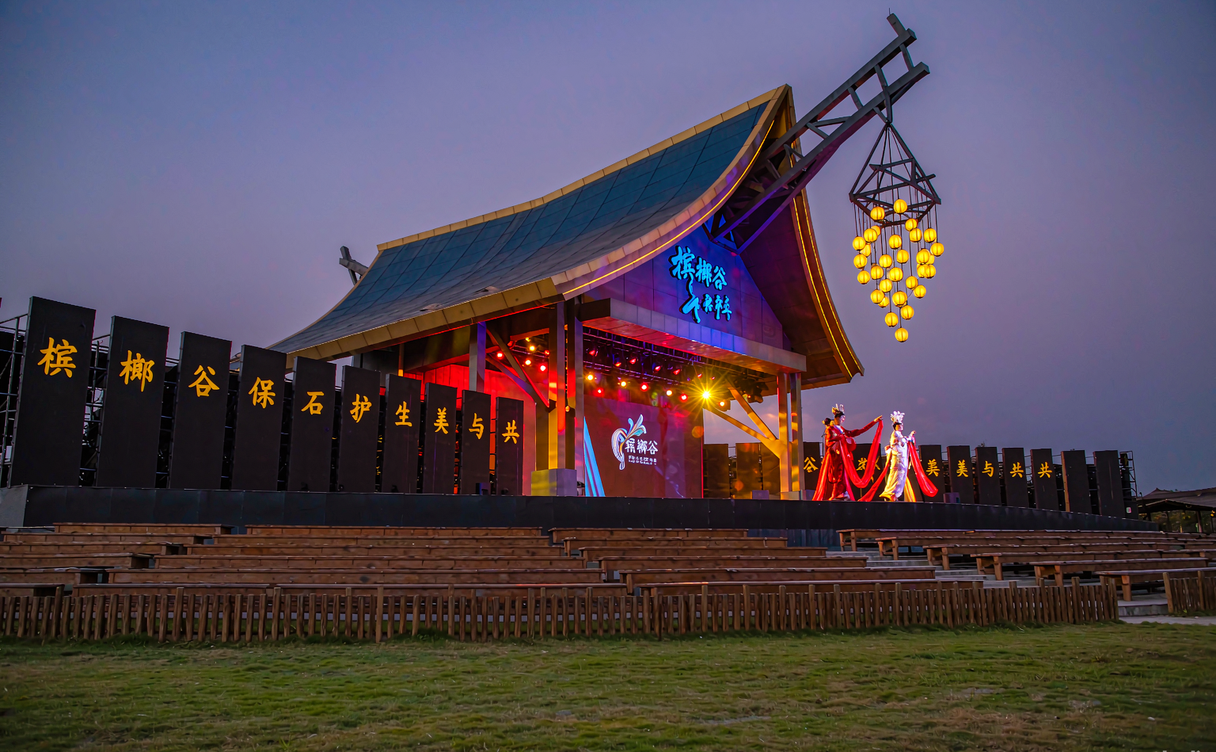
The Miao (苗族) section, called the Miao Village or San Yue San area, sits uphill and is built as a stilt-house stockade. The signature performance is the open-air dance show where Miao girls in silver headdresses spin in tight circles — the silver can weigh 5–8 kg and is real, not costume paste. Two shows run daily, roughly 11 a.m. and 3 p.m., each about 40 minutes; arrive 15 minutes early for a seat in the shade.
We have booked clients into the “Miao wedding” interactive segment where visitors get pulled on stage to “marry” a Miao girl — harmless fun, but we warn shy travelers to hang back. The lusheng pipe music that opens the show is genuinely good and, as far as we know, is recorded nowhere else on the island.
Food and Crafts to Try
The valley’s restaurants serve Hainan mountain cuisine: Wuzhishan five-finger tea, bamboo-tube rice (竹筒饭, 15–25 RMB a tube), Li-style grilled chicken with wild pepper, and sour fish soup. A set lunch at the cultural restaurant runs 68–98 RMB per person. For snacks, areca-nut candy and woven bookmarks (20–50 RMB) make easy souvenirs; hand-woven Li brocade scarves start around 180 RMB and climb quickly with size and pattern density.
Where to Stay Near Binglanggu
There is no international-chain hotel inside the valley. The closest comfortable options are in Baoting town, 15 minutes away, where clean business hotels like the Baoting Fulin Hotel run 220–360 RMB a night. Most of our clients, though, stay in Sanya and do Binglanggu as a half-day trip. It pairs naturally with a Guilin travel guide style of planning if you are stringing southern China together, or with a Guangzhou food guide stop on the way down. Resorts in Yalong Bay or Sanya Bay put you 30–50 minutes out but give you the beach at night, which most families prefer after a cultural day.
A Sample Half-Day Plan
- 8:30 a.m. — arrive at opening, show your e-ticket, walk the betel-nut path to Gupan Li Village.
- 9:00–10:15 a.m. — Li waist-loom demo, bronze drum museum, rice-wine tasting.
- 10:30–11:15 a.m. — Miao village walk and the 11 a.m. performance.
- 11:30 a.m.–12:30 p.m. — lunch at the cultural restaurant (book the set menu ahead in peak season).
- 1:00 p.m. — optional off-road vehicle ride or evening-show upgrade, then transfer back to Sanya.
Practical Tips We Give Every Client
- Wear closed shoes; the path is paved but the village areas have gravel and steps.
- Bring cash (100–200 RMB) for small craft purchases — some stalls still do not take cards reliably.
- The valley is large; a full relaxed visit is 4–5 hours, not 90 minutes.
- Mornings are cooler and less crowded; if you only have half a day, spend it before noon.
- Combine this with coastal stops like Xiamen only if you are building a multi-city China loop, since Xiamen is far up the coast from Hainan.
Booking Through Us
We handle the Sanya transfer, the timed tickets, and a Mandarin- or English-speaking guide who knows the weavers by name. In our experience the difference between a rushed gate photo and a real conversation with a Li elder comes down to timing and a guide who is welcomed in the village, not just licensed for it. Tell us your Sanya hotel and we will slot Binglanggu into a morning that leaves your afternoon free for the beach.