

I still remember the moment I stepped through the first gate of Prince Gong’s Mansion and the noise of Beijing seemed to switch off. One second I was on a busy hutong street near Shichahai; the next I was standing in a courtyard where the only sounds were my own footsteps on grey brick and the distant clack of a bamboo rake. For a foreign visitor, this is one of the easiest “wow” experiences in the city — a vast, intact Qing-dynasty princely residence that most guidebooks barely mention, tucked just north of the Forbidden City.
Prince Gong’s Mansion (恭王府, Gongwangfu) is the largest and best-preserved princely residence from the Qing dynasty still standing in Beijing. It covers about 60,000 square meters, with more than thirty buildings arranged along strict central axes, and a private garden at the back that feels like a smaller, more intimate version of an imperial park. I came expecting a quick stop and left two and a half hours later, slightly dazed, with a phone full of photos and a new appreciation for how the other half of Qing society lived.
Getting There
The mansion sits in the Shichahai area, in Xicheng District, at No. 14 Qianhai West Street. The nearest subway station is Beihai North (Line 6); take Exit B and walk about ten minutes south past the drum-tower crowds and the lakeside willow trees. I actually arrived from the north, drifting down from the hutongs, and that approach is half the fun — you pass tiny noodle shops and quiet alleyways before the mansion wall suddenly appears.
If you are building a first day in the city, you can pair this with a stroll through the surrounding lanes. My own plan started at the Beijing hutongs walking guide and ended here, which made the contrast between humble alley homes and aristocratic grandeur feel deliberate. Taxis and ride-hailing drop you within a five-minute walk, but on weekends the narrow streets clog up, so the subway is the safer bet. Aim to arrive right at the 8:30 opening if you want the courtyards to yourself.
What to See
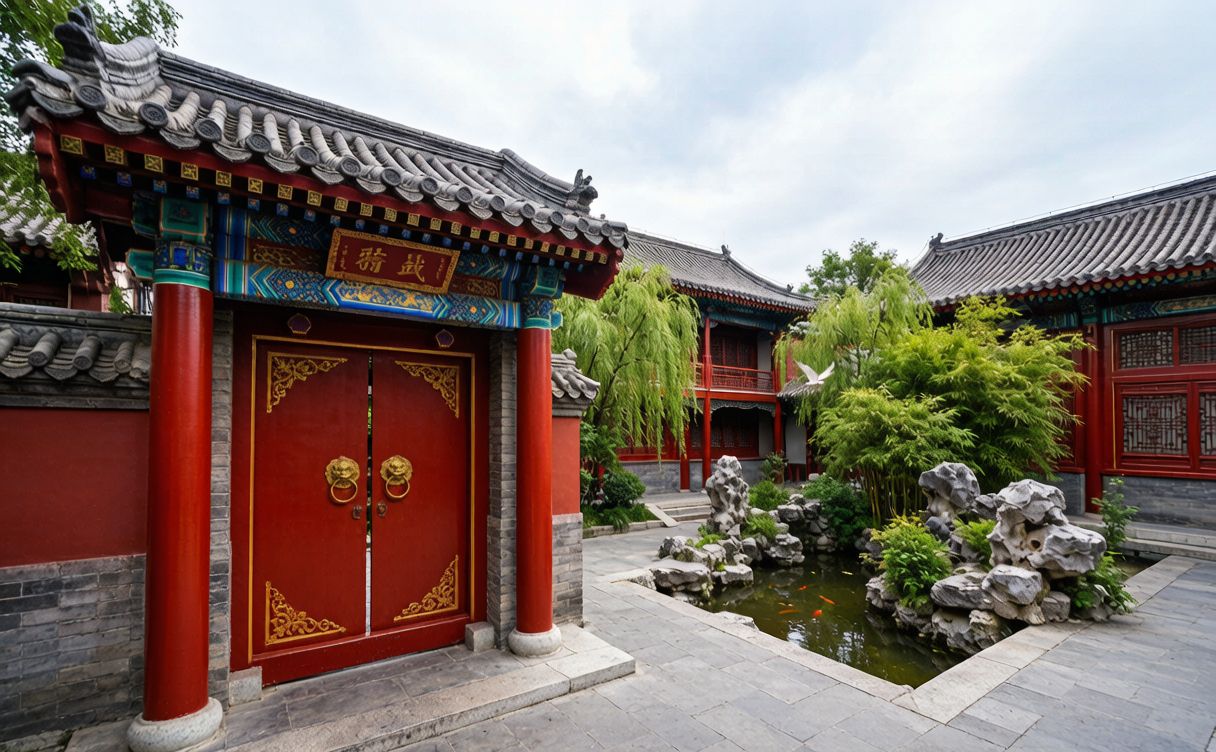
The residence is laid out in two parts. The front, formal section is a sequence of courtyards leading to the main reception halls, built on the kind of strict north-south axis you see at the Forbidden City. The first hall, the “Bao Guang Shi,” holds displays on the mansion’s history. The second and third courtyards are the most photogenic — long covered walkways, carved stone drums flanking the steps, and the kind of heavy timber beams that have survived two centuries of Beijing winters.
A personal favorite detail: the Western-style gate, a small stone arch modeled on European garden follies, built in the 19th century when Qing aristocrats had caught a taste for the exotic. It sits oddly but charmingly next to the thoroughly Chinese halls. I spent a good ten minutes just watching how the light fell across its worn masonry.
The back section belonged to the last great private owner, the notorious statesman Heshen, and later Prince Gong, after whom the estate is named. The furnishings are largely reconstructions, but the architecture — the proportions, the bracket sets, the brickwork — is the real thing. Take time in the study rooms and the opera pavilion; imagine a winter evening in the 1800s with singers performing for a prince who, technically, was not allowed to build anything this grand.
The Garden
This is the heart of the visit, and the reason I tell fellow travelers not to skip it. The garden, called Cuijin Garden (萃锦园), is a compact masterpiece of Qing landscape design: artificial hills, a winding stream, rockeries, and a two-story pavilion perched to catch the breeze off the lake. There is a famous bat motif — the Chinese word for bat, “fu,” sounds like the word for good fortune — repeated across screens, carvings, and roof tiles. I counted at least a dozen bats before I gave up.
A legend connects the site to the novel “Dream of the Red Chamber” (红楼梦). Local tradition holds that the garden’s layout and mood inspired, or at least echo, the fictional Grand View Garden where the novel’s young characters wander. Whether or not you buy the literary link, the atmosphere is unmistakable: enclosed, lush, slightly melancholy. I found a bench by the stream, sat for twenty minutes, and watched tour groups dissolve into the greenery. For a few quiet moments it was easy to believe I had slipped into someone else’s century.
Don’t miss the underground vault room near the garden’s north edge — a windowless stone chamber where Heshen supposedly stashed his fortune. It is cool, dim, and a little eerie, a neat counterpoint to the open, sunlit courtyards.
Tips
Buy your ticket online in advance through the official platform or a major Chinese travel app; same-day tickets sell out on weekends and holidays. Bring your passport — entry is by ID match. Wear comfortable shoes; the ground is uneven brick and stone, and you will walk a lot.
Go early. I cannot stress this enough. The first hour belongs to you; by late morning the main halls echo with guided groups. If you want photographs without strangers in every frame, the opening bell is your friend. Audio guides are available, and a few foreign-language panels exist, but I found the free paper map (ask at the desk) more useful for orienting myself between courtyards.
Give yourself at least two hours. Rushing this one is a mistake — the pleasures are small and slow. And if you get peckish, step back out to the surrounding Nanluoguxiang area for snacks afterward rather than eating inside.
Best Time
Spring and autumn are ideal. In April and May the garden’s trees flush green and the light is soft; in September and October the air is clear and the summer crowds have thinned. I visited in late October and the ginkgo outside the western wall had turned gold, which framed the grey roofs beautifully.
Summer is workable if you go at opening and retreat by midday — Beijing’s July humidity is no joke, and the courtyards offer little shade. Winter is my secret recommendation: cold, yes, but empty, and the bare branches and pale sky make the architecture read with unusual clarity. Snow turns the place into a woodblock print.
Good to Know
The mansion is fully wheelchair accessible on the main courtyard routes, though the garden’s stone paths are bumpy. Restrooms are clean and located near the entrance and the garden exit. Photography is allowed everywhere except in a couple of small exhibit rooms; drones are forbidden. There is a gift shop by the exit selling Beijing snacks and trinkets, but prices are tourist-level.
If you want broader context on the city or the country before you go, the Beijing first-time travel guide and the China travel guide for first-timers are good starting points. For official opening hours, ticket prices, and any seasonal closures, check the Beijing Government site before you travel.
I left Prince Gong’s Mansion the way I imagine its owners once did — through a side gate, back into the hum of the hutongs, secretly glad that something this private had been opened to the rest of us. If you are in Beijing for more than two days, this is the quiet gem worth carving out an morning for.