

The first time I stood in the Muslim Quarter of Xi’an, Shaanxi, China, the air was thick with the slap of a rolling pin against dough — biang, biang, biang. That rhythmic clap is the heartbeat of Shaanxi cuisine, and it pulled me back to this northwestern province three times in two years. Any honest Shaanxi food guide has to start right there: the cooking of Shaanxi is wheat-based, unapologetically garlicky, and built for cold winters and hot, dry summers along the old Silk Road.
Biangbiang noodles are the province’s most famous dish, even if most travelers cannot write the 58-stroke character that names them. These are hand-pulled belt noodles about three centimeters wide, served in a chili-oil gravy with crushed garlic, scallions, and a final tableside pour of sizzling oil that crackles as it lands. In Xi’an I paid RMB 18–32 for a full bowl at neighborhood shops, while restaurants near the Bell Tower charged RMB 38–45. The best Shaanxi biangbiang noodles I ate cost RMB 22 at a cramped Beilin-district shop where the only English on the wall was a hand-drawn noodle and the words “eat, pay, go.” Watch the cook stretch the dough: a proper biangbiang is slapped against the board to expel air, then yanked into a single unbroken ribbon that can be longer than your forearm.
Roujiamo is the Shaanxi answer to a sandwich, and locals call it “the Chinese hamburger.” Minced braised pork — or halal beef in the Muslim Quarter — is stuffed into a baiji mo flatbread baked in a clay oven until it shatters when you bite. A proper roujiamo in Xi’an runs RMB 12–18 for pork and RMB 15–22 for beef. I learned to ask for la (spicy) and extra coriander; the filling should be fatty and unctuous, never dry. At the popular Fanji and Ruixheng stalls you can expect a 10–15 minute queue at peak, but the sandwich vanishes in three bites and tastes of every one of them. On my last trip the vendor laughed and added a second spoon of fat without being asked — that is the Shaanxi way.
Beyond the headliners, Shaanxi cuisine rewards the curious. Yangrou paomo — a mutton broth you break flatbread into yourself before the cook simmers it — is a Xi’an breakfast ritual at RMB 28–45. Cold-skin noodles, liangpi, dressed in black vinegar, garlic water, and chili oil, are the province’s summer salvation at RMB 8–14. And guantang baozi, soup dumplings, fill late-night gaps for RMB 20–30 a steamer. On my second trip I joined a cooking class near the city wall where the chef explained that Shaanxi’s position on the Silk Road explains its cumin, its lamb, and its love of acid — flavors you rarely taste farther south in China.
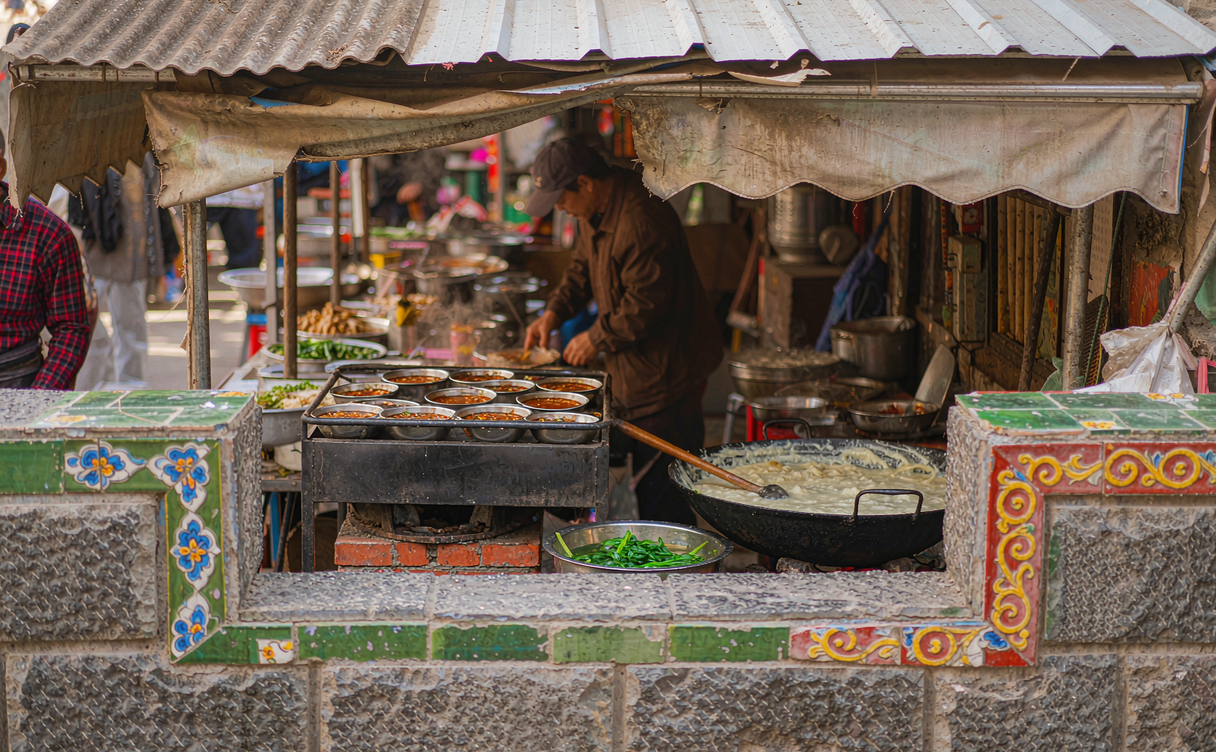
Regional variety surprised me most. The Guanzhong plain around Xi’an eats wide wheat noodles and mutton; northern Shaanxi, toward Yan’an, leans on 糜子 (proso millet) and sour preserved vegetables, with hearty zenggao steamed cakes; while southern Shaanxi, against the Qinling mountains, borrows rice and pickles from neighboring Hubei and Sichuan. If you only eat in Xi’an you miss that gradient, so I built a slow loop through the province rather than flying in and out.
Where should you actually eat? The Muslim Quarter (Huimin Jie) is loud, photogenic, and tourist-tuned, but it is also genuinely halal and historically the real deal. For a calmer, cheaper meal I preferred the lanes off Wenchang Gate and the morning market near the Small Wild Goose Pagoda, where RMB 6 bought a jiani mo you will not find in most guidebooks. If you are pairing this stop with our Beijing–Xi’an–Chengdu itinerary, keep at least two full evenings free in Xi’an for grazing rather than sit-down dinners.
Getting to Shaanxi, China is straightforward. The high-speed train from Beijing to Xi’an takes about 4.5–5.5 hours and costs RMB 515.5 second class; Shanghai to Xi’an runs 6–7 hours for RMB 669.5. Flights into Xi’an Xianyang International are plentiful, but trains spare you the airport commute and the security lines. The best Shaanxi dishes change with the season — spring brings fresh wheat noodles, autumn the fattest lamb — yet I would avoid the January cold (down to -5°C) for street eating and aim for April–June or September–October. Booking is rarely needed for street food; at the popular “Mr. Biangbiang” chains you can walk in, though weekends after 7pm mean a 20-minute wait.
A Shaanxi food guide is incomplete without day trips. From Xi’an the Terracotta Army is the obvious excursion (RMB 120 ticket, one hour by bus tour), but food lovers should also ride the high-speed line 30 minutes to Huashan foothill towns for shan zhen wild-vegetable stir-fries. For a wider lens on what else to fold into a Shaanxi stop, our best things to do in China overview lists the province’s Silk Road sites alongside its kitchens. I once detoured to Tongchuan for a bowl of noodle with locally pressed sesame oil that I have not found in the capital since.
Drinks matter here too. Skip the international soda and order a 冰峰 (Bingfeng), the local orange fizz that costs RMB 4 and tastes like childhood to every Xi’an native, or a glass of pomegranate juice (RMB 10–15) pressed at market stalls from the fruit grown in the Lintong orchards near the Terracotta site. Evening tea houses around the city wall serve fu cha (brick tea) for RMB 20 a pot, a warming end to a garlic-heavy day. Vegetarians should note that many broths use chicken powder or lard, so ask youqingzhen ma (is it halal/pure) and point at the vegetable dishes.
One mistake I made on trip one still makes me laugh: I ordered “duck” at a stall that turned out to be a fried tofu impersonator because I misread a single character. Since then I point at the dish on a neighbor’s table rather than trust my tones. Another tip worth repeating — the Muslim Quarter’s “free tea” invitations near the mosque almost always end in a sales pitch for jade, so a polite smile and a walk-on costs you nothing and teaches you plenty.
Budget-wise, a food-focused day in Xi’an costs me about RMB 90–140: RMB 22 noodles, RMB 15 roujiamo, RMB 30 paomo, plus RMB 20–40 in snacks and milk tea. First-timers will find our first-timer China travel guide useful for payment apps and ordering without Mandarin — Alipay’s tourist wallet let me scan and pay at stalls that had no English menu at all.
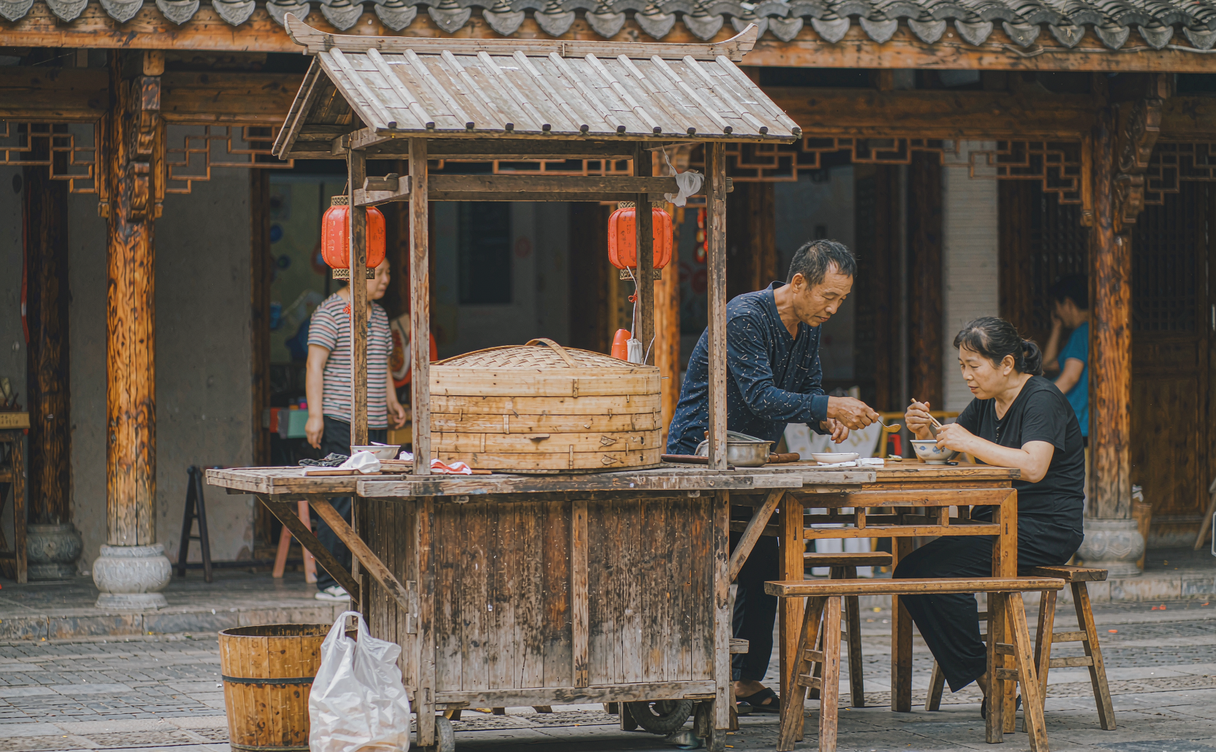
To sum up this Xi’an food guide: the best Shaanxi dishes share a rebellious confidence — wide noodles, sharp vinegar, meat that does not apologize. Shaanxi cuisine is wheat-country cooking shaped by nomads and traders, and eating your way through it is the fastest way to understand the province. The autumn window I keep returning for is short and sweet, bracketed by the summer heat and the winter chill, and it is when the lamb and the noodles taste most like home to the people who live here.
If you want the deeper history of the region’s flavors, the encyclopedia entry on Shaanxi cuisine at Wikipedia traces the noodle traditions back to the Han dynasty. For me, no article replaces standing in that noisy quarter watching dough become dinner in three slaps. Pack an empty stomach and a translation app — Shaanxi, China will feed you well, and a slow evening of street grazing beats any single restaurant you could name.