

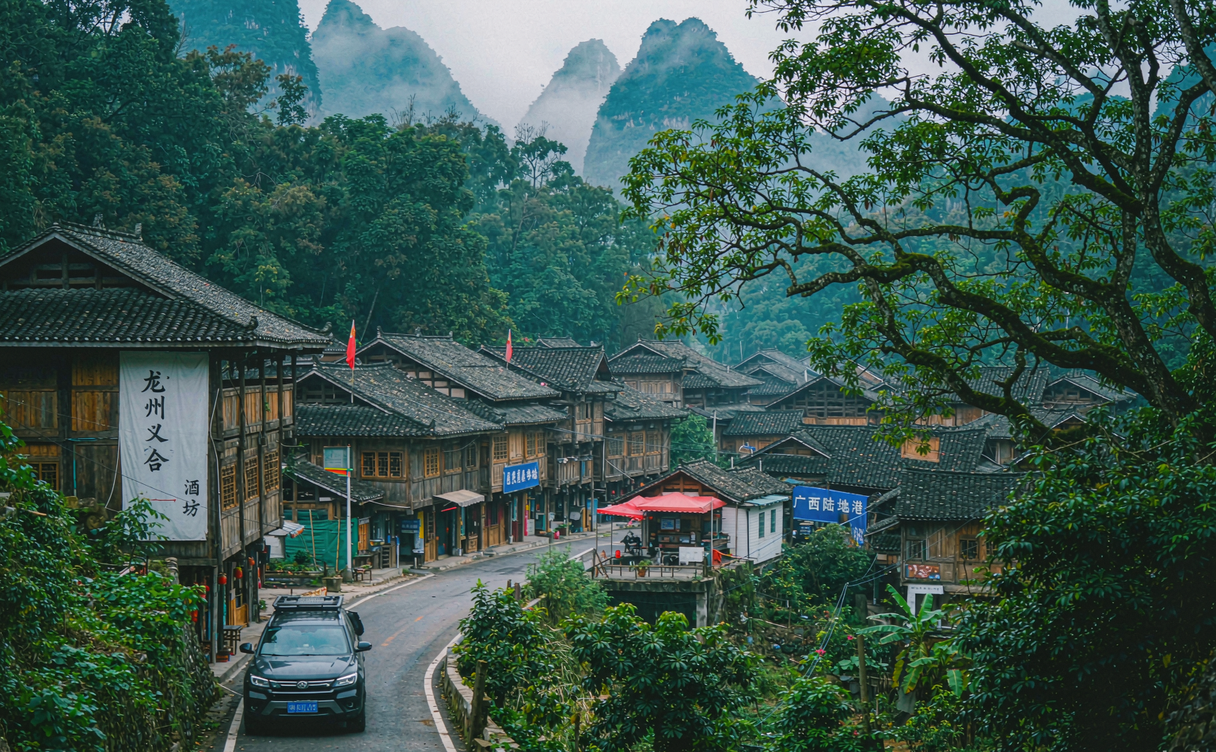
On the far western edge of Guangxi, where the Zuojiang River curls toward the Vietnam border, Longzhou is a sleepy county that guards one of China’s most astonishing open-air galleries. We first came for the Huashan rock art and stayed for the slower rhythms of a border town: French-colonial remnants, a Qing-dynasty hill fortress, and markets where the goods and the accents drift in from across the frontier. On our last visit, a boatman on the Zuojiang pointed up at a 2,000-year-old red figure painted on a sheer cliff and said, simply, “nobody knows how they got up there,” and that mystery is the whole pull of the place.
This guide covers when to go, how to reach this remote corner, what to see, and how to weave Longzhou into a broader Guangxi route.
When is the best time to visit Longzhou
The best time to visit Longzhou is autumn, from October to November, and spring, from March to April. These months bring comfortable temperatures, clear skies, and, crucially, manageable water levels on the Zuojiang River, which matter because the rock art is best seen from a boat. We avoid the summer rainy season, May through September, when heavy storms can swell the river, cancel cruises, and turn the border-region roads slick.
Winter is mild and quiet, good for the fortress and old town without crowds, though the river cruise can feel chilly in the wind. Whenever you come, bring sun protection and insect repellent; the riverside vegetation is lush and the midges are enthusiastic by late afternoon. Locals told us the clearest light for photographing the cliff paintings is the hour after sunrise, when the red pigment reads strongest against the rock, and our own shots confirm it.
How to get to Longzhou
Working out how to get to Longzhou takes a little planning, because the county has no airport and sits well off the main tourist trail. The nearest airport is Nanning, about a three hour drive. The game-changer is the high-speed railway to Chongzuo, which put the region within roughly one hour of Nanning; from Chongzuo station you take a hired car or a local bus for the final 60 to 90 minutes into Longzhou.
If you prefer road travel, long-distance buses run from Nanning to Longzhou in about 3.5 hours and cost roughly 70 to 100 yuan. We have also routed clients from Guilin via Nanning, a longer but scenic drive of around five hours that pairs naturally with the Li River. Once in Longzhou, distances between the rock art sites, the fortress, and the border port are best covered by private car, since rural buses are sparse and the boat piers are spread along the river. Arrange your driver the day before, because on-the-spot hiring is unreliable out here.
Things to do in Longzhou
The honest answer to what are the best things to do in Longzhou is: slow down and look up. The headline experience is the Zuojiang cruise to the Huashan rock art, a two to three hour boat trip past karst walls striped with ancient red figures of dancers, warriors, and frogs. The paintings stretch for kilometers along the cliff lines, and the boat stops at viewing points where you can study them up close. A second must-see is Xiaoliancheng, a Qing-dynasty chain of fortifications and pavilions built on a ridge just outside town to defend against French and border incursions; the walk up rewards you with sweeping views over the valley.
Back in town, the old quarter still shows traces of the early-20th-century French presence, including a restored customs building and a short stretch of broad, tree-lined road that feels out of place this far west. We spent a happy evening at a riverside grill sampling river shrimp and sour bamboo shoots while a group of old men played cards under a single bulb. None of this is on a typical China checklist, and that is precisely why we like it.
The Longzhou Huashan rock art
The Longzhou Huashan rock art is the local face of a much larger treasure: the Zuojiang Huashan Rock Art Cultural Landscape, which UNESCO inscribed as a World Heritage site in 2016. The figures were painted with red ochre, probably between 2,000 and 2,500 years ago, by the Luo Yue people, ancestors of today’s Zhuang communities. Nobody is certain how painters reached the sheer cliffs above the flood line, which only deepens the site’s hold on visitors.
We recommend taking the official cruise rather than trying to view the art from land, because the best panels sit directly above the water and are invisible from the road. Tickets for the boat, including site access, usually run 80 to 120 yuan. Go early, sit on the open deck, and bring a zoom lens; the boat moves slowly but never stops for long at each panel. For the wider picture of protected sites across the country, see our separate China UNESCO World Heritage guide for where else to see inscribed landscapes on the same trip.
The Longzhou Vietnam border
A defining feature of the county is the Longzhou Vietnam border, since Longzhou sits directly against Vietnam’s Cao Bang province, with the Shuikou land port handling cross-border trade. The border gives the town its mongrel character: Vietnamese coffee, fabrics, and snacks turn up in the markets, and you will hear a different rhythm to daily life than in inland Guangxi. We found the border-region food, a blend of Zhuang and Vietnamese flavors, to be a quiet highlight.
An honest travel note: you cannot simply wander across at Shuikou without the correct visa and paperwork, and crossing procedures change, so treat the border as a cultural backdrop rather than a day trip unless you have arranged documents in advance. If a Vietnam extension interests you, plan it through official channels in Nanning before you arrive. Our Guangxi cuisine guide digs deeper into the cross-border dishes worth seeking out while you are here.
Where to stay and what it costs
Longzhou is inexpensive and unhurried. The county town has clean business hotels in the 180 to 350 yuan range and a few riverside guesthouses at 150 to 280 yuan. We usually book one night in town and use it as a base for the rock art cruise and the fortress, then move on toward Detian or Chongzuo. A realistic daily budget for two, with the cruise, a driver, meals, and a mid-range room, lands around 500 to 900 yuan.
The cruise and the fortress are the main ticketed items; meals and transport are cheap. Mobile payment is standard, so set up Alipay or WeChat Pay, though carry some cash for the small border-market stalls. The town shuts early, so eat dinner before 8 p.m. or you will be limited to late-night noodle stands, which, to be fair, are excellent.
A Longzhou travel itinerary
Here is the Longzhou travel itinerary we suggest, built for two days with an optional waterfall extension. Day one: arrive from Chongzuo or Nanning, check in, and climb Xiaoliancheng for the sunset ridge view, then dinner in the old quarter. Day two: an early Zuojiang cruise to the Huashan rock art, an afternoon in the old town and border market, and an evening transfer toward Detian.
For a richer trip, add a third day at the Detian Waterfall, reachable in about two hours, which our Detian Waterfall guide covers in detail. Travelers flying in or out can use our Nanning travel guide and our Beihai travel guide as regional gateways.
Longzhou rewards the curious traveler who steps off the Guilin- Yangshuo conveyor belt. For background on the rock art and its heritage status, see the overview at Zuojiang Huashan Rock Art on Wikipedia. We have sent history buffs and photographers here and watched them fall quiet in front of those ancient red figures, which is the rarest and best compliment a destination can earn.