

Why Mount Tai Still Tops Our Shandong List
Of all the peaks we route travelers to in eastern China, Mount Tai (Tai Shan) in Tai’an, Shandong, is the one we recommend most often to first-time visitors who want a single, unforgettable day in the mountains. It is the eastern peak of China’s Five Great Mountains, a working UNESCO World Heritage Site since 1987, and the only one of the five with a real summit town, a cable car, and a sunrise crowd that shows up in every season. We have sent solo hikers, families with teenagers, and older couples who only wanted the cable car up and a slow walk down. This Mount Tai guide is built from those trips: the routes that actually save your knees, what the tickets cost right now, and how to time the sunrise without sleeping on a cold rock.
The main summit, Yuhuang Ding (Jade Emperor Peak), sits at 1,545 meters. That is not tall by Himalayan standards, but the climb from the Red Gate entrance gains nearly 1,400 meters on stone steps, and the sense of standing above the North China Plain at dawn is the reason emperors came here for 3,000 years.
How to Get to Tai’an and the Mountain Gates
Almost everyone arrives by high-speed rail. Tai’an Station (泰安站) is on the Beijing–Shanghai line. From Beijing South, a G-train takes about 2 hours and costs ¥214–314 in second class depending on the train. From Shanghai Hongqiao it is about 3.5 hours and ¥414–520. From Jinan, the provincial capital, it is a quick 20–35 minutes and ¥30–55, which makes Mount Tai an easy half-day add-on to a Shandong trip.
There are three entry gates, and picking the right one matters:
- Hongmen (Red Gate) — the classic pedestrian start at the foot of the mountain, inside the old city. Best if you are here to hike.
- Tianwai Cun (Outside-the-World Village) — a transfer center 3 km west where shuttle buses leave for the mid-mountain cable car. Best if you want to ride partway.
- Taohuayu (Peach Blossom Valley) — the western gate with a quieter shuttle and cable car. Best for avoiding crowds.
From Tai’an Station, a taxi to Hongmen runs ¥30–45 and about 25 minutes. A taxi to Tianwai Cun is ¥40–55. The local bus 39 or K39 also runs from the station area to the mountain for ¥2, but with luggage the taxi is worth it. If you are building a longer China loop, our Great Wall of China guide pairs well with Tai’an because both reward an early start and good shoes.
How to Climb Mount Tai: The Three Realistic Routes
When travelers ask us how to climb Mount Tai, we give them three options and let fitness decide.
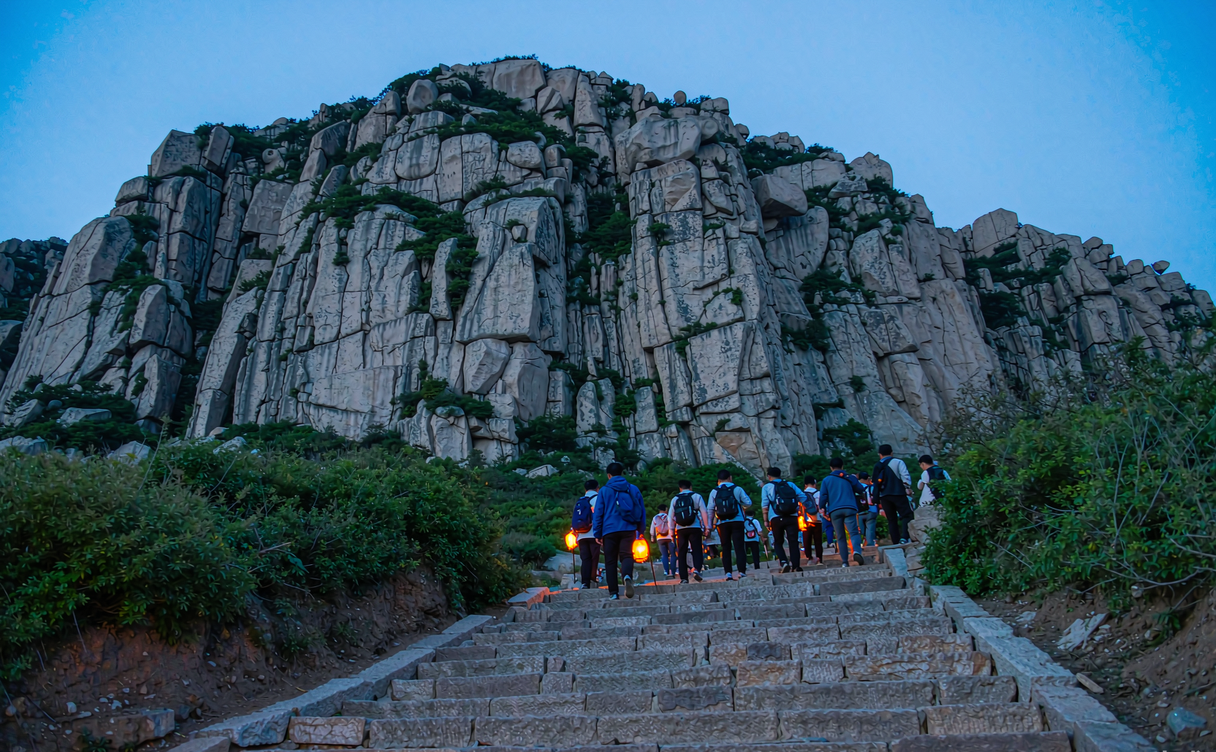
1. Full hike via Hongmen — about 7,000 steps and 9 km of paved path to the summit, roughly 4–6 hours at a steady pace. The path passes the Midway Gate to Heaven (Zhongtianmen) at the 3 km mark, where you can bail out to the cable car. This is the route we put energetic hikers on, and it is the only one that feels like a pilgrimage rather than a commute.
2. Shuttle plus cable car — take the shuttle from Tianwai Cun to Zhongtianmen (about 15 minutes, winding road), then the cable car to Nantianmen (South Gate to Heaven), about 8 minutes. This cuts the climb to under an hour of actual ascent and suits families and older travelers.
3. Western quiet route — shuttle from Taohuayu to the Halfway Pavilion, then cable car up. Fewer people, same summit. We suggest this on weekends and holidays.
Whichever you choose, the last stretch above Nantianmen is a steep stone ramp shared by everyone, so the cable car does not spare you the final puff. Mount Tai hiking is more stairmaster than trail, and trekking poles help.
Mount Tai Tickets, Shuttle and Cable Car Prices
These are the 2026 published rates, in RMB:
- Mount Tai tickets: ¥115 (peak season, roughly February–November); ¥100 (winter, December–January). A ¥2 accident insurance is optional at the gate.
- Dai Temple (Daimiao) at the foot, where the emperors prayed: ¥20–30 separate ticket; worth 60–90 minutes if you care about the history.
- Shuttle bus to Zhongtianmen (Tianwai Cun): ¥30 one way. To Halfway Pavilion (Taohuayu): ¥35 one way.
- Cable car Zhongtianmen–Nantianmen: ¥100 one way, ¥200 round trip.
Buy at the gate or through the official “泰山景区” mini-program; foreign cards are hit-or-miss on the app, so carry some cash and a Chinese payment app as backup. There is no separate “sunrise ticket” — your day ticket covers the whole mountain, but if you stay on the summit past the 5 p.m. closing you need a valid next-day ticket or a summit hotel booking. For context on regional food costs after the hike, our Qingdao seafood guide shows what a coastal Shandong meal runs.
Where to Watch the Mount Tai Sunrise
The payoff is the sunrise, and the two best spots are Yuhuang Ding (the very top) and Riguan Feng (Sun-Viewing Peak), a short walk east of the summit with a dedicated viewing terrace. Sunrise time swings with the season: around 4:50 a.m. in late June, about 7:10 a.m. in early January. Check the exact time the day before on the park board or weather app.
You have two ways to be there for first light:
- Overnight on the summit — book a summit hotel (¥600–1,200 for a standard room, more on holidays) and walk out at 4 a.m. This is what we arrange for clients who hate night hiking.
- Night hike — start from Hongmen around midnight to 2 a.m. and reach the top by 4:30 a.m. Headlamps are essential and the upper steps get slick. This is the classic Mount Tai sunrise experience and costs nothing extra beyond effort.
Either way, bring a windproof layer; the summit drops near freezing even in April and October, and the wind at Riguan Feng is no joke.
Best Time to Visit Mount Tai
The best time to visit Mount Tai is mid-April to May and September to mid-October. Skies are clear, the steps are dry, and the temperature at the top stays above freezing at night. We actively steer clients away from two windows: the National Day holiday (October 1–7) and Labor Day (May 1–5), when the staircases become human traffic jams and summit hotels triple in price. Winter (December–February) is cold, sometimes snowed-in, but stunning and nearly empty — good for photographers who pack crampons and check the road status first.
What to Book and How We Help
Most of this is bookable now: high-speed rail tickets open 15 days ahead on 12306, summit hotels open a few weeks out, and the cable car runs year-round except in ice storms. We typically lock rail and hotel first, then decide the route by weather two days before. If you want a calmer alternative after Tai’an, our Guilin travel guide covers karst cruises that are the opposite of a stair climb, and the best hotels in Suzhou are an easy high-speed hop west for gardens and canals.
You can read the broader cultural background on the Mount Tai (Wikipedia) page, which explains the imperial sacrifice tradition that shaped every step you will walk.