

Our Qinghai Lake guide starts with a warning we give every client: this is the largest lake in China, and at 3,200 meters above sea level it will take your breath away in both senses. Qinghai Lake, Qinghai, China sits on the northeastern edge of the Tibetan Plateau, ringed by snow-streaked mountains and seasonal grasslands that turn purple with blanket flower in July. On our last trip we pulled over on the southern shore so a family could watch a thousand migratory birds lift off at once, and none of us reached for a camera fast enough — some things you just stand and take in.
How to get to Qinghai Lake
Xining, the provincial capital, is the base. Xining Caojiabao Airport (XNN) has flights from Beijing, Xi’an, Chengdu, and Lhasa, and the high-speed train from Lanzhou to Xining takes about 1.5 hours (RMB 90). From Xining, Qinghai Lake is 150 kilometers southeast; a private car with driver runs RMB 600–900 for a day trip, and the cheaper option is the tourist shuttle bus from Xining Bus Station to Heimahe or Erlangjian (RMB 60–90 one way, about 3 hours).
If you are already planning a loop, our Qinghai–Gansu loop itinerary strings the lake together with Zhangye Danxia and Dunhuang across 7–10 days. We’ve sent cyclists who flew into Xining, spent a night acclimatizing, and then rode the lake loop — but they trained for the altitude first, which we insist on.
Things to do at Qinghai Lake
The lake has several entry areas, each with its own feel. Erlangjian is the main developed scenic zone on the southern shore, with a ticket of RMB 90 plus RMB 100 for the shuttle bus inside; it has boardwalks, a lake cruise (RMB 140), and the clearest water for photos. Heimahe, further west, is the classic sunrise spot where the lake meets the mountains, and it is free to access the shore road though the nearby teahouses charge for a seat.
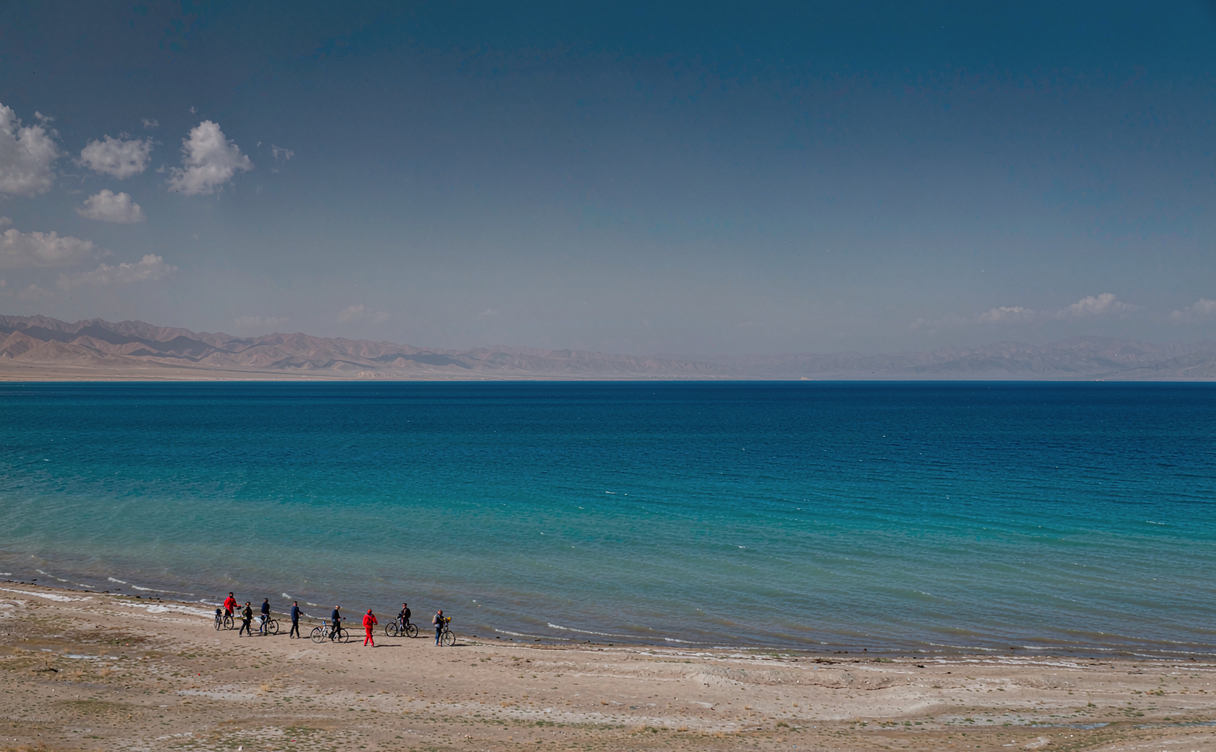
Qinghai Lake cycling is the activity that defines the place for many visitors. The 360-kilometer ring road is paved and mostly flat, and every July the lake hosts a major international cycling race. We rent road bikes in Xining for RMB 80–150 a day and recommend the two- to three-day loop from Heimahe clockwise to Gangca; support vehicles can carry your bags for RMB 400–600 a day if you don’t want to camp. On our last trip a client who had never ridden more than 20 kilometers managed 70 in a day because the wind at his back and the view ahead made the pedaling disappear.
Bird Island used to be the headline wildlife stop, but it has been closed to tourism since 2017 to protect breeding grounds; instead, the clifftop near Jintian and the wetlands at the lake’s northwest corner are where you now see bar-headed geese and brown-headed gulls from May to September. The Qinghai Lake travel guide has the current access points mapped, because the shore roads shift a little each year with pasture fencing.
Best time to visit Qinghai Lake
July and August are peak season for one reason: the rapeseed fields around the lake bloom yellow against the blue water, and the temperature sits at a comfortable 15–25°C during the day. This is also when the lake festival and cycling race happen, so expect crowds and RMB 500–1,200 room rates near Erlangjian. June and September are the shoulder sweet spot — fewer people, still-green grasslands, and crisp light. Winter is brutal (minus 15°C at night) but stunningly empty, with frozen sections of shoreline and the lowest prices of the year.
We check the plateau calendar against our best time to visit China overview because Qinghai runs cooler and earlier than the east; what is “summer” in Shanghai is “mild spring” here. Acclimatize in Xining (2,300 meters) for a night before the lake so the 3,200-meter shore doesn’t floor you.
Qinghai Lake itinerary
Day 1 — Arrive Xining, visit the Tibetan Medicine Museum or the Ta’er Monastery nearby (RMB 70), sleep low.
Day 2 — Drive or ride to Heimahe, watch sunrise, cycle east along the south shore to Erlangjian.
Day 3 — Continue the loop or take the shuttle back to Xining; if driving, add a stop at the Chaka Salt Lake (RMB 60, about 2 hours east) for the mirror-flat white expanse.
For food, our Qinghai cuisine guide covers the hand-pulled noodles, the yak meat skewers (RMB 5–8 each), and the salty butter tea that locals swear by at altitude — budget RMB 40–70 per meal at the lakeside towns, more at the Erlangjian restaurants.
Where to stay and what’s bookable today
The lake itself has a thin spread of guesthouses in Heimahe and at Erlangjian, from RMB 200 for a basic room to RMB 800 for a heated lakeside cabin in summer. Xining has the real range, RMB 250–1,500, and we book most clients there for night one and night three. Rooms are bookable in real time on Ctrip, but July and August sell out weeks ahead, so we lock them early. Camping on the shore is technically restricted in the protected zones, and the wind at night will punish a cheap tent anyway — we steer clients to the fixed guesthouses.
Birdwatching and the shore wetlands
The lake is a stop on the Central Asian flyway, and the birding is the quiet headline for patient visitors. From May to September, bar-headed geese — the highest-flying birds on earth, which cross the Himalayas — nest in the northwest wetlands, and brown-headed gulls wheel over the eastern bays. We lend clients a basic pair of binoculars from Xining and point them to the unfenced sections where herders let you walk the shore for free; the paid boardwalks at Erlangjian are easier but more crowded. Mornings are best, because the birds feed in the shallows before the midday wind picks up.
Chaka Salt Lake as a side trip
If you have a fourth day, the Chaka Salt Lake sits about two hours east and is the other great mirror of the region — a flat white expanse where the sky doubles on the brine. The ticket is RMB 60, and a small train runs across it for RMB 50. We treat it as a half-day: sunrise or sunset only, because the midday glare is harsh and the reflection is thin under a flat noon sun. Combined with Qinghai Lake it makes a two-wonder loop that most first-timers to the plateau remember more than any city.
Altitude and packing notes
The single most common mistake we see is underestimating the sun and the thin air. Bring SPF 50, a windproof shell, and lip balm; the plateau wind is dry and the UV is fierce even on a cool day. Walk slowly on your first lake morning and drink extra water. Most guesthouses have oxygen cans for sale (RMB 30–50) if anyone feels light-headed, and we keep the first day’s program light for every group.
Before you go
Foreign passports are fine everywhere around the lake; there are no special permits needed for Qinghai Lake itself, unlike some plateau areas. Carry cash for the small shore teahouses and the herder stalls selling dried yak cheese. For the lake’s geography and ecology, see Qinghai Lake on Wikipedia.