

On a trip with a family from Chengdu, we reached the bottom of the Jiuxiang elevator and stepped into a cavern so wide I could not see the far wall for a full second. A guide beside us called it the Lion Hall, and he was not exaggerating — the chamber holds a stadium. This Jiuxiang caves guide comes from runs like that, where the scale of the place does the selling and the only real planning question is how to fit it around Kunming.
The Jiuxiang caves Yunnan system sits in Yiliang County, about 90 km southeast of Kunming, and locals call it a “museum of karst caves” because more than a hundred caverns are known and six are open to visitors. What separates it from a single-show cave is the layering: you ride an elevator down a cliff, walk a river, boat through an underground stone forest, and end at twin waterfalls crashing together inside the mountain. It is an easy, high-reward day out of the provincial capital.
How to Get to Jiuxiang
The simplest how to get to Jiuxiang question has one answer: base in Kunming and drive. A private car from Kunming city to the Jiuxiang gate is 1.5 to 2 hours and costs ¥350–550 RMB one way for a sedan, ¥600–800 RMB for a van. The highway to Yiliang is fast; the last 30 km to the cave gate is a good provincial road. I usually have clients leave the hotel by 8:00 a.m. so they beat the midday coach crowds that roll in from Kunming around 11:00 a.m.
Public options exist but take longer. Buses leave Kunming East Coach Station for Yiliang county town roughly every 30 minutes, ¥25–35 RMB and 1.5 hours, then a local minibus runs Yiliang to the Jiuxiang gate for ¥12–18 RMB, another 40 minutes. The high-speed rail now reaches Yiliang North station from Kunming South in about 35 minutes (¥30–45 RMB), and from there it is a 50-minute road transfer. Our China high-speed train guide for foreigners shows how to book that leg with a foreign card and pair it with a driver at the Yiliang side.
Things to Do at Jiuxiang
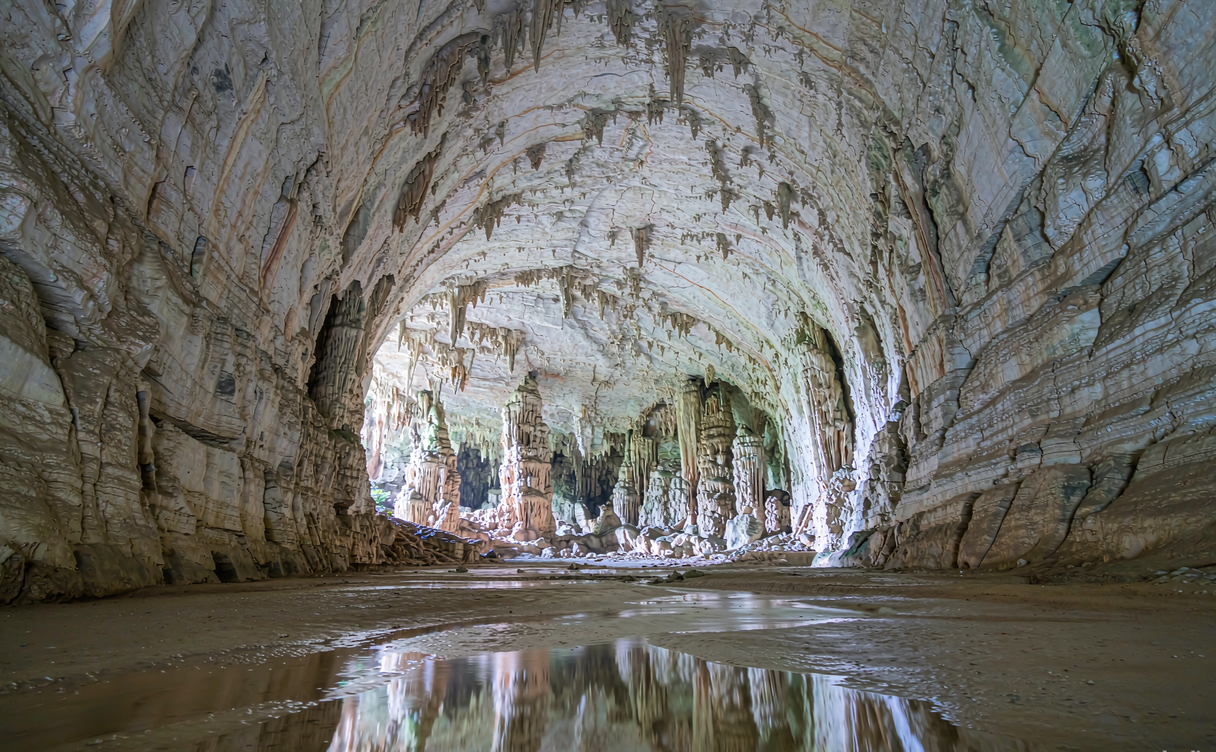
The things to do at Jiuxiang follow a fixed one-way route, which is good — you cannot get lost, and the pacing is built for first-timers. After the cliff elevator drops you roughly 100 meters, the first stop is the Lion Hall, a domed space with a flat floor where performances are sometimes held. From there a walkway threads past the “Welcome” cave with its hanging curtains of calcite, then down to the underground river.
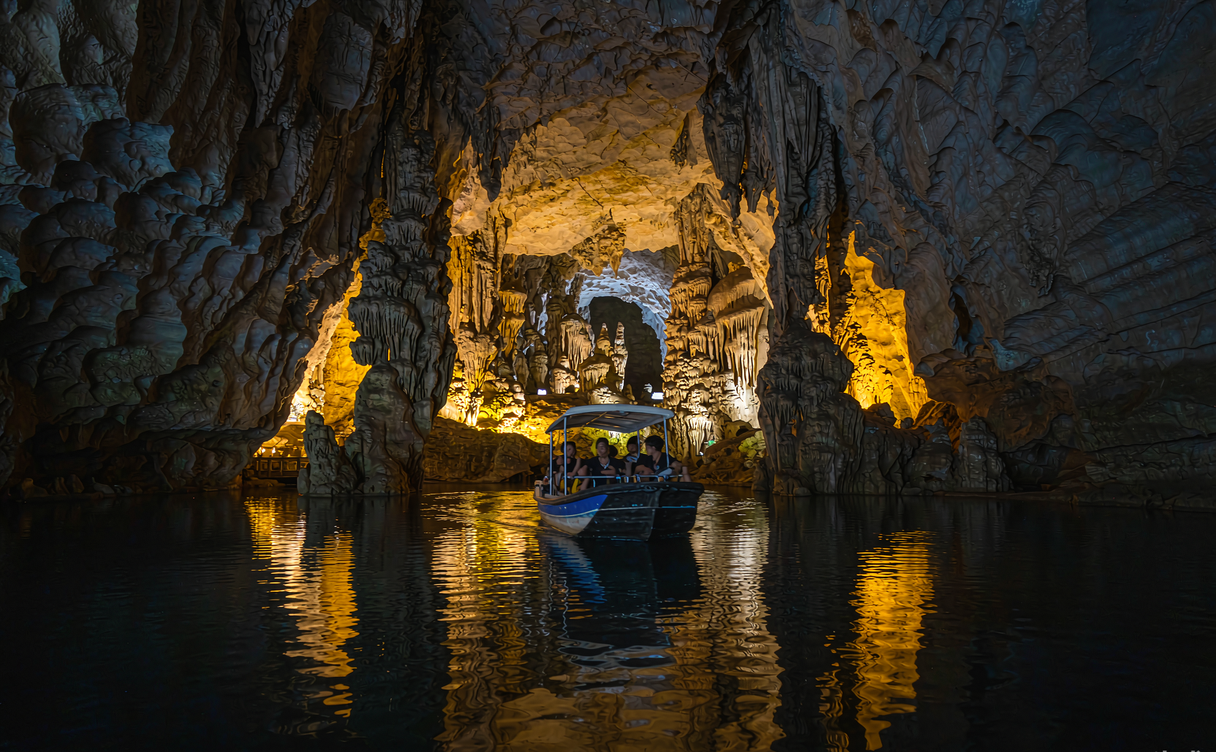
The boat ride is the part people remember. A short electric skiff carries you through the “Underground Stone Forest,” a stretch where stalagmites rise from black water like a flooded version of the famous surface karst. The paddle lasts 15 to 20 minutes and is calm; I have taken nervous travelers on it without issue. Upstream the route opens to the Male-and-Female Twin Waterfalls, two streams that fall from different heights and meet in a single plunge inside the cave — a setup you will not see above ground.
Photography is tricky because the caves are lit but dim, so I tell clients to bring a phone with night mode rather than a big camera they cannot steady. The walk out climbs a long stair flight back to the surface; there is a cable car as an alternative for ¥15–25 RMB if legs are tired, and I book it for older travelers without shame.
The karst itself is the reason the place exists. The Wikipedia overview of karst explains how soluble limestone, rainwater, and time produce exactly these chambers, and Jiuxiang is one of the densest examples in Yunnan. Standing in the Lion Hall, the slow geology finally makes sense.
Best Time to Visit Jiuxiang
The best time to visit Jiuxiang is the dry season, November through April, when Yunnan’s skies are clear and the underground river is at its calmest. I avoid the deep summer (July–August) because afternoon storms can raise the cave river fast and close the boat section for an hour or two. Spring (March–May) is my second choice: warm, green, and uncrowded before the May holiday crunch.
If you are sorting a broader Yunnan calendar, our best time to visit China page lays out the province’s wet and dry months so you can stack Jiuxiang with higher places like the plateau lakes. For Jiuxiang alone, a weekday in the dry season with a morning arrival is close to perfect.
Tickets, Hours and Food
As of 2026 the Jiuxiang combined ticket runs ¥90–120 RMB and includes the cliff elevator and the core caves; the underground boat and the exit cable car are sometimes bundled and sometimes sold separately (¥30–50 RMB together), so confirm at the window. The gate opens around 8:30 a.m. and the last entry is 4:00 p.m. Foreign card payment at the booth is unreliable, so carry cash or a Chinese app, and buy at the visitor center rather than from touts near the parking lot.
Food near the gate is limited to noodle stalls and a couple of simple restaurants where a bowl of Yunnan rice noodles (mixian) costs ¥12–20 RMB. The real eat is back in Yiliang town: Yiliang roast duck (kao ya) is a local legend, a crisp-skinned bird glazed with a honey-rose marinade, ¥60–90 RMB for a half, and I plan the return drive to land at a Yiliang duck house by 6:00 p.m. For a wider food and route picture, our Kunming travel guide covers the city side of the same day.
Pairing Jiuxiang With the Stone Forest
The classic mistake is treating Jiuxiang and the Stone Forest as the same stop. They are different counties and about an hour apart by road, so trying to do both in one day means rushing both. I send most clients to Jiuxiang as a half-day from Kunming, then reserve a full day for the Yunnan Stone Forest guide on a separate run, or link the two with an overnight in Yiliang. The Stone Forest is the famous surface karst; Jiuxiang is its hidden underground twin, and seeing both tells the fuller story of how this limestone behaved above and below ground.
For travelers building a longer swing, our Yunnan 10-day itinerary slots Jiuxiang into a Kunming arrival day and leaves room for Dali and Lijiang after. If this is your first China trip and you want the logistics spelled out, the China travel guide for first-timers walks through payments, apps, and the small things that smooth a cave day outside the big cities.
Sample Half-Day Jiuxiang Plan
Leave Kunming 8:00 a.m., arrive Jiuxiang gate 9:45, buy the combined ticket, take the elevator down, walk the Lion Hall and Welcome cave (60 min), boat the underground stone forest (20 min), see the twin waterfalls, climb out or take the cable car, lunch at a gate noodle stall, then drive to Yiliang for roast duck and back to Kunming by early evening.
Frequently Asked Questions
Is Jiuxiang worth it if I am already doing the Stone Forest? Yes — they show karst above and below ground, and Jiuxiang is far less crowded.
How fit do I need to be? Moderate. There are stairs and a long climb out; take the cable car if needed.
Is it good for kids? Yes, from about age five. The boat and waterfalls are the hits; skip the long stairs with strollers.
Can I visit independently without a tour? Easily. The route is one-way and signed; a driver gets you there and back.
Add Jiuxiang to a Kunming arrival day with our Yunnan 10-day itinerary and we will flag the driest weeks to go.
Compare the underground karst with the surface version in our Yunnan Stone Forest guide before you pick your route.
First time navigating Yunnan by rail and road? Our China travel guide for first-timers covers the apps and tickets you need.