

Shaoshan is a small county-level town in Xiangtan, Hunan province, best known as the birthplace of Mao Zedong and one of China’s most visited sites of “red tourism” — travel centered on revolutionary history. For foreign visitors it’s a compact, walkable stop that pairs easily with Changsha, and a window into a strand of Chinese domestic tourism few outsiders see. This Shaoshan travel guide covers what to see, when to go, how to get there, and how to build it into a Hunan trip.
Best time to visit Shaoshan
Shaoshan has a humid subtropical climate. The most comfortable months are March to May and September to November, with mild temperatures (18–26°C) and low rain. Summers (June–August) are hot and sticky (up to 35°C), and winters are damp and chilly without much snow. For a wider regional picture, our best time to visit China guide aligns Shaoshan with the rest of Hunan.
One timing note: the town draws heavy domestic crowds on dates tied to Mao’s birth (December 26) and major national holidays like Golden Week. If you want space to photograph the sites, aim for a weekday in spring or autumn.
How to get to Shaoshan
Most visitors arrive from Changsha, 100km northeast. The easiest route is the high-speed rail: Changsha South to Shaoshan South station takes about 35–50 minutes (RMB 35–55), with frequent departures. From the station, a local shuttle bus or Didi ride (RMB 15–30) covers the 8km to the scenic area. Driving or taking a long-distance bus from Changsha takes roughly 1.5–2 hours. First-time rail users should read our China high-speed train guide for foreigners — book tickets on 12306 a few days ahead, more for holidays.
If you’re building a Hunan itinerary from scratch, Changsha is the natural base, with overnight options and onward transport.
Things to do in Shaoshan
The sites cluster within a few kilometers and are linked by shuttle buses (a through-ticket covering the main sights runs about RMB 20–40 for the bus, with individual attraction entries mostly free or RMB 0–30):
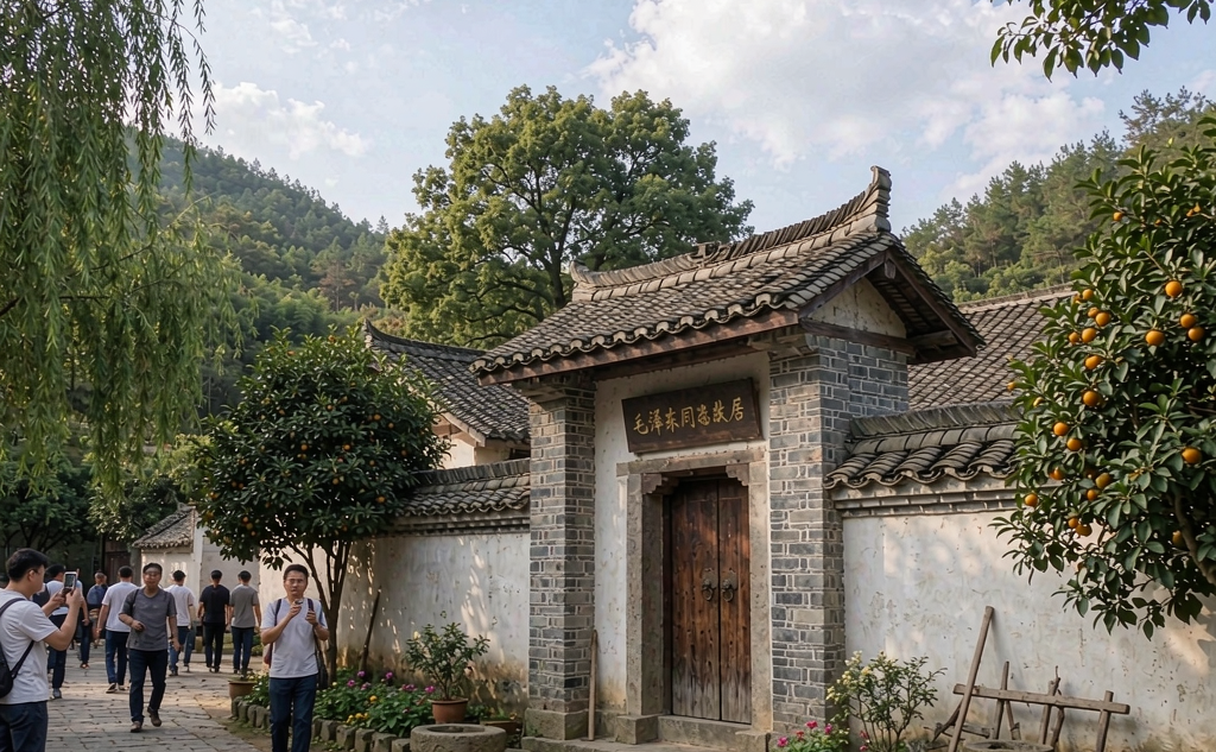
- Mao Zedong’s Former Residence: A preserved mud-brick Hunan farmhouse where Mao was born in 1893 and spent his early years. Free entry, but it’s the top draw, so arrive at opening (around 8am) to avoid the coach-tour crush. You walk through the rooms with a timed flow; photography inside is restricted.
- Mao Zedong Square and Bronze Statue: A large plaza with a towering statue, the natural gathering point and the best open space for photos. Free.
- Mao Zedong Memorial Hall / Museum: Exhibits on his life and era with documents and personal items; informative context for the sites. Free, bring your passport for registration.
- Dripping Water Cave (Shuiliudong): A wooded valley resort a few km west where Mao stayed in 1966; cool, green, and quieter than the central sites, with a small villa you can view. Entry around RMB 30–50.
Together these form the core of Shaoshan red tourism — a circuit most domestic visitors complete in half a day to a full day. For background on the town’s history, the Shaoshan page on Wikipedia is a neutral reference.
What to expect at the sites
The visit has a predictable rhythm. The Former Residence runs a one-way timed flow — you enter through the front court, walk the rooms, and exit through the orchard — so there’s little backtracking and photography inside is restricted to protect the contents. The central square often hosts a short flag-raising-style ceremony on weekend mornings, and it’s the spot where most domestic tour groups gather for the group photo. The memorial museum is a climate-controlled, well-labeled exhibition of photographs, documents, and personal items, presented as a biographical walk-through; allow 45–60 minutes. Expect a reverent, orderly atmosphere from local visitors, especially around the statue. Wear comfortable shoes — the site spreads across low hills and the walk between the residence and the square is a few hundred meters in the open.
Shaoshan itinerary
A realistic Shaoshan itinerary is a half-day if you’re efficient, or a relaxed full day with Dripping Water Cave:
- Morning: High-speed train from Changsha, shuttle to the scenic area, Former Residence and Square.
- Midday: Memorial Hall/Museum, lunch at a local restaurant.
- Afternoon: Dripping Water Cave, then train back to Changsha — or overnight if you want the town quiet after day-trippers leave.
Most foreign travelers do Shaoshan as a day trip from Changsha and return the same evening. If you’d rather linger, a handful of guesthouses and one or two mid-range hotels sit near the scenic area (RMB 200–500/night).
Food: Hunan cuisine
Shaoshan’s food is classic Hunan — bold, spicy, smoky. Try cai hu (pickled vegetables), braised pork in chili, and smoked cured meats. The town has simple noodle shops and banquet restaurants; for the real spread, save your appetite for Changsha. Our Changsha food guide maps the night-market eats, and the broader Hunan cuisine guide explains the regional staples so you can order with confidence.
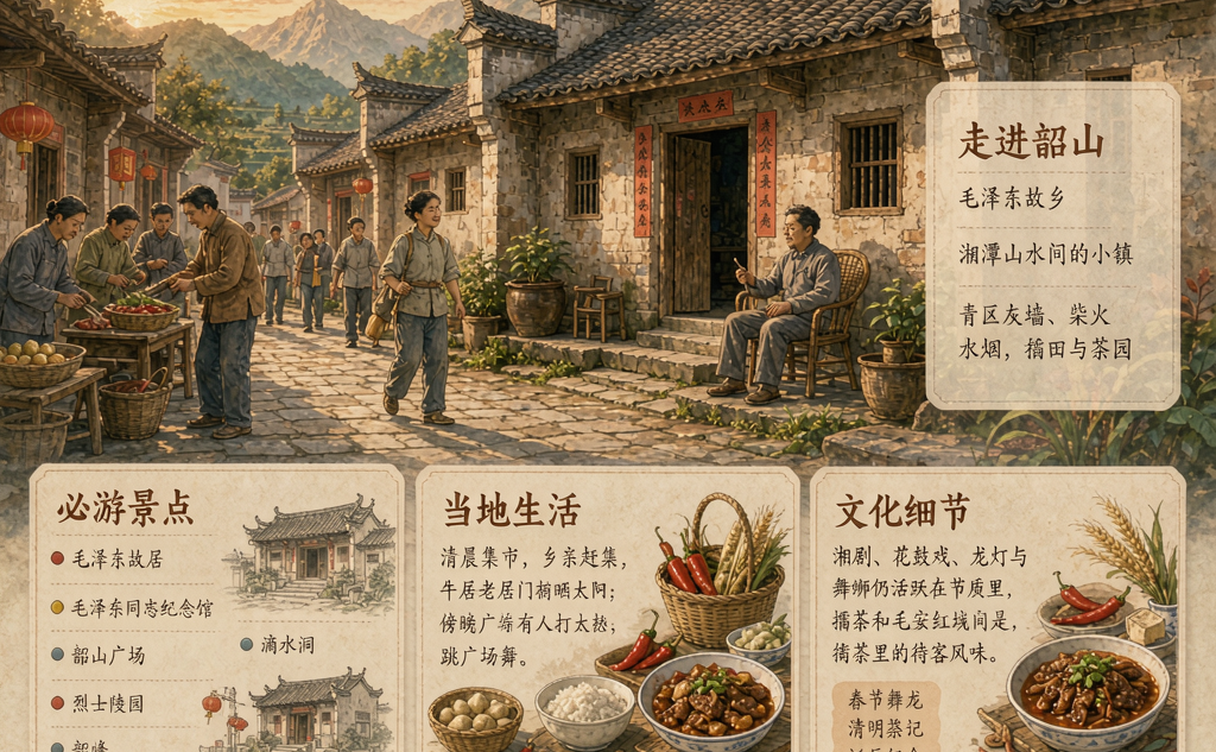
Pair Shaoshan with two days in Changsha and you get history plus some of China’s best street food — plan the rail day-trip now.
Nearby: Xiangtan and a Changsha base
Shaoshan sits inside Xiangtan prefecture, and most visitors use Changsha as the hub. If you have an extra day, Changsha itself rewards a stop: the Orange Isle (Juzizhou) riverside park, Yuelu Academy, and the busy Pozi Street night market are all worth an evening. Our Changsha travel guide lays out a 2-day plan that slots a Shaoshan day trip into day three. Trains between Changsha and Shaoshan run from early morning to evening, so you’re never stranded.
Souvenirs and local products
Shaoshan’s shops sell Mao-themed keepsakes — badges, reprints, and figurines — alongside genuinely useful local goods: Hunan chili paste, cured smoked pork (la wei), and packs of the region’s dark tea. The on-site memorial shops are fixed-price and reliable; the stalls outside the gates bargain gently. None of it is essential, but a small pack of chili sauce makes a practical souvenir that survives the trip home better than a porcelain bust.
Costs and booking
Shaoshan is cheap to visit. Budget RMB 150–300 per person for the day including rail (round trip ~RMB 80–110), local shuttles, entry fees, and a meal. It’s far lighter on the wallet than the big cities. No advance tickets are needed for the attractions themselves, but book your Changsha–Shaoshan high-speed rail a few days out, and longer ahead around holidays, using the tips in our first-timers travel guide.
A half-day in Shaoshan adds real depth to any Hunan trip — reserve your train seats and go.
Practical tips and etiquette
- Bring your passport: Sites register visitors; entry is smoother with ID ready.
- Dress modestly: This is a respectful, historically significant site for many Chinese visitors — covering shoulders and avoiding loud behavior fits the tone.
- Go early: The Former Residence queues build by 10am; an 8am arrival saves an hour.
- Cash and apps: Alipay works, but carry RMB 100–200 for small vendors and shuttle top-ups.
- Getting around the site: Electric shuttle buses loop the main sights on the through-ticket, and electric carts offer point-to-point rides for RMB 10–20. The walk between the Former Residence and the square is flat and shaded if you’d rather stroll between stops.
From Changsha’s markets to Shaoshan’s hills, Hunan rewards curious travelers — start building your red-tourism day trip today.
Shaoshan won’t take long, but it’s a genuine piece of modern Chinese history and an easy, affordable add-on to any Changsha-based trip.