

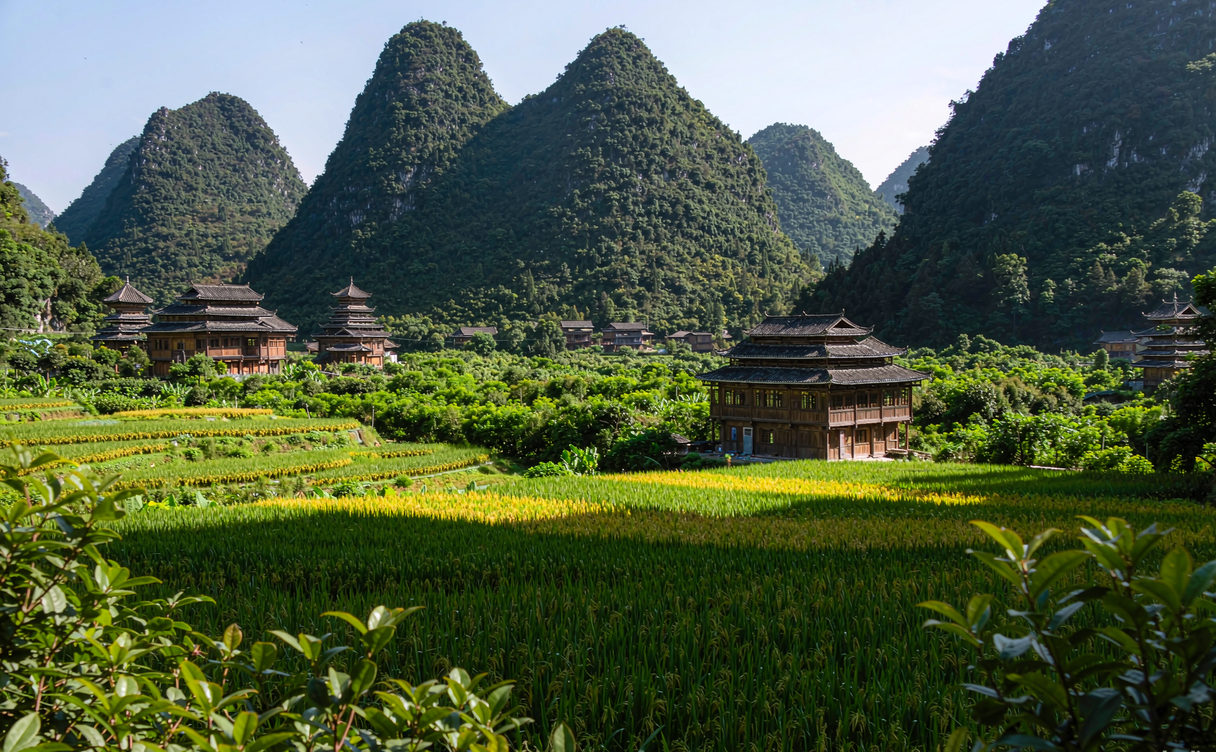
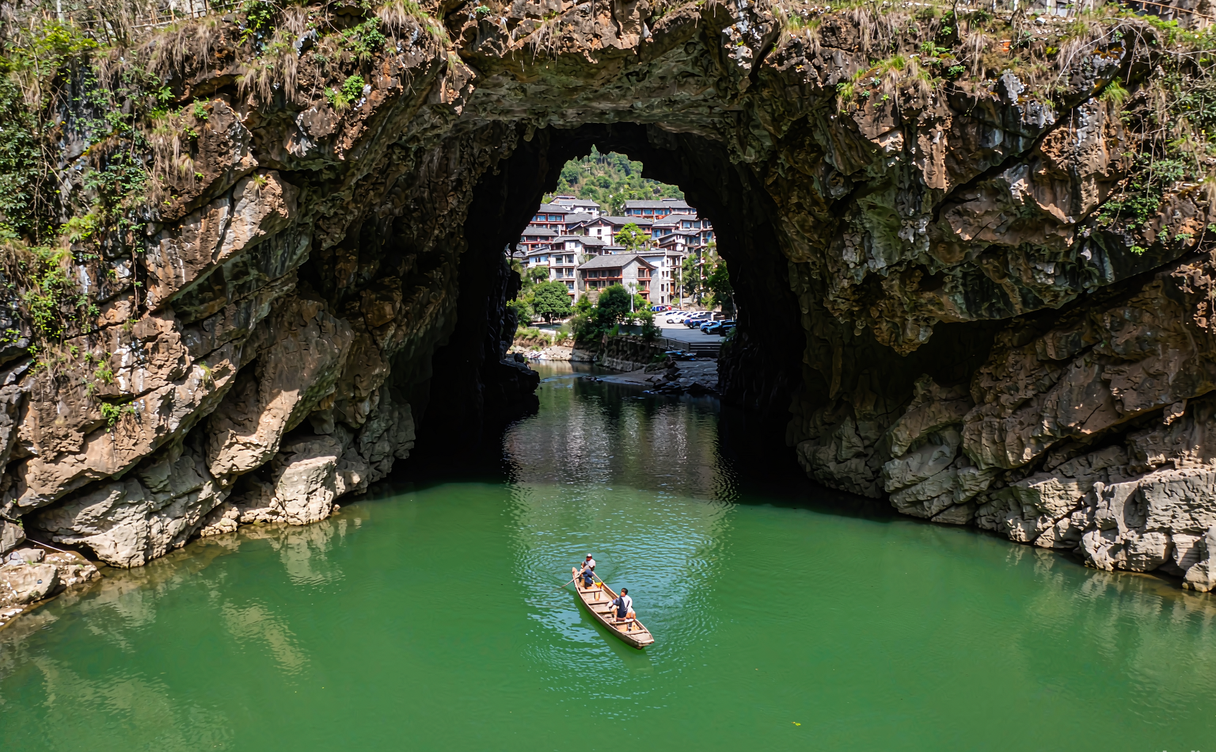
Some places earn a nickname and then live up to it. Guangnan, a county in southeastern Yunnan near the Guangxi border, is home to Bamei Village—a Zhuang settlement so cut off by limestone hills that you reach it by rowing through a karst cave. The Chinese call it “the Peach Blossom Spring” after the famous fable of a fisherman who stumbled into a hidden utopia. I went in March, and the peach trees were indeed blooming as our boat slipped out of the tunnel into a green valley. A Guangnan travel guide is a guide to the last shy corners of Yunnan, where the pace of life still follows the rice cycle.
Why Guangnan and Bamei Are Special
Guangnan sits in Wenshan Prefecture, a part of Yunnan less traveled than Lijiang or Dali. The draw is Bamei, a living Zhuang village where the Zhuang people still farm rice in paddies ringed by sheer peaks. Until recently the only way in was the cave boat ride; a road now exists but the water entrance remains the experience everyone remembers, and the one that gives Bamei its legend. For a broader route, our Yunnan 10-day itinerary can slot Guangnan into a southeast loop that also touches the province’s minority heartlands.
How to Get to Guangnan
The practical rail hub is Guangnan County Railway Station on the Nanning–Kunming line. High-speed trains from Kunming take about 2–2.5 hours and cost ¥90–¥140; from Nanning (Guangxi) it is roughly 2 hours and ¥80–¥120. From the station, a bus or DiDi covers the 40–50 kilometers to Bamei (¥60–¥100, about 50 minutes). If you are new to the network, our China high-speed train guide for foreigners covers tickets, real-name ID, and station navigation.
By road, Guangnan is about 4–5 hours from Kunming by bus (¥90–¥130) or private car. Within the county, local minivans to Bamei leave when full for around ¥15–¥25 per seat, a cheap and cheerful option if you are not in a rush.
Things to Do in Guangnan
Bamei Village cave boat ride. The signature entry: a wooden boat rows you about 10–15 minutes through a dark limestone cave (now partly with electric lighting) and out into the sunlit valley. The combined ticket for Bamei is about ¥80–¥110 including the boat and a shuttle; I paid ¥100 in peak season. Once inside, paths link the paddies, a small Zhuang museum (¥10–¥20), and a lookout over the valley where you can see the whole hidden basin at once.
Zhuang culture and festivals. The local Zhuang (a branch of the Tai-language peoples) keep rice farming, spinning, and folk song traditions alive. If you visit around the “Wheel Turning Festival” (dates vary by lunar calendar, often in spring), you may see bullfights and song fairs that draw villagers from surrounding valleys. I joined a village cooking session—sticky rice steamed in bamboo (¥20–¥30) was the highlight, eaten straight from the tube with chopsticks.
Guangnan town and Baozhuang Mountain. The county seat has a low-key old quarter and the nearby Baozhuang Mountain forest park (¥20–¥40) with short hikes and a pagoda view over the rice country. A calm half-day before or after Bamei. The Kunming travel guide is your launch point if you start from the provincial capital, with notes on where to eat and stay before heading southeast.
Planning a Yunnan food trail? Our Yunnan rice noodles guide explains the noodle culture you will meet across the province, including the southeast, so every bowl you order in Guangnan makes sense and you know what to ask for.
Best Time to Visit Guangnan
The best time to visit Guangnan is spring (March–May) and autumn (September–November). March brings the peach and rapeseed blooms that justify the “Peach Blossom Spring” name, with 16–24°C days and clear mornings. October offers golden rice terraces and clear karst air, the harvest season when the paddies glow. Summer is warm and green (26–32°C) with afternoon showers; winter is cool and quiet, occasionally misty, and the cave boat can feel chilly.
For nationwide timing, our best time to visit China overview helps sequence Guangnan with other regions. I went in mid-March and the cave exit onto the blooming valley was worth the trip alone—better than any postcard.
Where to Stay and Eat
Inside Bamei, a handful of homestays run ¥150–¥300 per night, basic but clean, often with a family dinner (¥40–¥60 extra). I stayed one night in a wooden guesthouse and watched fireflies over the paddies—a memory worth more than the room rate. In Guangnan town, hotels range ¥160–¥350, with better heating and Wi-Fi for those who prefer comfort.
Food centers on Zhuang home cooking: bamboo-steamed sticky rice, sour fish soup, free-range chicken, and wild greens foraged from the hills. A village meal for two runs ¥60–¥100. In town, try the rice noodles (¥10–¥18 a bowl), from the cross-the-bridge soup to the dry-tossed version. The night market near the bus station is cheap and friendly, with roast corn and soy-milk stands.
A Two-Day Sample Plan
- Day 1: Train to Guangnan, transfer to Bamei, cave boat entry, walk the paddies and museum, village dinner, overnight in the valley.
- Day 2: Morning Zhuang cooking or lookout hike, return to Guangnan town, Baozhuang Mountain if time, train onward to Kunming or Xishuangbanna.
This slow pace lets the hidden-valley feeling sink in rather than racing through as a photo stop.
Practical Tips and Budget
Bamei gets crowded on Chinese holidays (May Day, National Day); go midweek in March or October for near-empty paths. The cave boat can feel enclosed—not for the claustrophobic, though lighting has improved and boats are steady. Wear sturdy shoes for paddy paths, and bring cash; mobile pay reaches the town but not always the village stalls, where a ¥50 note covers a meal. A daily budget: transport ¥80–¥150, food ¥60–¥120, lodging ¥150–¥350, entries ¥100. Respect photography manners with villagers—always ask before shooting portraits.
Extending south? Our Xishuangbanna travel guide continues the minority-culture theme into tropical Dai country, an easy train or flight from Kunming after Guangnan. Keep it open as your next stop so the cultural thread runs through your whole Yunnan trip.
Why This Is the Real “Peach Blossom Spring”
The fable of the hidden valley has many claimants in China, but Bamei’s cave-entrance geography makes the comparison unusually literal—you truly pass from dark to light into a walled world. The Wikipedia entry on Guangnan County confirms its location in Yunnan and its Zhuang heritage, a useful neutral reference before you go, with notes on the county’s ethnic makeup.
Guangnan will not wow you with grand monuments. It wins through atmosphere: a boat, a tunnel, a sudden green world, and a village that still farms as it did generations ago. Build it as a slow two-day detour and you will have a Yunnan story none of your friends can match, plus a genuine sense of having found something most travelers miss.
Getting Around Guangnan and What to Budget
Getting into Bamei smoothly is mostly about timing. I booked the 07:40 high-speed train from Kunming South to Guangnan County (¥118, 2.2 hours) and pre-arranged a DiDi at the station (¥88, 50 minutes) so I reached the Bamei cave entrance by 11:00, ahead of the midday bus tour. The combined Bamei ticket was ¥100 (boat plus shuttle), and I added the small Zhuang museum (¥15). Inside, a homestay dinner of bamboo-steamed sticky rice and sour fish soup ran ¥55.
Carry cash: the village stalls and the boat-tip box do not take mobile pay, and a ¥50 note covered a snack-and-drink stop. The county-town ATMs work, but I pulled ¥300 before leaving Kunming. Transport within Guangnan is cheap — local minivans to Bamei are ¥18 per seat, leaving when full, while a private car for the day costs about ¥200. My two-day total landed near ¥900 per person: ¥236 trains, ¥176 local transport, ¥300 lodging (one Bamei night plus one Guangnan town night), ¥170 food, and ¥115 entries. The Bamei Village cave boat is the unmissable line item, and going midweek in March meant I shared the hidden valley with perhaps a dozen other visitors — the Peach Blossom Spring at its quietest, exactly as the old fable promised.
Ready to find the hidden valley? Book your Kunming–Guangnan train, reserve a Bamei homestay for a weekday in March or October, and pack cash for the village. The Peach Blossom Spring is one boat ride away—start your reservation tonight and the cave light is waiting on the other side.