

I flew into Haikou expecting beach food and found something gentler: an island kitchen built on coconut, free-range chicken, and the cleanest seafood I’ve eaten in southern China. Hainan’s food is the least oily of any Chinese regional style I know — the heat is tropical, so the cooking stays light, sour, and bright. This Hainan cuisine guide comes from a week split between Haikou’s old arcades and the Wenchang countryside where the island’s most famous bird is raised.
The four famous dishes, and why Wenchang chicken leads
Hainan officially celebrates four “famous dishes”: Wenchang chicken, Jiaji duck, Dongshan goat, and Hele crab. Of these, Wenchang chicken is the one you’ll see on every menu from street stall to resort. The birds are free-range, slow-grown around Wenchang city, and served bai qie — simply poached, then chopped bone-in and dressed with a sharp ginger-scallion-soy dip. The magic is the skin: poached, then plunged in ice so it sets into a jelly-rich, faintly yellow slip.
Where to eat it: in Wenchang itself, Tian Fu Wenchang Chicken (天福文昌鸡) is the local legend, about ¥68 for a half bird feeding two. In Haikou, Qiong Shan Wenchang Chicken branches near the old town charge ¥88–118 for a whole bird. The meat should be just-cooked, never rubbery, and the ginger dip is non-negotiable. If you’re building a round-island route, our Hainan 7-day itinerary threads Wenchang between Haikou and Sanya.
A Wenchang chicken where to eat tip from me: avoid the airport and resort versions at ¥150+. The real bird lives in modest tiled restaurants on the provincial roads, where the owner’s nephew probably raised it.
Coconut chicken hotpot: the island’s comfort ritual
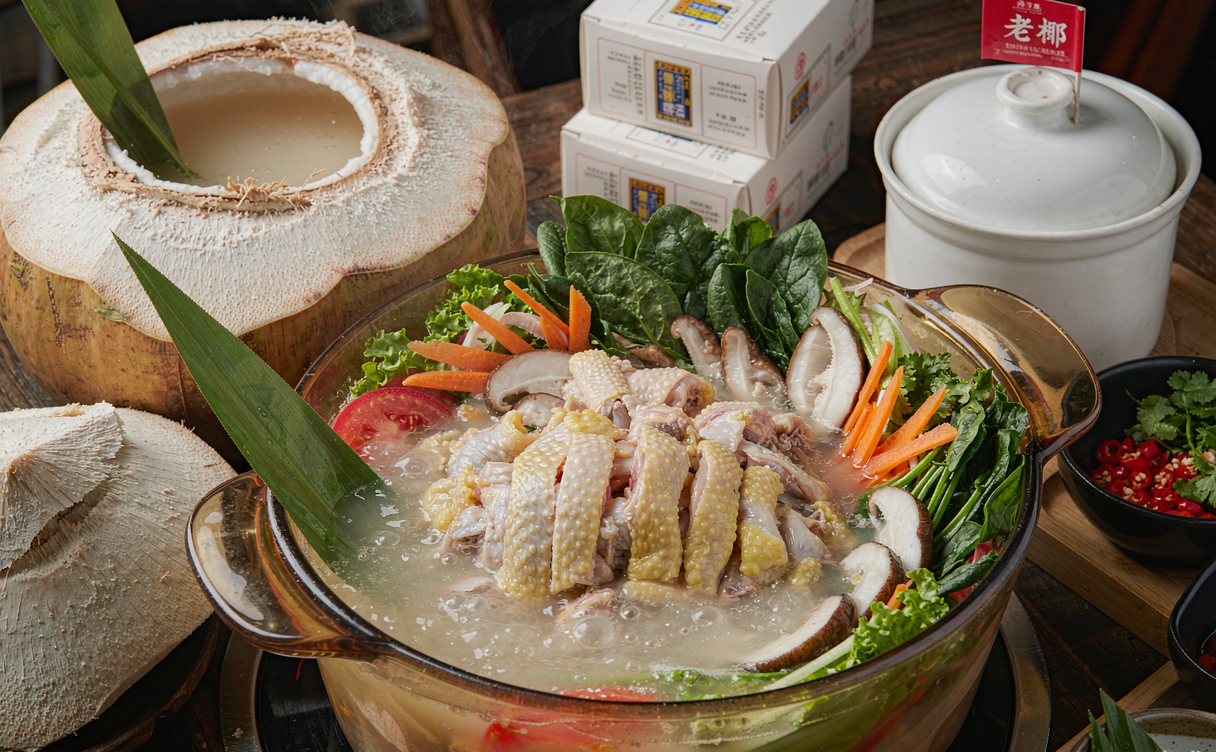
On a humid Haikou evening, nothing beats a Hainan coconut chicken hotpot. A copper or ceramic pot is filled with the clear juice of young coconuts plus a few flesh chunks, brought to a gentle simmer, then you slide in poached chicken pieces and let them poach in the sweet broth. After the meat, you cook leafy greens, tofu and mushrooms in the now-chicken-scented coconut stock, and finish with a small bowl of the soup itself.
The broth is clean, faintly sweet, never greasy — a relief after heavier northern hotpots. A two-person coconut chicken set runs ¥98–138 at chains like Qiong Ge (琼哥) or Tan Di (探弟) in Haikou. Add a plate of Wenchang chicken on the side and you’ve eaten the island in one meal.
For a coastal counterpoint, our Sanya seafood guide covers the grilled-and-boiled side of the island’s larder.
Haikou old town breakfast tea: the Cantonese cousin
Haikou’s Haikou old town breakfast tea culture is a quiet surprise. The restored qilou arcade streets of Bo’ai Road and Zhongshan Road hide old teahouses where retirees gather at 6 a.m. for yum cha — steamed buns, rice-noodle rolls, fried dough sticks, and pots of oolong. It’s more laid-back than Guangzhou but cheaper: a table of four eats for ¥60–90.
Try jian zhe guo (a Hainan rice-flour roll with a peanut-shrimp filling, ¥8) and qing bu liang — a cold sweet soup of mung bean, barley, coconut milk and watermelon, the island’s answer to air-conditioning, ¥10 a bowl. Our China breakfast guide maps this kind of morning ritual across provinces.
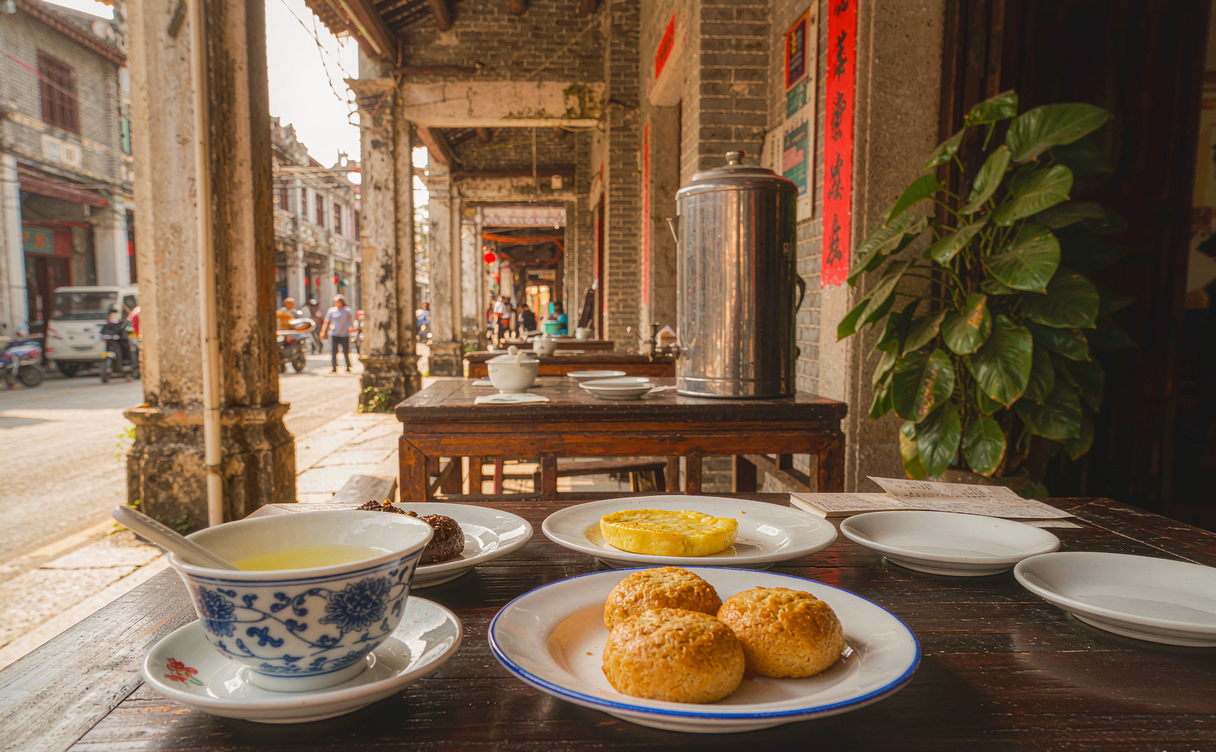
The old town’s best-kept secret is Bo’ai Road’s Hainanese coffee (gā bī) — a dark, sweet, condensed-milk brew from the island’s returned Overseas Chinese heritage, ¥12 a cup. Pair it with a pork bao and you’ve eaten like a Haikou local.
Seafood, goat and the road south
Beyond chicken, Hainan’s Hainan four famous dishes round out with Jiaji duck (free-range, roasted or braised, ¥78/half), Dongshan goat (stewed with herbs, gamey and rich, ¥98), and Hele crab (steamed, sweet, ¥120–200/kg in season). Around the coast you’ll find qing zheng (clear-steamed) fish so fresh it needs only scallion and soy.
The Jiaji duck deserves its own mention: raised around Qionghai and fed a grain-and-shrimp diet, it’s roasted to a lacquer-red skin then chopped through bone, served with a sweet-sour dip that cuts the fat. Dongshan goat from Wanning is the island’s red meat — braised with fermented tofu and ginger until the joints slip apart, best in cool weather. And Hele crab, from the Hele town beds, is steamed whole and eaten with a shard of ginger in black vinegar; the roe-laden females in late autumn are the prize locals will quietly fight you for at the market.
A where to eat Hainan food note: the best seafood value is at the wet-market cooking stalls. Buy your crab or prawns at the market, pay a stall ¥10–20 to wok-fry them, and eat at a plastic table. A feast for two rarely tops ¥200.
Hainan’s drinks, sweets and a simple eating plan
Beyond the four famous dishes, Hainan snacks reward slow wandering. Qing bu liang appears everywhere in dozens of variations — some add taro, sago, or longan — and a ¥10 bowl is the island’s universal cooler. Coconut rice (ye zi fan), sticky rice steamed inside a young coconut, is a gentle dessert at ¥15. For something savory, Hainan rice noodles (fen hou) from the Wenchang/Haikou belt come dry-tossed with sesame, pork and peanut, ¥12.
If you’re short on days, anchor the food trip on two stops: Haikou for old-town breakfast tea, coconut chicken hotpot and wet-market seafood, then Wenchang (an hour by bus or train) for the definitive chicken and a countryside lunch under the rubber trees. Sanya is for the beach-and-grill side; our Sanya seafood guide covers that coast. The beauty of Hainan is that the signature dishes repeat island-wide, so even a single city gives you the whole story. If you visit in March or April, ask for the spring coconut shoot (ye zi xin), the tender heart of the palm stir-fried with pork — a seasonal delicacy that appears for only a few weeks and tastes like the island condensed into one crunchy, faintly sweet bite.
Seasons, festivals, and honest tips
November to April is peak — cool, dry, and when Wenchang chicken and crabs are fattest. Avoid the July–September typhoon window if you can. The Hainan coconut chicken hotpot is year-round but feels best in the muggy summer when the cold coconut broth resets you.
Things I wish I’d known:
- Portions of coconut hotpot look small but the broth fills you; order one set per two people, then add veg.
- Ginger dip on Wenchang chicken is salty — dip lightly.
- Old-town teahouses open early and close by mid-morning; be there before 9.
- Hainan’s food is mild; if you want heat, ask for la jiao (chilli) — it’s not automatic.
For seafood strategy more broadly, our China seafood dining guide is a useful read.
Hainan cooking is the gentle side of Chinese food — coconut-sweet, chicken-clean, seafood-honest. For the broader context of how island and southerly styles fit together, the Wikipedia page on Hainan cuisine is a handy reference. Bring an appetite and a light hand with the chilli.