

Yunfu (云浮) was a working stop for me long before it was a leisure one. I used to pass through on stone-trade business — this is the city that cuts and polishes a very large share of China’s marble, and the highway into town is lined with slab yards for kilometres. Then a client asked me to find somewhere in Guangdong with real Chan Buddhist history and a hot spring, within an hour of Guangzhou by rail, and I realised the answer had been under my nose. This Yunfu travel guide is drawn from four trips, the most recent in March 2026, and it covers what I would actually book, what I would skip, and the transport trap that catches nearly everyone.
Why Yunfu, and what it is not
Set expectations first. Yunfu is not a pretty old town. The city centre, Yuncheng District, is a functional mid-sized Guangdong city built around minerals — marble, and historically sulphur. The reasons to come are spread across the wider prefecture: Xinxing County to the south, where the Sixth Patriarch of Chan Buddhism was born and died; a limestone cave in the city’s western hills with genuinely rare formations; a 1,251-metre mountain that is the highest point in central-southern Guangdong; and a serious cluster of hot spring resorts.
That geography is the whole story of the trip. Sights sit 40 to 90 minutes apart by road, and public buses between them are slow and infrequent. I now tell everyone the same thing: either hire a car with a driver for the days you are out of the city, or accept that you will see two things instead of five. Yunfu is one of the few Guangdong destinations where I do not recommend going car-free.
Yunfu to Guangzhou train and getting around
The Yunfu to Guangzhou train is the reason this works as a short break. Yunfu East Station (云浮东站), in Yuncheng District, sits on the Nanning–Guangzhou high-speed line, and direct C and D services reach Guangzhou South in roughly 55 to 70 minutes for about ¥60–90 CNY in second class. Coming the other way, Nanning is around three hours. A newer station south of the city on the Guangzhou–Zhanjiang line has also made Xinxing County directly reachable by rail, which cuts out the old cross-county drive — worth checking when you book, because it changes which end of the prefecture you should sleep in.
Yunfu East is about 25 to 35 minutes from the centre; a taxi runs ¥40–60 CNY, and city bus lines connect for around ¥2 CNY. There is no commercial airport, so most international visitors fly into Guangzhou and take the train. Our China high-speed train guide for foreign travellers covers the passport-scan and ticket-collection steps that trip people up at smaller stations like this one.
Building a Pearl River Delta route? Start with our Guangzhou travel guide and treat Yunfu as the quiet two-night western extension once the city has worn you out.
Yunfu Six Patriarch temple: Guoen Si and Xinxing
The heart of the trip is Guoen Temple (国恩寺) in Liuzu Town, Xinxing County, about 60 to 75 minutes south of Yuncheng by car. Huineng, the Sixth Patriarch of Chan (Zen) Buddhism, was born in this valley in the seventh century and died here; the temple was founded in his lifetime and is now a nationally protected heritage site. Together with Guangxiao Temple in Guangzhou and Nanhua Temple near Shaoguan, it forms the trio of ancestral halls that matter to anyone following Chan history.
The Yunfu Six Patriarch temple complex is free to enter, which surprises people. A guided explanation ran about ¥30 CNY when I last asked, and it is worth it — the lychee tree said to have been planted by Huineng and the Zhuoxi spring mean little without the story. Gates open around 08:30 and the halls close for a midday break, so arrive before 11:00 or after 14:30. Dress covered shoulders and knees; this is an active monastery with real worshippers, not a museum.
Next door, a purpose-built Chan-themed town stages a large evening performance about Huineng’s life. It is well produced and unashamedly commercial. I take clients who like spectacle and skip it with clients who came for quiet.
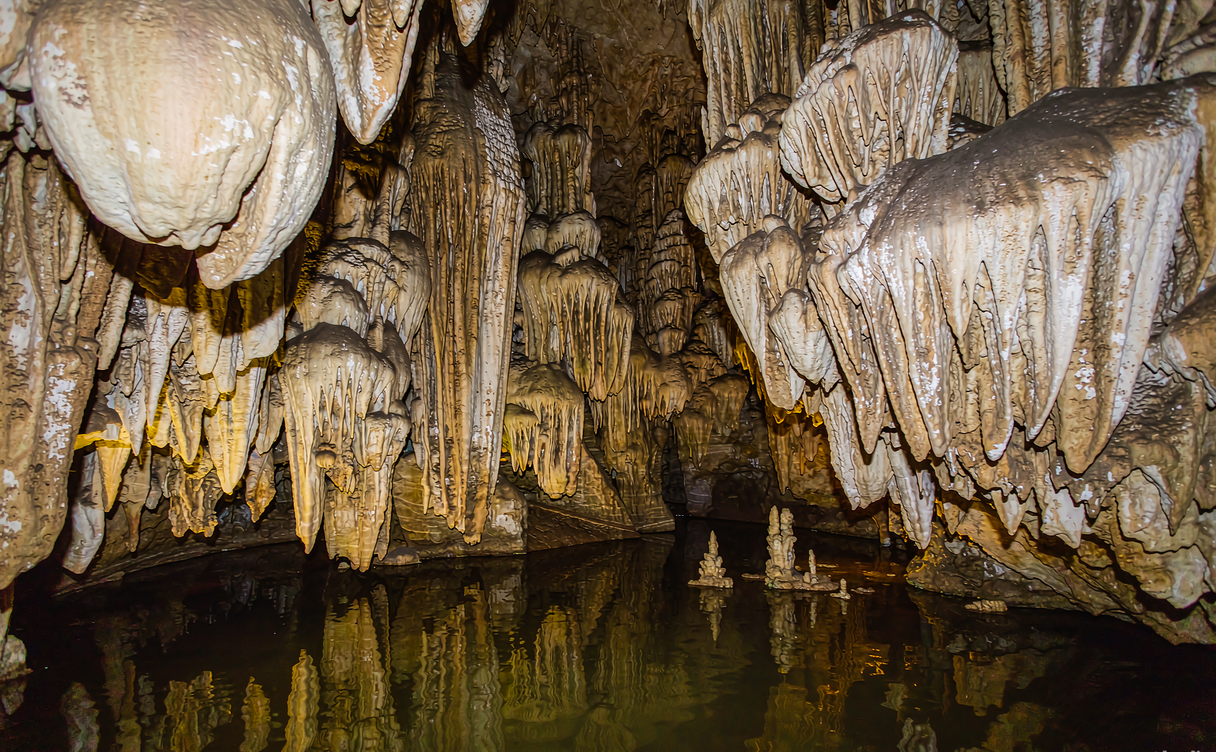
Yunfu Panlong Cave and the stone city
Yunfu Panlong Cave (蟠龙洞) sits on Panlong Road in the western part of Yuncheng, reachable by city bus and about ¥15–25 CNY by taxi. Admission was ¥30–50 CNY depending on season and channel, and hours ran roughly 08:30–17:30. Allow 1.5 to 2 hours.
What makes it unusual is not size — it is a modest cave by Guangxi standards — but the crystal formations. Panlong is known for rare snow-white calcite “stone flowers”, clusters that look like frost blooming off the wall, plus a translucent draped formation locals call the jade umbrella canopy. It stays cool year-round, which makes it the best possible refuge on a 34°C Guangdong afternoon. Wear grippy shoes; the walkways are permanently wet and the lighting is dim in places.
Pair it with the small city museum to make sense of the marble industry, or, if you have a car and a free half-day, drive up to the wind-turbine ridge above Longwan in Luoding — over 1,000 metres, free, unpaved in stretches, and the closest thing to an alpine view in this part of the province. Take an SUV and a warm layer.
Tianlu Mountain, plum blossom and hot springs
Tianlu Mountain (天露山) in Lidong Town, Xinxing, tops out at 1,251 metres and is the highest peak in central-southern Guangdong. The resort area charged ¥48–60 CNY for basic entry, with rafting, a glass slide and a hill train priced separately at ¥75–150 CNY as combos. January and February bring plum blossom across the terraces; May and June bring high-altitude rhododendron. Rafting sessions run to a fixed afternoon window, so confirm times before you drive 90 minutes for it.
The hot springs are the other reason people come. Longshan and the newer resorts in Xinxing charge roughly ¥99–160 CNY for day entry to the outdoor pools, and resort rooms with pool access run ¥400–900 CNY a night. These places are busy with Guangzhou and Foshan weekenders — go Monday to Thursday and you will have the pools nearly to yourself. For the wider Cantonese context, our Foshan travel guide pairs naturally, since most road trips out here start there.
What to eat, and where to sleep
Yunfu food is Cantonese with a rural accent and a strong vegetarian tradition around the temples. Three things I order every visit: Luoding crinkle-skin fish tofu (罗定皱纱鱼腐), a provincial intangible-heritage dish of pounded mud carp, at ¥40–60 CNY per person in a local restaurant; Xinxing wrapped rice dumplings (裹蒸粽), steamed for eight hours or more, at ¥8–15 CNY each; and stone-milled rice noodle rolls for breakfast in Yuncheng at ¥6–12 CNY. Luoding black-bean chicken and West River freshwater fish are the standard banquet dishes, ¥50–90 CNY per head. Temple vegetarian meals near Guoen Si are cheap and genuinely good.
For beds: Yuncheng District business hotels run ¥180–380 CNY and put you next to the cave and the train station. Xinxing’s hot spring resorts run ¥300–900 CNY and put you next to the temple. I split it — one night each — and stop worrying about backtracking.
Not sure a small Guangdong city belongs on your route? Our guide to the best things to do in China helps you weigh Yunfu against the bigger names before you commit the days.
Best time to visit Yunfu, and practical tips
The best time to visit Yunfu is March to May and October to November — 18 to 27°C, low humidity by Guangdong standards, and clear enough for the mountain. January and February are cool (8–18°C) and give you the plum blossom plus prime hot spring weather. July to September is typhoon season: hot, wet, and prone to short-notice closures of mountain attractions. I have had one Tianlu day written off entirely by a storm warning, so keep the itinerary flexible in late summer.
Four things I would tell any first-timer. Book the hot spring and any temple performance online in advance; walk-up prices are higher and weekend slots sell out. Carry cash-free payment but also ¥100 CNY in notes for village stalls. Confirm your driver’s return time in writing. And do not try to do Xinxing and Luoding in the same day — I have watched clients spend six hours in a car to see three car parks. Background on the prefecture’s history is on the Yunfu entry at Wikipedia. For seasonal planning across the country, see our best time to visit China overview.
Things to do in Yunfu: a two-night shape
The things to do in Yunfu that justify the trip fit neatly into two nights. Day one: train from Guangzhou, Panlong Cave in the afternoon, rice rolls and river fish in Yuncheng. Day two: drive south to Guoen Temple in the morning, hot spring in the late afternoon, sleep in Xinxing. Day three: Tianlu Mountain or a slow morning at the resort, then rail back. Budget roughly ¥900–1,500 CNY per person for two nights excluding the intercity train and the hire car, which adds ¥500–800 CNY a day split between you.
First trip to the country? Read our China travel guide for first-time visitors before you book the driver, then reserve your Xinxing hot spring room for a weekday rather than a Saturday.