

Most foreign travelers who make it to Qinghai stop at Qinghai Lake and call it a trip. We’ve sent clients far past that line, and the ones who went all the way to Mangnai (茫崖) in the northwest corner of Haixi Prefecture still message us years later. A proper Mangnai travel guide is hard to find in English because the town barely registers on international maps, but that quiet obscurity is exactly why it is worth the effort.
Mangnai sits in the Qaidam Basin (see the Qaidam Basin overview on Wikipedia), a high desert plateau at roughly 3,000 meters above sea level. It is the kind of place where the landscape looks edited — turquoise lakes ringed in white salt, red Yardang wind-eroded cliffs, and a sulfur spring that locals call the “Eye of the Earth.” If you are building a Qinghai far west desert route, this town is the anchor.
Getting there: fly in, or drive the long road
The practical entry point is Huatugou Airport (花土沟机场), about 5 km from the town center. There are daily flights from Xining (roughly RMB 600–900 one way in season) and a handful of connections routed through Golmud. We generally book these three to four weeks ahead because the aircraft are small and loads are tiny — a missed flight means an unplanned night in a very quiet town.
The overland option is the classic Mangnai to Golmud trip, about 400 km of good paved G315 highway across the basin. We have done it in a 4×4 with a driver; budget a full day with photo stops at the U-shaped “Sky Road” viewpoint near Lenghu. Fuel and driver together run roughly RMB 1,200–1,600 for the transfer. Most of our clients combine the two towns into a four- or five-day Qinghai far west loop rather than treating Mangnai as a one-night stop.
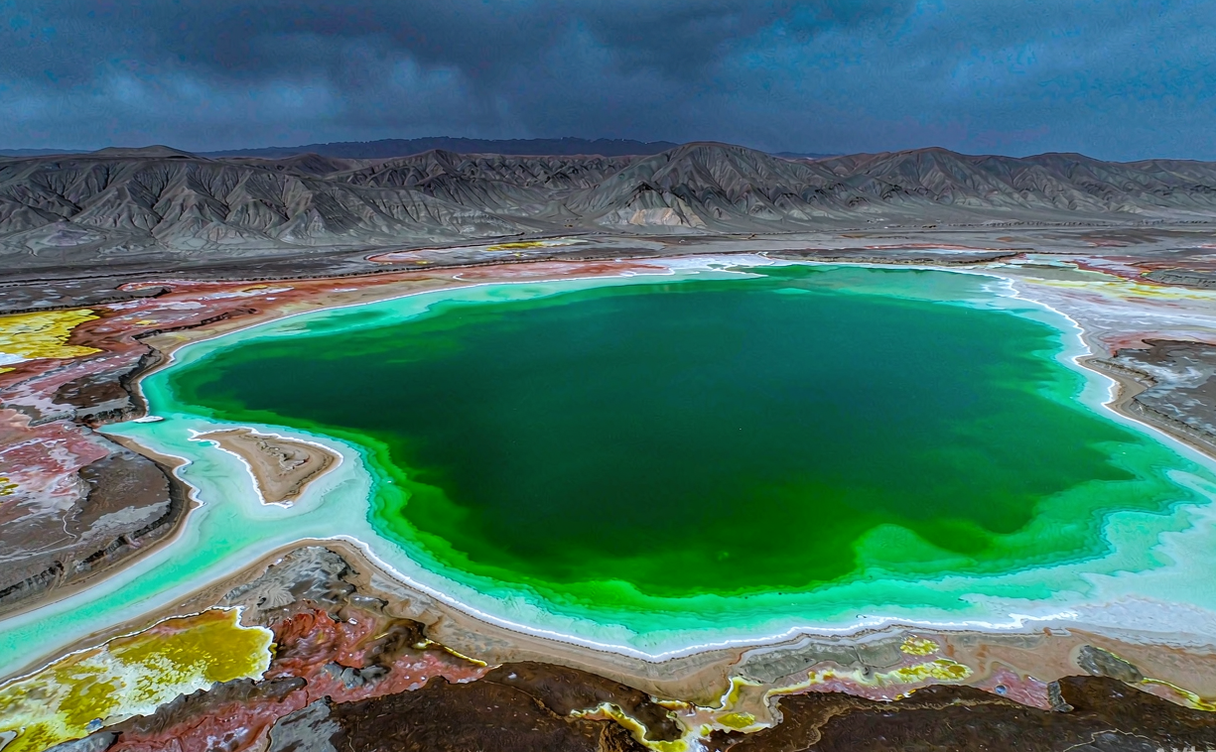
Emerald Lake (翡翠湖)
Emerald Lake is the headline sight and the reason most people make the journey. It is a former potash mining pit that filled with groundwater tinted green by dissolved minerals. There are actually several linked pools, each a slightly different shade, and the salt crust at the rim forms perfect white rings. The light here is brutal and beautiful — midday gives you the postcard colors, but we prefer the 7–9 am window when the wind drops and the rings glow.
Entry is cheap: RMB 20–30 for the shuttle into the lake area, plus a small environmental fee. You can walk the rim or, in summer, take the little sightseeing train (RMB 50). Drones are technically restricted near the airport, but the lakes are far enough out that we have flown ours with no trouble — always ask your guide first, because the rules shift.
Aiken Spring (艾肯泉) — the Devil’s Eye
About 25 km from town, Aiken Spring is a hot sulfur spring feeding a circular red-and-yellow pool. From the ground it looks like a murky pond; from a drone it is a perfect eye staring up at the sky, which is why it went viral across Chinese travel feeds. The access road turns to rough gravel for the last 6 km, so a normal sedan will struggle — we send the 4×4. There is no formal entry ticket, but the herder who manages the gate may ask RMB 10–20.
The sulfur smell is strong and the water is not for touching. We tell clients to bring a mask if they are sensitive, and to keep a 10-meter distance from the edge, which is soft and crusty and gives way without warning.
The Yardang and the Mars Camp side trip
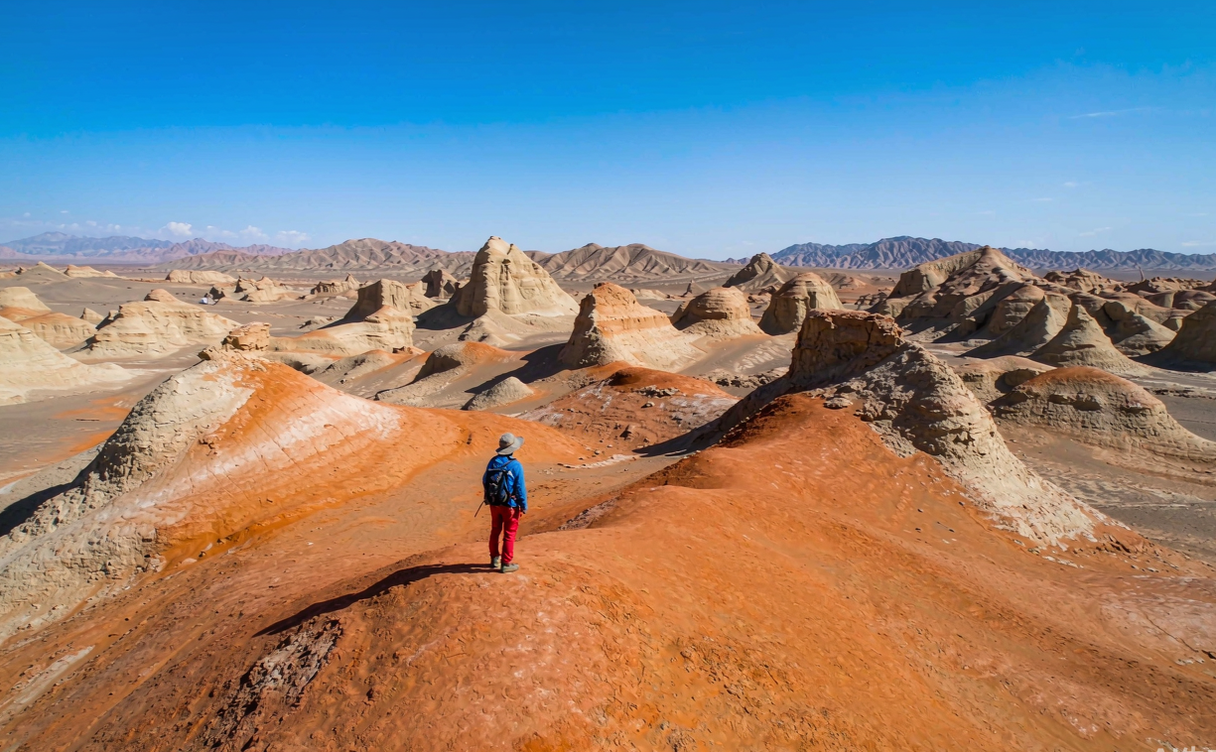
If you liked the alien feel of Aiken Spring, keep driving north toward Lenghu and you hit the Yardang landforms — wind-carved red ridges that stretch for kilometers. Just outside Lenghu there is a Mars-simulation camp (冷湖火星营地) built among the formations, with domed lodges and a small exhibition. It is a quirky overnight if you want the full “another planet” experience; a bed in the dome runs RMB 300–500 and you need to reserve ahead because capacity is around a dozen rooms.
This whole stretch is what we mean by Qinghai far west desert — not dunes, but eroded silence. The things to do in Mangnai Qinghai are few, and that is the point. You come for the colors and the space, not for a checklist.
Seasons, altitude, and what to pack
Mangnai is best from late May to early October. June through August is warmest (daytime highs 18–25°C) but also the windiest, with afternoon gusts that wreck drone footage. September is our favorite month: clear, calm, and the light turns golden. Winter (November to April) drops to -20°C at night and several guesthouses close; we only run it for serious photographers with proper cold-weather gear.
At 3,000 m, altitude is real but mild compared with Tibet. Still, we build in a night in Golmud or Xining first so clients acclimatize before the basin. The dryness is the bigger shock — lip balm, eye drops, and two liters of water a day are non-negotiable. Sunscreen and a real hat matter more here than almost anywhere else we operate.
If you are also eyeing lake scenery elsewhere, our Qiandao Lake near Hangzhou guide covers a very different, greener kind of water trip, and the Namco Lake in Tibet, China guide compares a high Himalayan salt lake if you are continuing south.
Where to sleep and eat
Mangnai town has a handful of mid-range hotels — a Vienna International branch and a couple of local chains running RMB 250–450 a night in season. Do not expect luxury; expect clean, warm, and a decent breakfast buffet. Food is northwestern Chinese and leans halal: hand-pulled noodles (RMB 15–25 a bowl), mutton skewers, and local Qaidam yak beef. There is a small night market by the main road in summer, and a few hot-pot spots that stay open year round.
For a wider desert experience before or after, our Kubuqi Desert guide walks through dune camping in Inner Mongolia, and if your route bends toward Xinjiang, the Heavenly Lake (Tianchi) in Xinjiang, China guide is a natural add-on from the same high-altitude lake family.
A sample two-day plan
Day 1: fly into Huatugou, drop bags, and head to Emerald Lake for golden hour — the colors at dusk are worth skipping lunch in town for. Day 2: leave by 8 am for Aiken Spring by 4×4, then either push on to the Lenghu Yardang and Mars Camp or start the drive back along the G315 Sky Road toward Golmud.
We have run this as a standalone trip and as the western tail of a bigger Qinghai loop. Either way, Mangnai rewards patience. This is not a place you tick off a list; it is a place you sit with, watch the light move across the salt, and quietly admit you have never seen anything like it.