

In 1972 thirteen farmers from a village of eighty households sold their goats, bought hammers and steel chisels, and started cutting a road through a vertical cliff. They had no machinery and no engineers. Five years and four thousand hammer heads later they broke through: 1,250 metres of tunnel, five metres high, with more than thirty rough windows punched through the outer wall to throw the rubble out. This Guoliang village travel guide covers that tunnel, the settlement on the clifftop above it, and how to reach one of the strangest pieces of infrastructure in China.
Content Preview
- Where Guoliang is and the story of how the tunnel was built
- Season-by-season conditions in the Taihang Mountains
- Trains, buses and the scenic-area shuttle, with a cost table
- The tunnel, the Sky Ladder, the village and the walks around it
- Where to stay on the cliff, a two-day plan, and practical advice
Where Guoliang Is and Why the Tunnel Exists
Guoliang (郭亮村) sits on a narrow shelf of rock about 1,700 metres up in the southern Taihang Mountains, in Huixian county, northern Henan. It forms part of the Wanxianshan scenic area (万仙山), along with the neighbouring hamlets of Nanping and Luojiezhai.
For most of its history the only way in or out was the Sky Ladder (天梯), a set of shallow footholds hacked into a sheer 100-metre face. Villagers carried grain, coffins and sick relatives up it. Children walked it to school. When the county refused to fund a road, the village organised its own crew, and the result — the Guoliang Tunnel (郭亮洞) — opened to traffic in 1977. Chinese media call it “the road that tolerates no mistakes”, and the engineering history is summarised on the Guoliang Tunnel entry at Wikipedia.
The tunnel made the village famous. Film crews arrived in the 1980s, more than a hundred productions have shot here since, and the stone houses now largely operate as guesthouses. It is no longer undiscovered. It is still remarkable.
Best Time to Visit
April to June. The best all-round window. Temperatures of 14–27°C, wildflowers on the terraces, clear air, and the cliff faces catching morning sun. Book ahead for the 1–5 May holiday or avoid it.
July and August. Warm rather than hot at altitude, 22–30°C, and cooler than the plain below. This is also the rainy season, when waterfalls run properly but cloud can sit in the canyon for days and the mountain road gets slippery.
Late September to early November. The photographers’ season. Dry, stable, 10–22°C, with the Taihang forests turning red and gold from mid-October and the low sun raking across the cliff windows.
December to March. Cold, −8°C to 6°C, with ice on the approach road and occasional closures. Guesthouses run on coal stoves and many shut for the winter. Beautiful and genuinely uncomfortable.
How to Get There
There is no railway station anywhere near. The practical answer to how to get to Guoliang Village is Zhengzhou or Xinxiang by train, then road transport in two stages.
| From | Mode | Duration | Approx. cost |
|—|—|—|—|
| Beijing West → Zhengzhou East | High-speed rail | 2 hr 20 min | ¥310 (US$44) |
| Xi’an North → Zhengzhou East | High-speed rail | 2 hr 10 min | ¥240 (US$34) |
| Zhengzhou East → Xinxiang East | High-speed rail | 25 min | ¥40 (US$5.60) |
| Xinxiang → Huixian | Local bus | 45 min | ¥10 (US$1.40) |
| Huixian bus station → Wanxianshan gate | Rural coach | 1 hr 30 min | ¥25 (US$3.50) |
| Zhengzhou → Wanxianshan gate | Private car or chartered Didi | 2 hr 30 min | ¥600–800 (US$85–113) |
| Scenic area gate → Guoliang village | Park shuttle through the tunnel | 25 min | included in shuttle fee |
Rural coaches from Huixian are infrequent and stop running by mid-afternoon, so check the last departure before you commit to public transport. A chartered car costs more but removes the two worst connections, and drivers will wait a day for around ¥400 extra.
Entry to Wanxianshan runs about ¥125 (US$18) plus a compulsory shuttle fee of roughly ¥45 (US$6.40). Private vehicles are not permitted on the tunnel road — everyone rides the green shuttle buses, which is safer and gives you a better view anyway.
Guoliang Village Travel Guide to the Main Sights
The tunnel itself
The shuttle takes about four minutes to drive it. Do not let that be your only experience — walk it. The full length takes 30–40 minutes on foot, and you should do it early, before the buses start running in numbers.
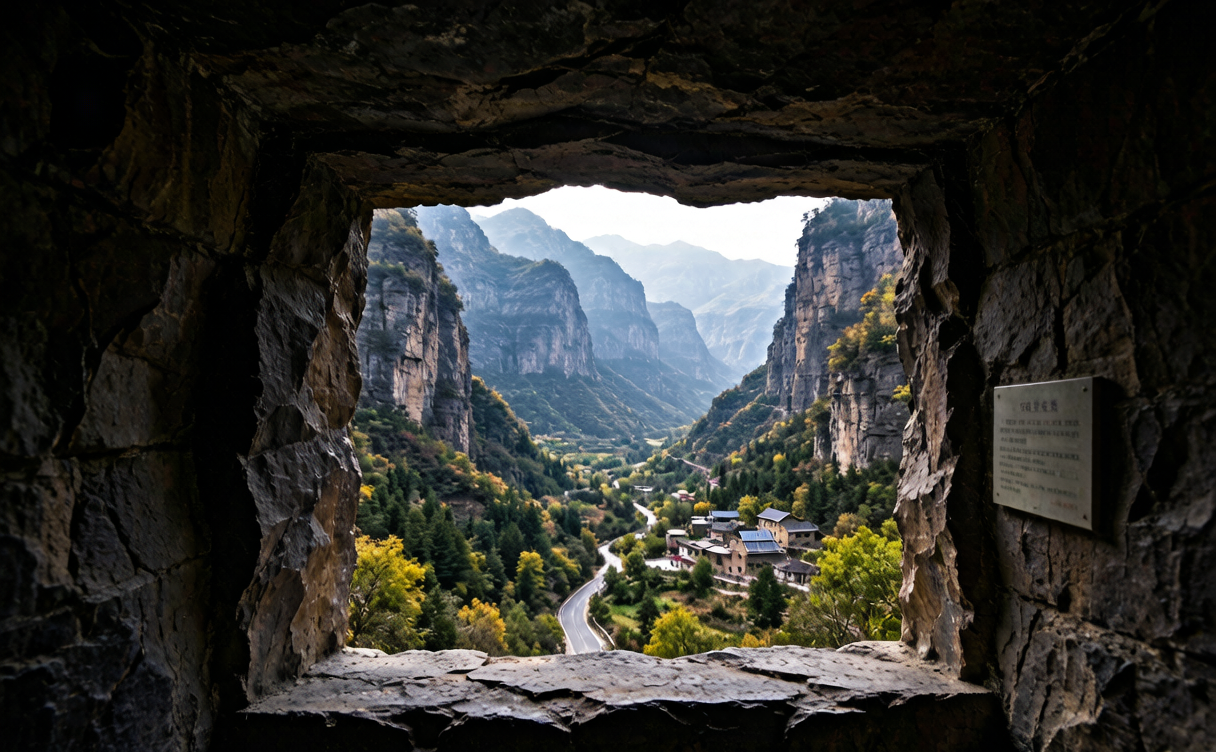
The rock is unfinished, chisel marks everywhere, the roof sagging and rising as the crew followed the softer seams. Every twenty metres or so a ragged window opens onto a 200-metre drop and the canyon opposite. There is no railing at most of them. The floor is damp, and the light alternates between near-dark and blinding. Photographs never capture how narrow it feels when a bus comes through.
There is a small memorial near the upper mouth listing the thirteen men who dug it, several of whom died during the work.
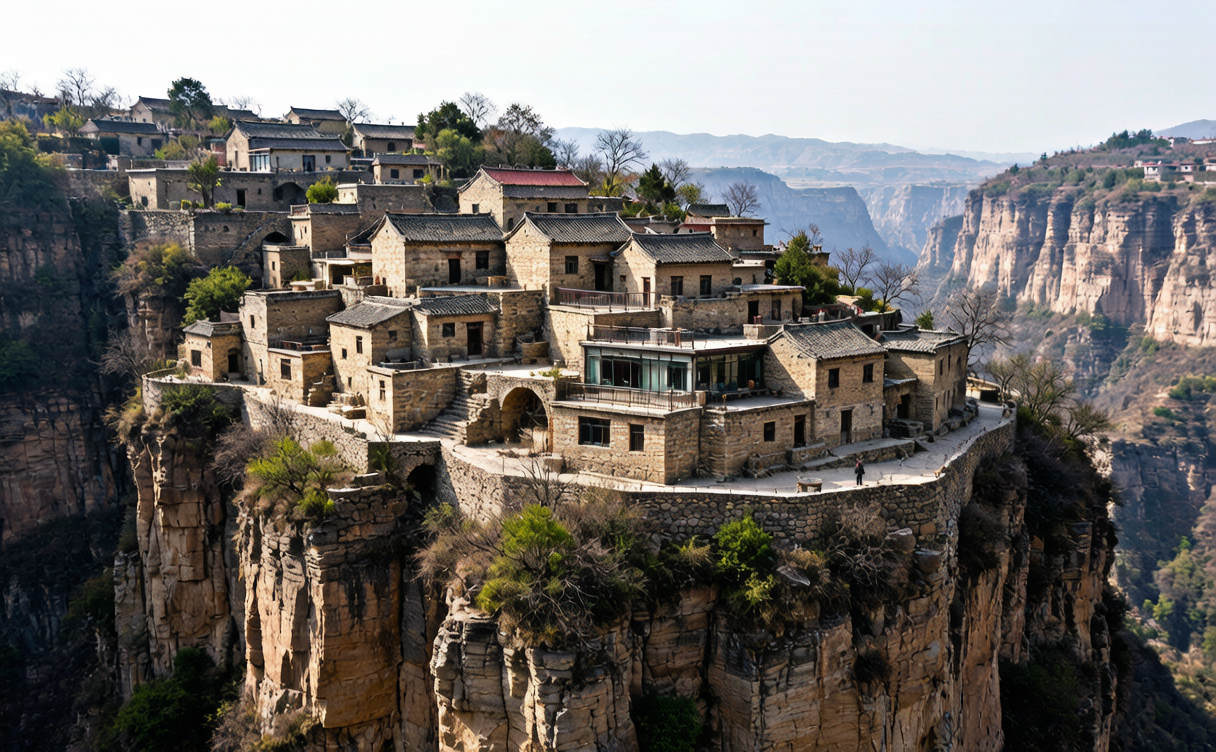
The village on the clifftop
Guoliang proper is a compact settlement of grey stone houses with stone-slab roofs, threshing floors and walnut trees, spread along the rim. Walk to the eastern edge for the classic view back along the cliff with the tunnel windows visible as a line of dark dots.
The film-set history is inescapable — several courtyards advertise which production used them — but the village still farms, and outside the main lane you will find drying corn, chickens and people getting on with their day. Early morning and after the day-trippers leave around 17:00 are the two good hours.
The Sky Ladder and the canyon walks
The original Sky Ladder still exists and can be descended, with care, from a point below the village. It is exposed, uneven and not for anyone uneasy with heights; allow an hour down and considerably more back up.
Easier walking includes the Red Dragon Cave path, the Sky Pool (天池) on the plateau, and the Black Dragon Pool waterfall, which is best after summer rain. The Guoliang Village hiking trails and routes are mostly short link paths between viewpoints rather than long treks — half a day covers the lot. For bigger objectives elsewhere in China, see our China hiking and trekking guide.
Nanping and the wider scenic area
Nanping, a shuttle ride away, has waterfall trails and far fewer visitors. Luojiezhai, higher again, is where you go for sunrise over the escarpment. Both are included in your ticket and both are skipped by day-trippers, which is why they suit a second day.
Where to Stay
Cliff-top guesthouses — ¥100–250 (US$14–35). Dozens of village houses rent rooms, and this is the reason to stay overnight. Standards are basic: hard beds, thin walls, shared bathrooms in the cheaper places, dinner cooked by the family. A canyon-facing room costs a little more and is worth it.
Mid-range — ¥300–500 (US$42–71). Renovated stone courtyards and small hotels near the scenic-area gate, with en-suite bathrooms and heating.
In Huixian or Xinxiang — ¥180–400 (US$25–56). Chain hotels if you would rather commute. You lose the empty village at dawn, which is the best thing about the place.
Book ahead for October weekends — rooms sell out and there is no walk-in overflow.
Sample Itinerary: Two Days
Day 1
- Morning train to Xinxiang, road transfer to the Wanxianshan gate
- 14:00 Shuttle up through the tunnel; drop bags at your guesthouse
- 15:00 Walk the tunnel on foot from the upper end
- 17:30 Village lanes and the eastern viewpoint for sunset
- 19:00 Dinner in the courtyard; Henan noodles and mountain mushrooms
Day 2
- 06:30 Sunrise from the rim before the first buses
- 08:00 Sky Ladder descent, or the Sky Pool circuit if heights are not your thing
- 11:00 Shuttle to Nanping for the waterfall walk
- 15:00 Return transport to Xinxiang or Zhengzhou
Practical Tips
- Passport required. Tickets are sold under your real name and checked at the gate. Bring the physical passport, not a photo.
- Book online if you can. The scenic area uses a WeChat mini-program. If it will not take your passport number, the ticket window will.
- Payment. Alipay and WeChat Pay work almost everywhere and now accept international cards. Carry ¥300 cash anyway — signal on the plateau is patchy. There are no ATMs in the village.
- English is essentially absent. No English menus, no English-speaking staff, minimal signage. Save your guesthouse name in Chinese characters.
- Mind the drops. The tunnel windows and several viewpoints have no barriers. Keep children close and stay off wet rock near the edge.
FAQ
Is Guoliang Village worth the effort to reach?
If you like infrastructure, engineering history or dramatic landscape, yes. It is a long day of transport from Zhengzhou for a place you can walk across in ten minutes, so the value depends on staying overnight. Day-trippers see the tunnel from a bus window and miss the point.
What are the Guoliang Village tickets and opening hours?
The Wanxianshan scenic area generally operates 07:00–18:00, shorter in winter. Entry is about ¥125 with a separate shuttle fee near ¥45, and tickets are usually valid for two days, which suits an overnight stay.
Can I do a Guoliang Village day trip from Zhengzhou?
It is possible with a chartered car — roughly two and a half hours each way, leaving four or five hours on site. By public transport it is not realistic, because the last rural coach back to Huixian leaves in the afternoon.
Is the tunnel safe to walk?
Yes, with sense. Shuttle buses share the space, so walk on the inside, listen for engines and step into a window recess when one passes. Wear shoes with grip; the floor is wet in places.
Is this a good destination for photography?
One of the best in northern China. Low side light through the rock windows in the early morning, canyon mist after rain, and the stone village at dusk. Our China photography tour guide covers how to build a trip around locations like this.
Written by Karl · Updated August 6, 2026