

At 1,600 metres in subtropical central China you expect bamboo, or pine, or cloud forest. What you get here is grass — thousands of hectares of it, rolling over the ridge tops in green waves with nothing taller than your knee, which is why Chinese hikers call this place the sea of grass and why on a summer Saturday the summit looks like a tent city. This Mount Wugong travel guide covers how the meadows work, which of the three main routes to take, whether to camp or catch the last cable car down, and how to get there from Nanchang or Changsha without wasting a day.
Content Preview
- Why a subtropical mountain has alpine grassland on top
- Best time to visit, and what the weather does to your plans
- Getting to Pingxiang by rail, then to the gate
- Mount Wugong hiking trails and routes, the cable car and the Jinding summit
- Camping, tickets, where to stay, a two-day plan and practical tips
What Mount Wugong Is
Wugong Shan (武功山) straddles the boundary between Pingxiang and Ji’an prefectures in western Jiangxi. Its main summit, Jinding (金顶) — the Golden Summit, also called White Crane Peak — stands at around 1,918 metres, the highest point in this part of the province. Around it spread roughly 6,600 hectares of high-altitude meadow, unusual at this latitude, produced by thin soils, persistent wind and centuries of grazing and burning.
The mountain has been a Taoist site for well over a thousand years, and stone altars still stand on the summit where pilgrims left offerings. Today most people come to walk and camp. The Wikipedia entry for Jiangxi gives the geographical context for a wider provincial route.
Best Time to Visit
Late April to June. Grass at its greenest, azaleas out on the slopes, 12–24°C on the ridge. Also the wettest stretch, so expect a soaking.
July and August. Warm days, cool nights, and the peak camping season — the summit meadows fill with tents at weekends. Valley heat can hit 35°C but the ridge stays around 18–25°C. Book everything ahead.
September to early November. For most people the best time to visit Mount Wugong: dry, stable, 10–22°C, the grass turning gold, and the clearest chance of a sunrise above cloud. Avoid 1–7 October entirely.
December to March. Cold, 0–8°C on the ridge with wind chill well below, frequent fog, and rime ice that draws its own photographers. Sections of the trail and the cable car may close in bad weather.
How to Get There
Pingxiang North (萍乡北) on the Shanghai–Kunming high-speed line is the gateway, and it is remarkably convenient: under an hour from Changsha, a little over an hour from Nanchang. From the station, a scenic-area shuttle or taxi covers the roughly 45 kilometres to the main gate. Book rail tickets under your passport name. For how China’s protected scenic areas handle permits and access, see our China national parks guide.
| From | Mode | Duration | Typical cost |
|—|—|—|—|
| Changsha South → Pingxiang North | High-speed rail | 40 min | ¥85 (US$12) |
| Nanchang West → Pingxiang North | High-speed rail | 1 hr 10 min | ¥110 (US$16) |
| Shanghai Hongqiao → Pingxiang North | High-speed rail | 5 hr | ¥560 (US$78) |
| Pingxiang North → Wugongshan main gate | Tourist shuttle bus | 1 hr 15 min | ¥25 (US$3.50) |
| Pingxiang North → main gate | Taxi or Didi | 1 hr | ¥180 (US$25) |
| Main gate → Shigu Temple lower cable station | Scenic shuttle | 20 min | ¥20 (US$3) |
A car and driver for two days from Pingxiang runs ¥800–1,200 (US$112–168) and is worth it if you plan to start on one side and finish on another.
Mount Wugong Travel Guide to the Routes and the Summit
Entrance tickets typically run around ¥70 (US$10) in high season, with the cable car about ¥70–90 (US$10–13) each way and scenic shuttles charged separately. Gates generally open around 07:00 and the cable car stops running in the late afternoon, often by 17:00 — miss it and you are walking down in the dark. Book through the scenic area’s WeChat mini-program; the ticket window accepts passports but is slow.
The Pingxiang side: cable car and Jinding
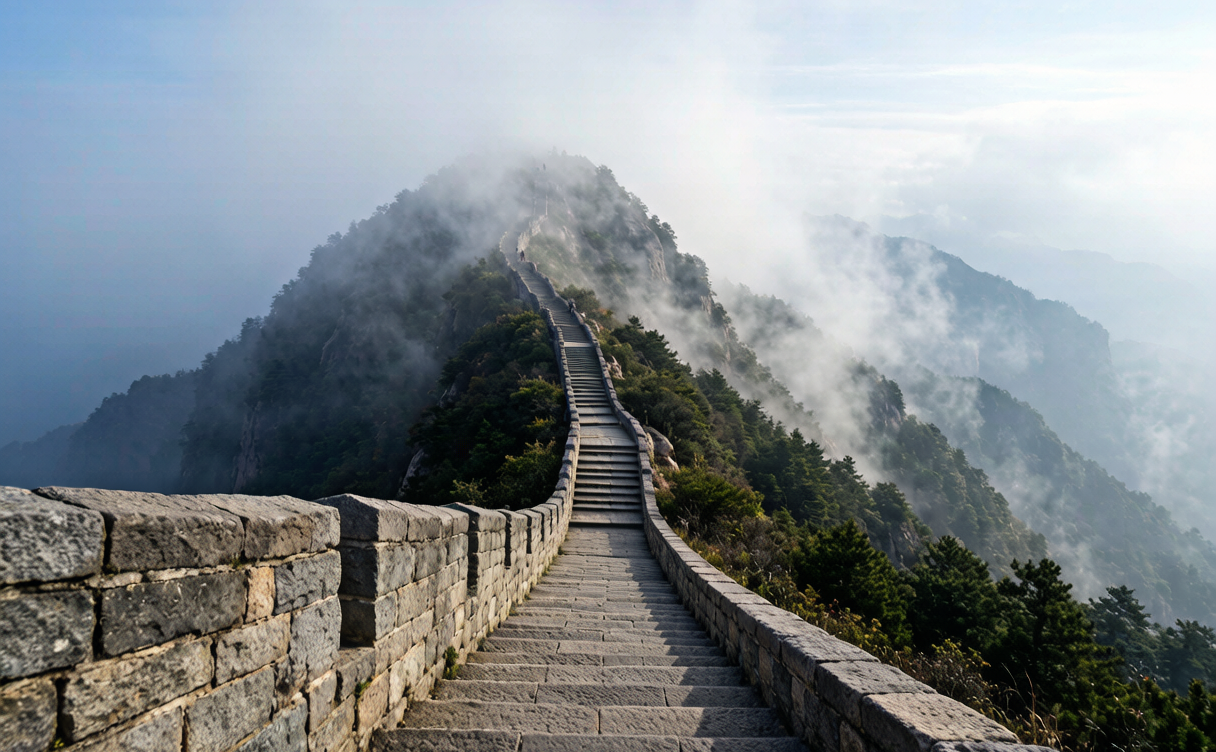
The standard approach starts on the northern, Pingxiang side. A shuttle takes you to the lower cable station near Shigu Temple; the cable car lifts you to the mid-mountain terminus in around twenty minutes, and from there it is roughly an hour to ninety minutes of stone stairway to Jinding.
The last section has a name every Chinese hiker recognises: Juewang Po (绝望坡), Desperation Slope, a long unbroken staircase up an open grass face with the top always further away than it looks. Take it slowly. On the summit there are Taoist altars, a weather-beaten stele or two, and — on a good morning — an unbroken cloud floor stretching to the horizon.
The full traverse
The serious option is the ridge traverse, usually walked over two days from the Pingxiang side across to Fayunjie (发云界) and out at Shenzi village, or the reverse. Roughly 25 to 30 kilometres of grassland ridge, several substantial climbs, no cable car for most of it, views the whole way. Do not attempt it in fog without offline maps: the meadows look identical in every direction and people get lost here every season.
Yangshimu
Yangshimu (羊狮慕), on the Ji’an side, is the third entrance and a different landscape — granite outcrops, twisted pines and cliff walkways rather than open grass. It has its own cable car and makes a half-day if you have a car. Most first-time visitors skip it.
Camping on the ridge
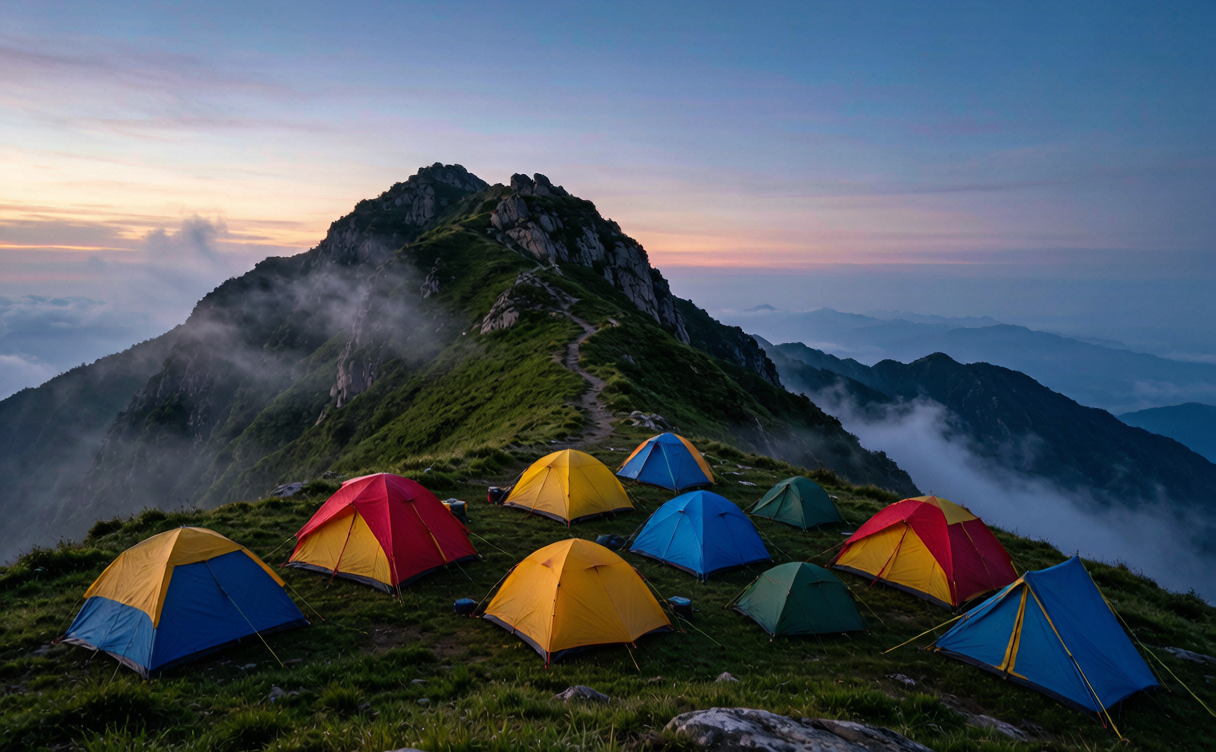
This is what Wugong is really known for. Designated camping areas sit on the meadow near the summit, and on summer weekends hundreds of tents go up. Carry your own or rent on site — tent, mat and sleeping bag packages typically run ¥150–300 (US$21–42), booked through the operators’ mini-programs.
Be realistic about conditions. The ridge is fully exposed, wind picks up after dark, and temperatures drop 10–15°C from the daytime high even in August. Our China camping and glamping guide covers the gear-rental system in detail.
Where to Stay
On the ridge — ¥150–400 (US$21–56). Tents, plus a few basic guesthouses and dormitories near the summit meadow. Cold, noisy at weekends, and the only way to get sunrise without a 03:00 start.
At the gate — ¥180–450 (US$25–63). Guesthouses and small hotels cluster around the Pingxiang-side entrance and the hot spring resort area nearby. The soak after a day of stairs is not a gimmick.
Pingxiang city — ¥130–320 (US$18–45). Chain hotels near Pingxiang North station. Best for a late arrival or early departure, worst for actually climbing.
Resort — ¥600–1,100 (US$84–154). A couple of larger hot-spring properties at the mountain’s foot, popular with Changsha weekenders and often full on Saturdays.
Sample Itinerary
Two days from Changsha or Nanchang, with a night on the mountain.
Day 1 — up and over
- 07:00 train to Pingxiang North
- 09:00 shuttle to the main gate, then the scenic bus to the cable station
- 10:30 cable car up
- 12:00 lunch at the mid-mountain terminus
- 13:00 climb Desperation Slope to Jinding
- 15:00 walk out along the meadow ridge, pitch camp
- 19:00 sunset, then a very early night
Day 2 — down
- 05:30 sunrise from the ridge
- 08:00 breakfast, pack up
- 09:00 walk back to the cable car, or continue towards Fayunjie
- 13:00 hot spring at the foot of the mountain
- 16:30 train home from Pingxiang North
Practical Tips
- Book tickets and tents online. Weekend capacity at the summit campsites is capped and does sell out. Reserve under your passport name.
- Carry your passport. Gate scanners are built for Chinese ID cards; staff will process passports manually, so allow extra time.
- Watch the last cable car. It typically stops in the late afternoon. If you miss it, the walk down takes two to three hours on stone steps.
- Weather changes fast. Clear valley, fogged ridge is the normal pattern. Pack a shell and warm layer regardless of the forecast.
- Cash and signal. Mobile payment works at the gate and most stalls, but ridge signal is patchy. Carry ¥300 and download offline maps.
- No English. Signage, ticketing and rescue notices are Chinese only. Walk with a translation app and tell your hotel your route.
- Water. Refills exist at the mid-mountain terminus and summit stalls, but they are pricey and can run out at weekends.
FAQ
Is Mount Wugong worth visiting?
If you want to walk and camp, it is one of the best places in central China to do it — the grassland ridge is genuinely unusual and the sunrise above cloud earns the effort. For temples, gorges or classic Chinese mountain scenery, Lushan or Huangshan serve you better.
How to get to Mount Wugong?
High-speed rail to Pingxiang North, then a shuttle bus or taxi to the main gate, roughly an hour. Changsha South to Pingxiang North takes about 40 minutes, Nanchang West a little over an hour.
Can I do a Mount Wugong day trip from Nanchang?
Just about, using the cable car both ways and skipping the ridge walk. You will be out from 06:00 to 22:00 and you will miss sunrise, which is the main event. One night on the mountain is much better.
How hard is the hike?
The cable car plus Jinding route is moderate — one to two hours of steady stairs, including Desperation Slope. The two-day traverse is hard: 25 to 30 kilometres of exposed ridge with repeated climbs and no easy exit points.
Do I need my own camping gear?
No. Tents, mats and sleeping bags rent on the summit meadow for around ¥150–300 a night, usually booked through a Chinese mini-program. Bring your own warm layer, headtorch and rain shell whatever you decide.
What are Mount Wugong tickets and opening hours?
Entry is typically around ¥70 in high season, with the cable car about ¥70–90 each way and shuttles extra. Gates open around 07:00 and the cable car generally stops by late afternoon. Prices shift seasonally.
Written by Karl · Updated August 6, 2026