

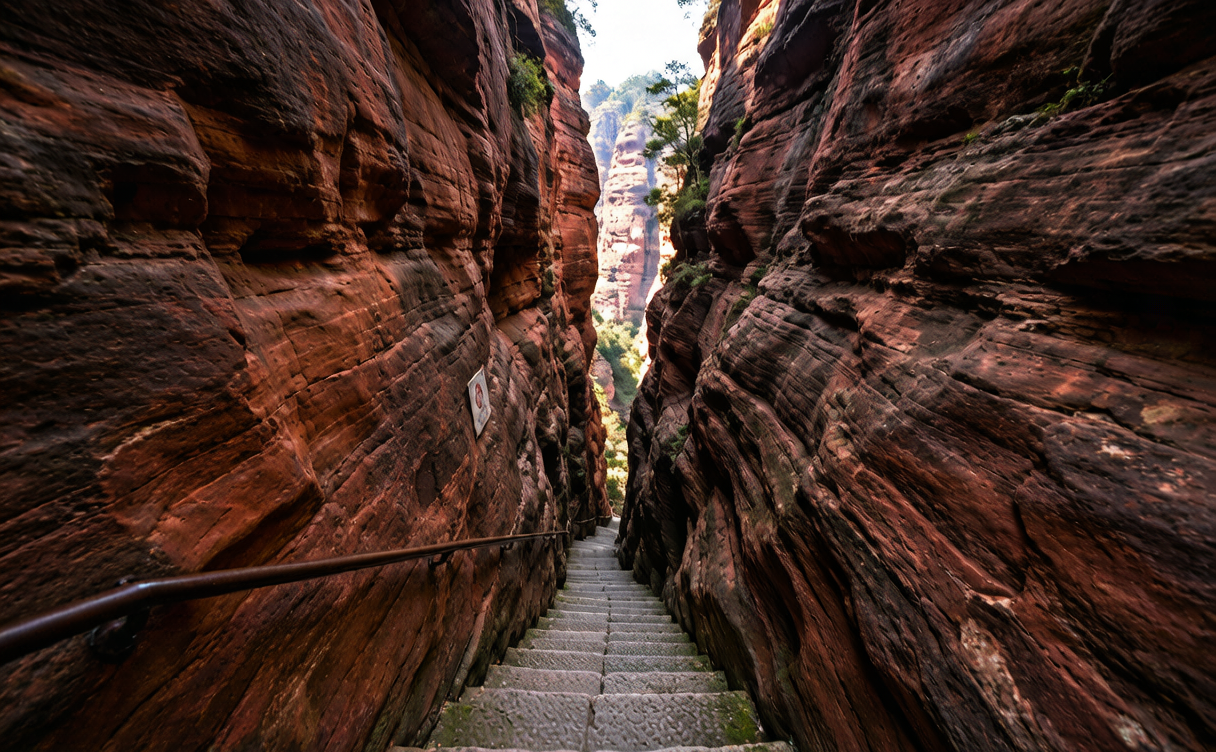
There is a crevice here called Tianyi Xiang where the rock walls close to less than a metre apart for a couple of hundred metres, and you walk it sideways with your pack in your hands. Above it stand red sandstone towers shaped like candles, camels and one improbable chilli pepper. Below it a jade-green river carries bamboo rafts past cliffs. Almost nobody outside China has heard of the place, even though it carries a World Heritage listing. This Mount Langshan travel guide covers the peaks, the trails, the rafting and the awkward business of getting to a corner of southwestern Hunan that no railway reaches.
Content Preview
- What danxia landform means and why Langshan is on the World Heritage list
- Best time to visit, including cloud-sea and rapeseed seasons
- How to reach Xinning from Changsha, Guilin and Shaoyang
- Mount Langshan hiking trails and routes: Lajiao Peak, Bajiaozhai, the Natural Bridge and the Fuyi River
- Tickets, cable cars, walkways, where to stay and a two-day plan
What Langshan Actually Is
Langshan (崀山) sits in Xinning County (新宁县), in the southwest corner of Hunan province, right against the Guangxi border. It is a danxia landscape: red terrestrial sandstone and conglomerate, laid down in ancient basins, uplifted, then cut by water into freestanding towers, domes, arches and narrow gorges. In 2010 it was inscribed alongside five other sites as part of China Danxia on the UNESCO World Heritage list.
The scenic area covers roughly 108 square kilometres in four or five clusters. Two do most of the work: Lajiao Feng (辣椒峰), the “Chilli Peak” area, and Bajiaozhai (八角寨) in the north, which straddles the provincial line into Ziyuan County, Guangxi, China. You cannot see both properly in one day.
Best Time to Visit
Late March to May. The strongest season: rapeseed in the valleys, 15–26°C, and the best chance of the cloud seas that made Bajiaozhai famous. Bring rain gear — spring here is wet.
June to August. Hot, 28–36°C in the valley, with afternoon storms and cooler ridges. Best for rafting the Fuyi River, worst for long stair climbs.
September to November. The other good window, and for most people the best time to visit Mount Langshan: dry, stable, 14–25°C, excellent visibility. Quiet after the October holiday.
December to February. 2–10°C, often foggy, with occasional ice closing higher walkways at short notice. Very few visitors.
How to Get There
There is no railway station in Xinning, and this is the single thing that keeps Langshan empty. You reach it by road from a high-speed rail hub. Shaoyang North (邵阳北) on the Shanghai–Kunming line is the usual choice from Changsha; from Guilin, driving in via Ziyuan and the Bajiaozhai north gate is often faster. Shaoyang Wugang Airport (WGN) is around 40 kilometres away with a handful of domestic routes. Book rail tickets under your passport name. For how protected areas like this one are run and ticketed, see our China national parks guide.
| From | Mode | Duration | Typical cost |
|—|—|—|—|
| Changsha South → Shaoyang North | High-speed rail | 1 hr | ¥120 (US$17) |
| Shaoyang North → Xinning town | Coach or car | 2 hr 15 min | ¥50 / ¥400 (US$7 / 56) |
| Guilin → Xinning, via Ziyuan | Private car | 3 hr | ¥600 (US$84) |
| Guilin → Bajiaozhai north gate | Private car | 2 hr | ¥450 (US$63) |
| Changsha → Xinning | Direct long-distance coach | 5 hr | ¥140 (US$20) |
| Xinning town → Langshan visitor centre | Taxi or Didi | 20 min | ¥30 (US$4) |
Inside the scenic area, shuttle buses (typically around ¥40, US$5.60 for a day pass) link the clusters; the walk between them is far too long. Hiring a car and driver for two days from Shaoyang or Guilin costs ¥1,200–1,800 (US$168–252) and removes most of the pain.
Mount Langshan Travel Guide to the Peaks and Trails
Tickets are sold as a through pass covering the main clusters, typically around ¥168 (US$24) for adults, valid for two days, plus the shuttle fee and separate cable car charges. Gates generally open around 07:30 and stop admitting at about 16:30 or 17:00, earlier in winter. Buy online through the scenic area’s WeChat mini-program where you can; the window accepts passports but the queue is slow.
Lajiao Feng and Tianyi Xiang
Lajiao Feng (辣椒峰), Chilli Peak, is a single rock tower of roughly 180 metres that narrows towards its base, so it looks balanced rather than rooted. Nearby, Jiangjun Shi (将军石) — General Rock — is a lone pillar over 70 metres tall standing clear of the cliff behind it, and the single most photographed thing at Langshan.
The walk in this cluster takes you through Tianyi Xiang (天一巷), a fissure some 200-plus metres long that narrows to well under a metre at its tightest. It is frequently called the narrowest walkable crevice in China. If you are broad across the shoulders, or claustrophobic, this is your warning. Allow around three hours for the full loop including the stairs.
Bajiaozhai and the sea of clouds
Bajiaozhai (八角寨), at about 818 metres, is the northern cluster and the reason photographers come. From the summit platform you look down on dozens of rounded red domes packed together — the formation locals call qun luo guan tian, “a cluster of snails gazing at the sky.” On a spring morning with cloud filling the gaps, it is one of the great views in southern China.
A cable car runs most of the way up, typically around ¥100 (US$14) one way, cutting a climb of roughly two hours to about ten minutes plus a short walk. Cliffside plank walkways link the viewpoints, and some sections have glass floors bolted to the rock — solidly built, but not for everyone. Sunrise here needs an overnight in Ziyuan or at the north gate.
Tiansheng Qiao and the Natural Bridge
Tiansheng Qiao (天生桥) is a natural rock arch spanning a stream gorge, formed where a cave roof collapsed. It is a shorter, easier stop than the two big clusters and works well as a filler on an afternoon, often combined with the Camel Peak viewpoints.
Rafting the Fuyi River
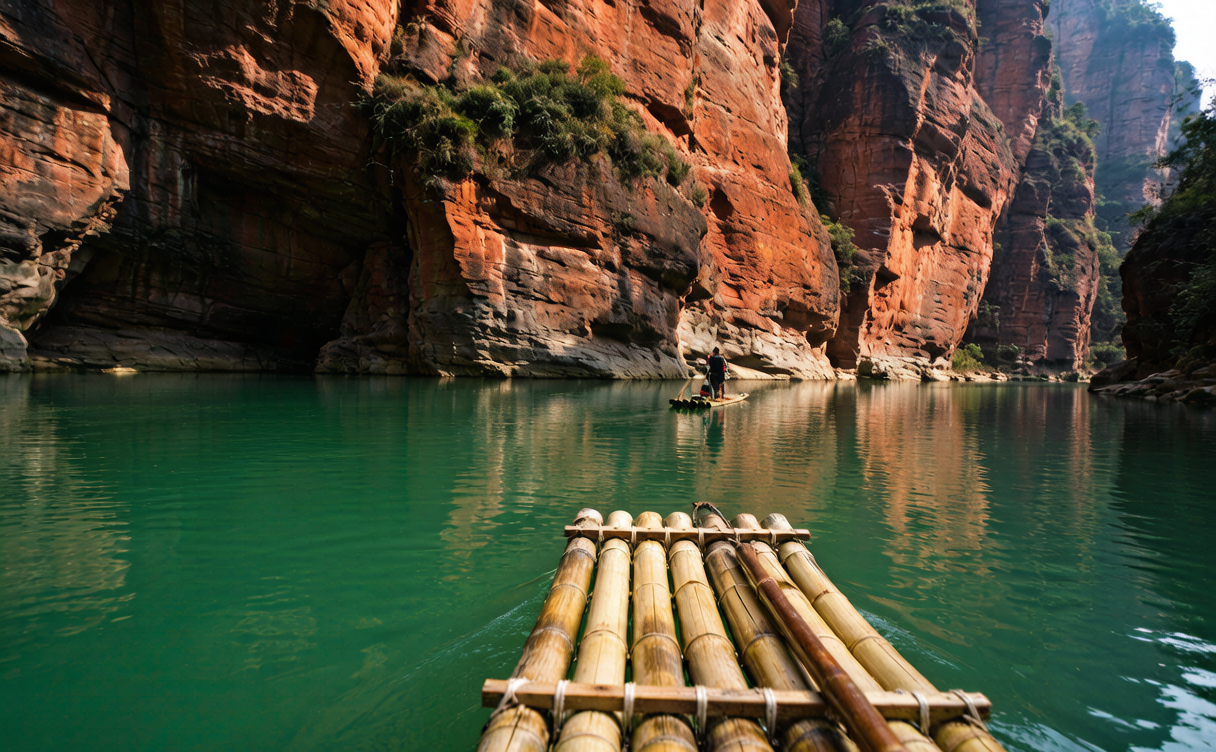
The Fuyi River (扶夷江) runs through the middle of the scenic area, and drifting it on a bamboo or rubber raft is the best ninety minutes you will spend here: green slow water, cliffs going straight up on both sides, and a welcome change of angle after two days of stairs. Runs typically cost ¥100–160 (US$14–22), operate roughly April to October, and stop after heavy rain. Our China hiking and trekking guide puts Langshan alongside the country’s bigger routes.
Where to Stay
At the mountain — ¥150–350 (US$21–49). Guesthouses and small hotels cluster around the Langshan visitor centre and the villages near Lajiao Feng. Basic, family-run, often with home cooking included. This is the right choice for an early start.
Xinning town — ¥120–300 (US$17–42). Twenty minutes away, with chain hotels, ATMs and proper restaurants. Better beds, less atmosphere.
Bajiaozhai north side — ¥180–400 (US$25–56). A few guesthouses on the Ziyuan, Guangxi, China side of the ridge. Worth it only if sunrise at Bajiaozhai is the priority.
Resort — ¥600–1,100 (US$84–154). One or two larger properties near the main gate, with proper heating and hot water pressure — which matters more than it sounds in winter.
Sample Itinerary
Two days, arriving the evening before from Changsha or Guilin.
Day 1 — the Hunan clusters
- 07:30 gate opens; shuttle to Lajiao Feng
- 08:00 Tianyi Xiang crevice, then the stairs to the viewpoints
- 11:00 General Rock and Camel Peak
- 13:00 lunch at the visitor centre
- 14:30 Tiansheng Qiao natural bridge
- 16:30 Fuyi River raft, in season
Day 2 — Bajiaozhai
- 06:00 drive to the Bajiaozhai gate
- 07:30 cable car up for the morning cloud
- 09:00 ridge walkways and the summit platform
- 12:00 down, lunch, then drive to Guilin or back to Shaoyang North
Practical Tips
- Book with your passport. Tickets and the online reservation system accept passport numbers, but carry the physical document — the gate scanners are built for Chinese ID cards and staff will check manually.
- Bring cash. Mobile payment works at the main gates; village guesthouses and raft operators sometimes prefer notes. Carry ¥500.
- No English. Essentially none — not on signage, not at ticket windows, not in guesthouses. Download offline maps and a translation app first.
- Shoes matter. Steep stairs, slippery wet stone, uneven footing in the crevices. Trail shoes, not sandals.
- Weather closes things. Glass walkways and rafting both stop in storms, and refill points on the ridges are few. Keep a flexible half-day in the plan.
- Getting out. The last coaches from Xinning to Shaoyang leave in the late afternoon. Confirm times the day before, or arrange a car.
FAQ
Is Mount Langshan worth visiting?
If you like landscape and do not mind effort, yes. It has World Heritage rock scenery with a fraction of the crowds at Zhangjiajie, and the crevice walks are genuinely unlike anything else in China. If you want convenience and English signage, it will frustrate you.
How to get to Mount Langshan without a car?
Train to Shaoyang North, then a coach to Xinning, then a local taxi. It works, but it eats most of a day in each direction. Direct coaches also run from Changsha.
Can I do a Mount Langshan day trip from Changsha?
Not sensibly. Changsha is around five hours away by road, or an hour by rail plus two hours by coach. Give it two nights.
How difficult are the trails?
Moderate to hard. Almost everything is stone steps rather than rough ground, but there are thousands of them and the crevices are tight and steep. A cable car removes the worst of the Bajiaozhai climb; Lajiao Feng has no such option.
What do Mount Langshan tickets and opening hours look like?
A through ticket of around ¥168 covers the main clusters for two days, with shuttles at roughly ¥40 and cable cars charged separately. Gates typically open around 07:30 and close admissions in the late afternoon, earlier in winter. Check current prices before you travel.
Written by Karl · Updated August 6, 2026