

Around 2,600 years ago, people living along a river in what is now eastern Jiangxi began burying their dead in caves punched into vertical red cliffs, sixty metres above the water, with no obvious way up. Centuries later a Taoist alchemist called Zhang Daoling chose the same valley to refine his elixir, and the lineage he founded has had its headquarters here ever since. This Mount Longhu travel guide covers a place where both stories are visible from the deck of a bamboo raft — a UNESCO-listed danxia landscape barely known to foreign visitors, forty minutes by train from Nanchang.
Content Preview
- Where Mount Longhu is and what “danxia” means
- Season-by-season weather and when the crowds arrive
- Trains, shuttles and the park entrance system, with a cost table
- The raft drift, the hanging coffins and the Celestial Master’s Mansion
- Where to stay, a two-day plan, and the questions travellers ask most
Where Mount Longhu Is and What Danxia Means
Mount Longhu (龙虎山, “Dragon and Tiger Mountain”) sits about 20 km southwest of Yingtan, a railway junction city in eastern Jiangxi. Do not expect a mountain in the alpine sense — the high point is barely 250 metres above the plain. Instead you get blunt red sandstone towers standing in green farmland, cut through by the shallow Luxi River.
This is danxia topography: iron-rich sandstone laid down in ancient basins, uplifted, then weathered into walls that glow orange in low sun. Six Chinese sites were inscribed together in 2010 as China Danxia on the UNESCO World Heritage List, and this is one of them.
The second layer is religious. Zhengyi (Orthodox Unity) Taoism traces its authority to this valley, and the hereditary Celestial Masters of the Zhang family administered it from Shangqing town for most of a millennium. If you have been to Wudang, this is the other half of the picture — our Wudang Mountain guide covers the Complete Perfection tradition of Hubei.
Best Time to Visit
March to May. The best all-round window: 15–26°C, a full clear river, rapeseed flowers around the villages in late March. Expect some rain.
June to August. Hot and humid, 30–37°C, with no shade on the rock. The raft drift is pleasant in this weather; the trails are not.
September to November. Dry, stable, 16–27°C, cliffs at their most photogenic, and the easiest season for walking. Avoid 1–7 October, when the National Day holiday fills every raft.
December to February. Cold and damp rather than freezing, 3–12°C. Visitor numbers collapse, rates halve, and mist between the rock towers looks extraordinary. Bring a windproof layer — you sit still on open water for over an hour.
Weekends draw two to three times the weekday crowd, with Nanchang, Hangzhou and Fuzhou all within easy reach.
How to Get There
Yingtan is on the Shanghai–Kunming high-speed line, so the answer to how to get to Mount Longhu is almost always a train to Yingtan North (鹰潭北), then a 40-minute bus or taxi.
| From | Mode | Duration | Approx. cost |
|—|—|—|—|
| Nanchang West → Yingtan North | High-speed rail | 40 min | ¥60 (US$8.50) |
| Hangzhou East → Yingtan North | High-speed rail | 2 hr 20 min | ¥250 (US$35) |
| Shanghai Hongqiao → Yingtan North | High-speed rail | 3 hr 20 min | ¥320 (US$45) |
| Huangshan North → Yingtan North | High-speed rail | 1 hr 40 min | ¥170 (US$24) |
| Xiamen North → Yingtan North | High-speed rail | 3 hr 40 min | ¥340 (US$48) |
| Yingtan North → visitor centre | Bus K2 | 40 min | ¥10 (US$1.40) |
| Yingtan North → visitor centre | Didi or taxi | 35 min | ¥70–90 (US$10–13) |
Inside the scenic area you do not drive. Your ticket includes the green shuttle buses looping between the visitor centre, the raft pier, Shangqing town and the eastern trailheads, roughly every 15 minutes from 08:00 to 17:30.
Mount Longhu Travel Guide to the Main Sights
Entrance costs around ¥100 (US$14) including shuttle transport, with the raft drift sold separately at roughly ¥100–120. Combined passes run ¥200–260 (US$28–37). Prices shift by season, so treat these as planning figures.
The Luxi River bamboo raft drift
This is the reason to come. Wide rafts poled by two boatmen carry six passengers on a slow 5 km drift down the Luxi River past the whole sequence of cliffs, taking 60–90 minutes. You sit low, close to the surface, with kingfishers working the shallows and red walls closing in overhead.
Rafts run from about 08:30 until mid-afternoon, and the last departure is earlier than you expect — be at the pier by 15:00. Take a hat and sunscreen; there is no shade. In heavy rain the drift is suspended.
The hanging coffins and the cliff-burial show
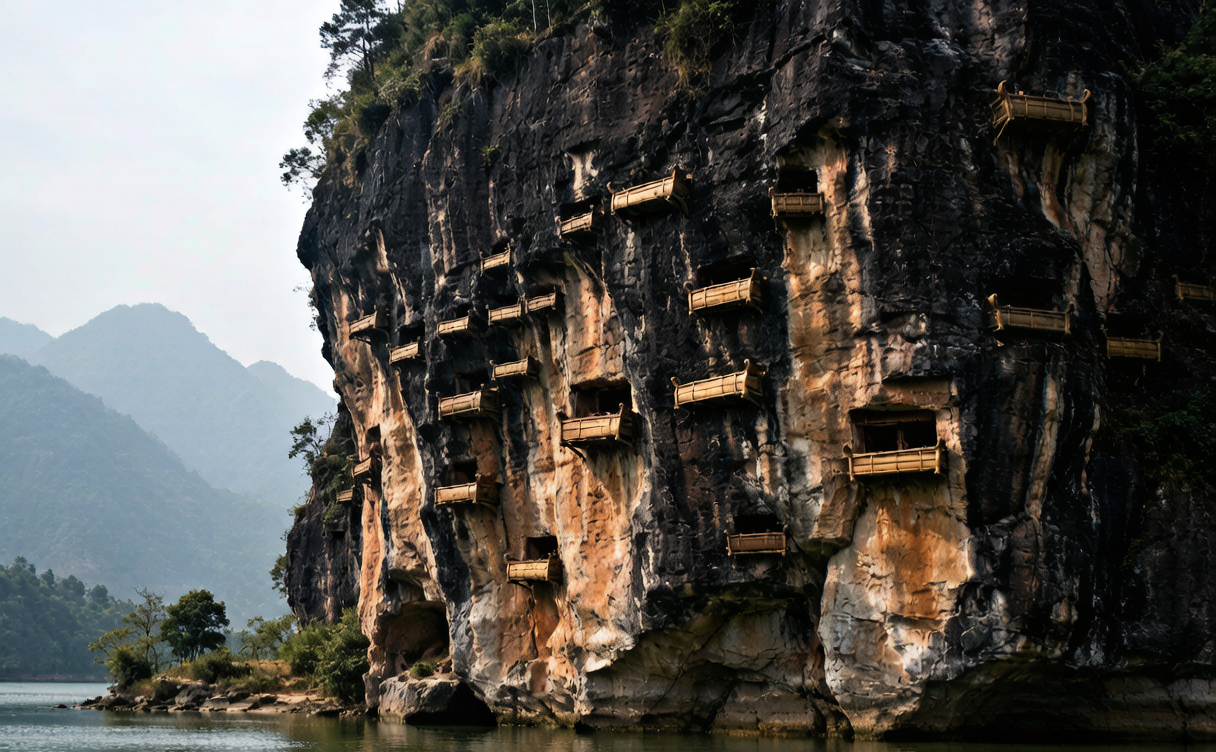
Roughly halfway down the river, look up at a honeycomb of caves in the sheer face. These held the wooden coffins of the Guyue people, placed there between about 770 and 476 BC. More than two hundred burial caves have been recorded here — one of the largest concentrations in China — and the silk, pottery and instruments recovered from them are in the site museum.
Nobody is certain how the coffins got up. Several times a day performers demonstrate the leading theory: climbers descend on ropes from the clifftop while a windlass crew hauls a replica coffin up the face. It is a tourist show, and also the clearest explanation of the engineering you will get. Performances usually run three or four times daily between 09:30 and 16:00 — confirm times at the entrance, because rafts are timed to arrive for them.
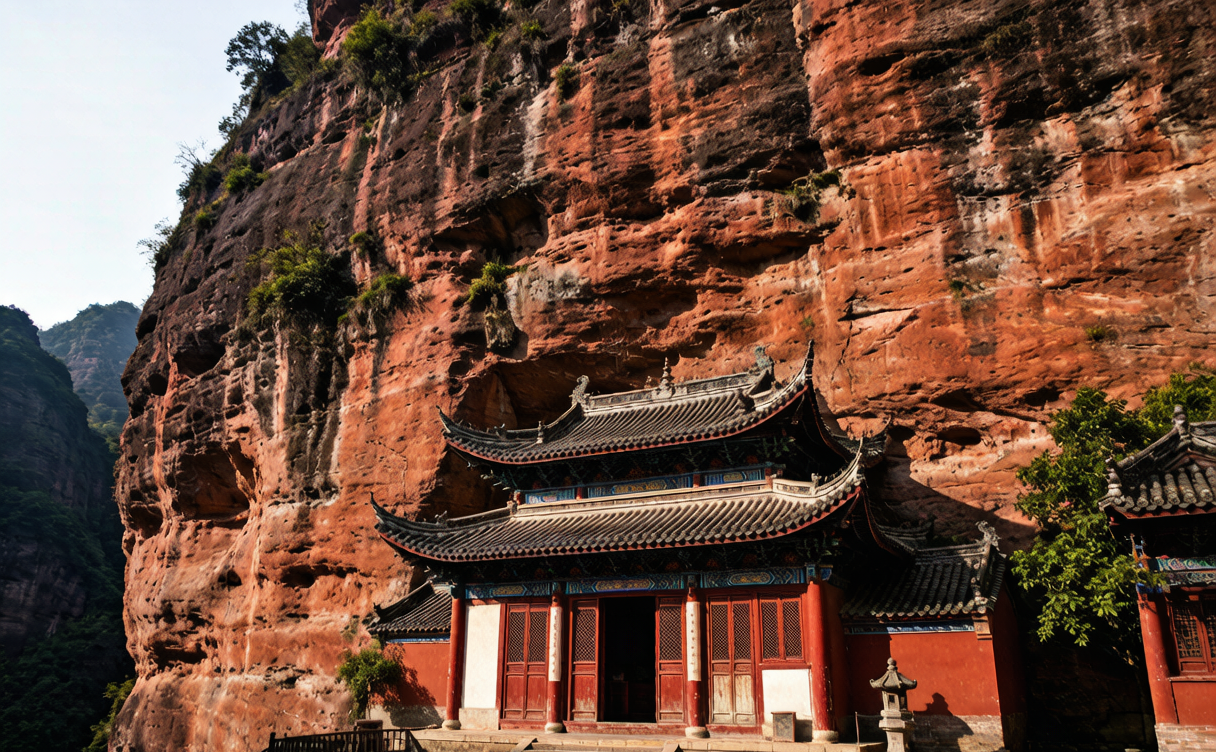
Tianshi Mansion at Shangqing
Eight kilometres upriver, Shangqing town holds the Celestial Master’s Mansion (嗣汉天师府), seat of the Zhang family who led Zhengyi Taoism. The buildings are largely Ming and Qing, set around courtyards of old camphor trees, with a garden behind that feels more like a scholar’s estate than a temple. Priests still conduct rituals here. Allow an hour, plus thirty minutes for the old street outside. Nearby Zhengyi Guan (正一观) marks where Zhang Daoling refined his elixir — a modern rebuild, quiet and rarely busy.
Elephant Trunk Hill and the walking routes
The Mount Longhu hiking trails and routes are short and steep rather than long. Elephant Trunk Hill (象鼻山) is the signature formation, a natural arch that really does look like an elephant lowering its trunk to drink. A stepped path loops around and above it in ninety minutes, best from the far side in afternoon light.
On the eastern side, trails climb to Xianshui Rock (仙水岩) and a ridge walk with planks bolted to the cliff. None of it takes more than half a day. For something more demanding, our China hiking and trekking guide lists routes at a different scale.
Where to Stay
Budget — ¥120–220 (US$17–31). Family guesthouses outside the main gate and chain hotels around Yingtan railway station. Basic, clean, often with a lift to the entrance in the morning.
Mid-range — ¥300–550 (US$42–78). Resort-style hotels near the visitor centre, plus business hotels in Yingtan city. Staying at the gate is worth the premium if you want the first raft.
Splurge — ¥700–1,300 (US$99–184). A few design guesthouses and one large resort near Shangqing with river-facing rooms. Book ahead for October and Chinese New Year.
Sample Itinerary: Two Days
Day 1 — the river
- 08:30 Enter at the visitor centre, shuttle to the raft pier
- 09:00 Bamboo raft drift down the Luxi River
- 10:30 Coffin museum, then the cliff-burial performance
- 12:30 Lunch at the pier village: river fish and Jiangxi rice noodles
- 14:30 Elephant Trunk Hill loop, staying for late light on the cliffs
Day 2 — the Taoist valley
- 08:30 Shuttle to Shangqing; Celestial Master’s Mansion before the tour groups
- 10:30 Old street and Zhengyi Guan
- 12:30 Xianshui Rock plank trail after lunch
- 16:00 Bus back to Yingtan North for an evening train
One full day covers the raft, the coffins and Shangqing if you start at opening time and skip the trails.
Practical Tips
- Bring your passport. Tickets are sold under your real name; you need the physical document to buy and to pass the gate. A phone photo is not accepted.
- Reserve online. Jiangxi scenic areas use WeChat mini-programs. Foreign passport holders can usually register; if the form rejects your document, use the ticket window.
- Payment. Alipay and WeChat Pay accept international cards and are smoothest. Cash works everywhere; foreign credit cards mostly do not.
- English signage is patchy. Main boards are bilingual, trail junctions are not.
- Wear grippy shoes. Danxia sandstone polishes smooth and turns slick after rain.
FAQ
How many days do I need at Mount Longhu?
One full day covers the raft drift, the hanging coffins and the Celestial Master’s Mansion. Two days lets you add the walking trails and see the cliffs at both ends of the day, when they look best.
Can I do a Mount Longhu day trip from Nanchang?
Yes, comfortably. The first train from Nanchang West reaches Yingtan North in about 40 minutes; you can be inside the park by 09:00 and back for dinner. Buy return tickets in advance at weekends.
What are Mount Longhu tickets and opening hours?
The scenic area opens 08:00–17:30, with shorter hours in winter. Entry with shuttle transport runs around ¥100, and the raft is a separate ¥100–120. The raft is what sells out first.
Is the raft drift suitable for children?
The Luxi River is shallow and slow, and the rafts are wide and stable. Life jackets are provided and should be worn. There is no shade and no toilet for the duration, which is the real consideration with young children.
Is Mount Longhu worth visiting if I have already seen Zhangjiajie or Huangshan?
They are different landscapes. Zhangjiajie is quartz sandstone pillars in forest; Huangshan is granite above cloud. Mount Longhu is low, red, riverine and cultural, and far quieter than either. Pair it with the terraced villages in our Wuyuan travel guide for a good week in Jiangxi.
Written by Karl · Updated August 6, 2026