

This Wuhan food guide is for travelers who want to eat like a local at 7 am. Wuhan, the sprawling capital of Hubei, China, sits where the Yangtze and Han rivers meet, and its food culture is built around “guo zao” — the morning habit of grabbing breakfast from the street and eating on the move. The undisputed icon is hot dry noodles, but the city’s river fish, lotus-root soups, and midnight duck-neck snacks are just as memorable. A Wuhan food guide is less about fine dining and more about joining the cheerful chaos of the breakfast rush. If you want a Hubei route, our Zhangjiajie travel guide sits a train ride west.
Content Preview
- Wuhan Food Guide: Best Time to Visit (and Food Seasons)
- Wuhan Food Guide: How to Get There
- Top Dishes to Eat in Wuhan
- Where to Eat & Stay in Wuhan
- Sample Wuhan Food Itinerary
- FAQ
Wuhan Food Guide: Best Time to Visit
The best time to visit Wuhan for food is spring (March–April) and autumn (September–November), when the humidity drops and riverside strolls are pleasant. Summers are famously brutal — Wuhan is one of the “three furnaces” of the Yangtze — yet that is exactly when a bowl of cold noodles and iced soy milk hits hardest. Winters are cold and grey; the lotus-root-and-rib soup becomes the comfort dish of choice.
Wuhan’s food calendar is informal but worth knowing: the lotus season (July–August) brings fresh lotus root and seeds, while the Yangtze’s fatty fish is best in cooler months. Around the Spring Festival, family reunion dinners feature a whole fish for luck. Plan timing with our best time to visit China guide. The city’s role where the Yangtze and Han rivers meet is detailed on Wikipedia’s Wuhan article.
A practical tip: because Wuhan’s summers are so hot, many locals shift their eating outdoors and late, so the best street food energy is after sunset from June to August. In winter, the same stalls pivot to steaming bowls and hotpot, so there is no bad season — only a different menu. Build your days around the morning “guo zao” and an evening walk, and the city opens up easily.
Wuhan Food Guide: How to Get There
Wuhan is a national transport giant. Tianhe International Airport (WUH) has flights nationwide and some international routes, and the city is a top high-speed rail hub — about 4 hours from Beijing, 2 hours from Changsha, and 5–6 from Shanghai. The metro connects the airport and both riverbanks efficiently. Foreigners booking trains should see a dedicated high-speed rail guide before traveling.
| Mode | Route | Time | Approx. Cost |
|——|——-|——|————–|
| Flight | Shanghai → Wuhan (WUH) | ~2h | ¥500–1,100 |
| High-speed rail | Changsha → Wuhan | ~1h 30m | ¥160–260 |
| High-speed rail | Beijing → Wuhan | ~4h | ¥520–900 |
| Metro | Airport → Hankou | ~50m | ¥7–12 |
| Taxi | Airport → city center | ~50m | ¥110–150 |
The three towns — Wuchang, Hankou, and Hanyang — are linked by bridges and metro; Didi covers the gaps between markets.
Top Dishes to Eat in Wuhan
Wuhan’s breakfast spread is the star. Here are the essentials.
| Dish | What it is | Where to try |
|——|———–|————–|
| Hot dry noodles (热干面) | Sesame-paste wheat noodles, the signature | Any “guo zao” stall |
| Doupi (豆皮) | Crispy rice-skin stuffed with rice and pork | Lao Tong Cheng |
| Steamed shaomai | Peppery pork-and-mushroom dumplings | Breakfast shops |
| Lotus-root rib soup | Milky soup with sticky root | Home-style restaurants |
| Duck neck (周黑鸭) | Braised, spicy dark-meat snack | Zhou Hei Ya shops |
| Mianwo | Fried rice-flour ring, savory | Street carts |
The Wuhan hot dry noodles define the city: springy noodles tossed with sesame paste, pickles, and scallion — no broth, just slick, savory heat. Wuhan street food peaks at night with duck neck and skewers along the Han River, while doupi is the brunch treat worth queuing for. For something soothing, the lotus-root rib soup is a Hubei classic that surprises first-timers with its sweet, sticky root.
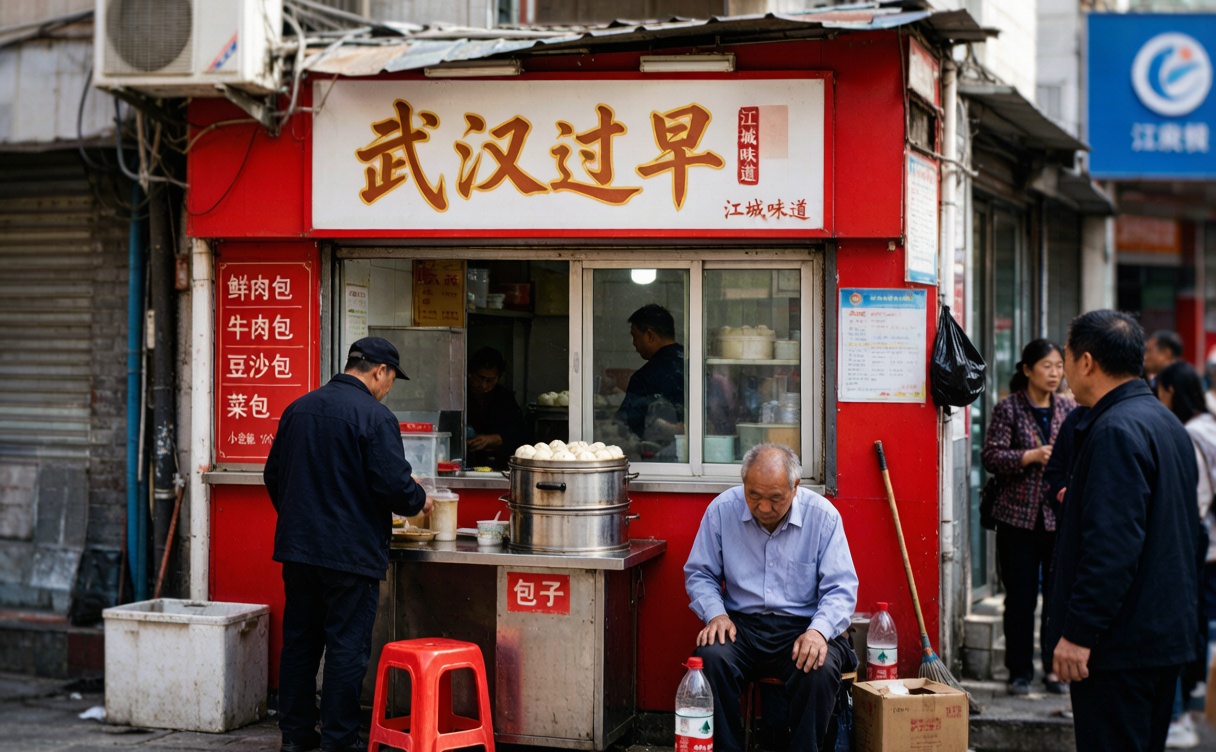
What makes Wuhan’s food distinct is the “guo zao” mindset — breakfast is not a quick bite but a proper, seated, multi-dish affair treated as the day’s first social event. Office workers queue at 7 am for a bowl and a seat, then drift to work. Joining them is the single best way to feel the city’s rhythm, and the variety at one stall row can rival a restaurant menu.
Where to Eat & Stay in Wuhan
For breakfast, follow commuters to the “guo zao” lanes near Hankou and Wuchang stations, where ¥5–10 buys a full morning meal. The Jianghan Road pedestrian street and the areas around Hubu Lane are the famous (busy) clusters; quieter neighborhoods reward the curious. For dinner, riverside hotpot and fish restaurants along the Yangtze are lively and good value.
Stay central — Hankou for colonial architecture and nightlife, Wuchang for the East Lake and universities. Hotels run ¥200–600. Our best things to do in China lists Wuhan among the great river-city stops.
Wuhan Food Guide: Practical Tips
A Wuhan food guide works best with a few habits. Breakfast early — the best “guo zao” stalls sell out by 9 am. Spice is moderate but duck neck is fiery; beer or soy milk cools it. Mobile payment rules, so set up Alipay or WeChat Pay, though cash still works at old stalls. A translation app with camera mode reads the Chinese-only menus.
Summer heat is no joke — carry water and avoid midday walking. Try the breakfast habit at least once even if you prefer hotels; it is the real Wuhan. Watch for crowded metro at rush hour and keep small bills for the tiny carts. With these tips, Wuhan is a safe, filling, and friendly food city that rewards an early riser.
Solo travelers can still eat well: most stalls serve single portions, and a “guo zao” breakfast costs less than a coffee back home. Tipping is not expected, and photo menus at larger spots save you from guessing. Carry your hotel’s Chinese address on a card for taxi rides, since drivers rarely read Romanized names.
Sample Wuhan Food Itinerary
Day 1: Arrive, breakfast on hot dry noodles, explore Jianghan Road, duck-neck dinner by the river.
Day 2: Morning doupi and shaomai, East Lake walk, lotus-root soup lunch, night market snacks.
Day 3: Final “guo zao,” souvenir duck neck, evening train out.
FAQ
What is Wuhan famous for eating? Hot dry noodles above all, plus duck neck and lotus-root soup.
Is Wuhan street food safe? Yes, at busy stalls with fast turnover; drink bottled water.
How do I get to Wuhan? Fly into WUH or take high-speed rail; it is a major hub.
When is the best time to visit Wuhan? Spring and autumn; summers are extremely hot.
How many days for food? Two to three days is enough for the classics.
By Karl — Last updated July 27, 2026