

I still remember the first time I stepped off the bus in Dali and saw them. It was a soft, grey morning, the kind where the Cangshan range disappears into cloud and the air smells of damp earth and woodsmoke. And there they were — three slender white pagodas standing in perfect stillness against the mountains. I had read about the Three Pagodas of Chongsheng Temple (崇圣寺三塔) for years, but nothing prepared me for how quietly monumental they are in person. They do not shout. They simply stand, as they have for more than a thousand years, watching over the old kingdom of Dali.
I had arrived the night before, tired from the train, and booked a hostel inside Dali Ancient Town. The next morning I wandered north without a plan, turned a corner, and the towers rose in front of me like a held breath.
If you are planning a trip through Yunnan, this is one of those sights you simply should not skip. It is the symbol of Dali, it is easy to reach, and it rewards both the casual traveler and the history lover. Here is everything I wish I had known before my first visit.
Getting There (Dali, Yunnan)
Dali sits in western Yunnan, and getting there is half the fun. Most foreign travelers arrive first in Kunming, the provincial capital, and then take a high-speed train west. The train from Kunming to Dali takes about two hours and glides through some of the most beautiful green countryside in China. If you want a full rundown of the city itself before you head west, our Kunming travel guide is the best place to start.
Once in Dali, you have two hubs: Dali Ancient Town, the tourist-friendly old town, and Xiaguan, the modern city center where the train station sits. The Three Pagodas are about 1.5 kilometers north of Dali Ancient Town. I found the easiest option was a short taxi or DiDi ride, which costs only a few dollars and drops you right at the south gate of the complex.
You can also rent a bicycle and pedal there along quiet lanes flanked by wheat and rape fields. I did this one misty morning and it was lovely, though the return leg uphill toward the base of Cangshan had me walking the bike more than riding it. E-bikes are cheap to rent and make the short hop effortless.
If you are coming from the north, many travelers combine Dali with Lijiang and Shangri-La on a classic western Yunnan route. The train between Dali and Lijiang is quick and scenic, and you can find practical details in our Lijiang Old Town travel guide.
What to See
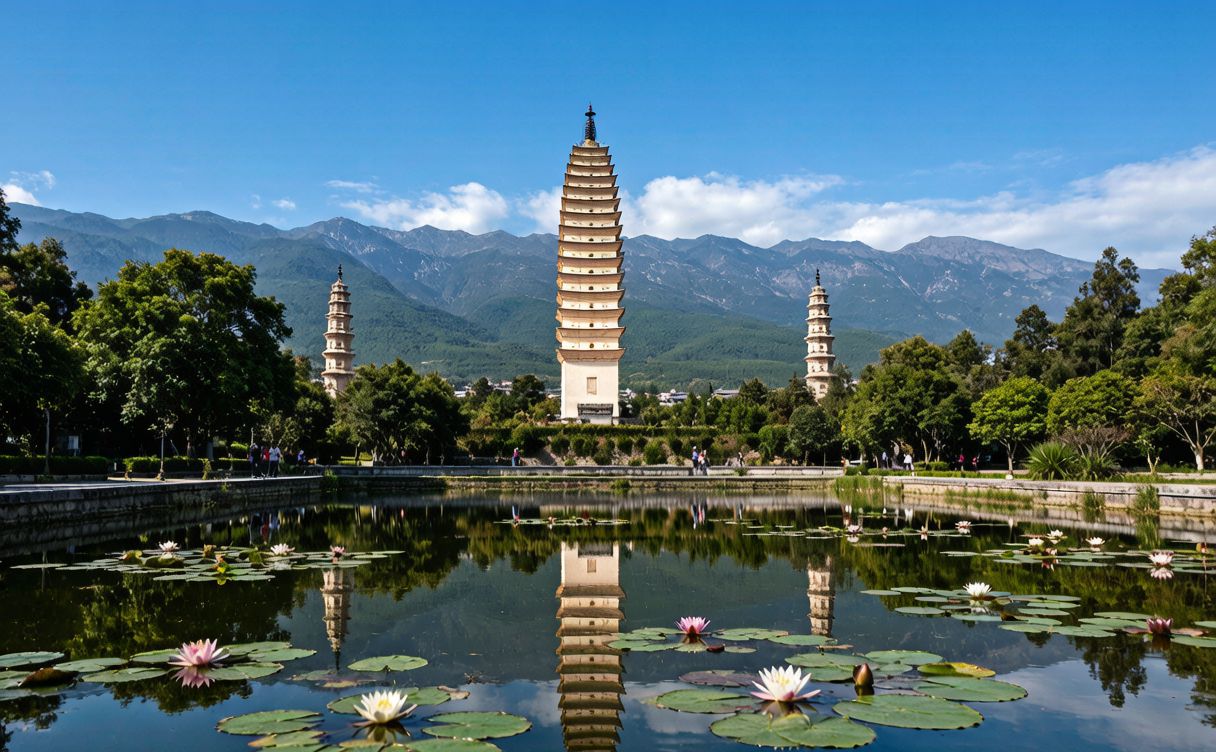
The star, of course, is the central Qianxun Pagoda. It rises about 69 meters and is a square, sixteen-story brick tower built in the elegant style of the Tang dynasty. Its lines are clean and unadorned, leaning ever so slightly — though locals will proudly tell you it has weathered more than a dozen major earthquakes and never once fallen. Flanking it are two smaller pagodas, each ten stories tall, set at the northwest and southwest corners. The three together form a near-perfect symmetrical triangle that has become the defining image not just of the temple but of Dali itself.
The famous reflection pond sits in front of the complex. I arrived early, before the tour buses, and the water was mirror-still. The three pagodas doubled themselves perfectly in the pond, and for a moment I could not tell which was real and which was reflection. This is the photograph everyone comes for, and it is worth the early wake-up. The best light is in the first hour after opening, when the sun is low and the brick glows a soft warm gold.
Behind the pagodas is the restored Chongsheng Temple. The original temple burned centuries ago, and what stands today is a careful reconstruction completed in the early 2000s. Some purists grumble that it is new, but I found it genuinely beautiful — a sweeping series of halls climbing the hillside, with golden roofs, red lacquer columns, and the smell of incense drifting down toward the pond. Even if you prefer the ancient towers, the temple gives the whole site a sense of living devotion rather than a frozen museum piece. Monks still chant here at certain hours, and the sound carries across the courtyard in a way that stopped me mid-step.
Inside the museum near the entrance, you will find Buddhist statues, carved tablets, and artifacts recovered from the site, including a massive bronze bell once used to mark time across the valley. Give yourself at least two hours to walk the full circuit slowly — rushing it would be a shame.
History
The pagodas were built during the Nanzhao Kingdom and the later Dali Kingdom, between roughly the 9th and 10th centuries. This was a golden age for the Bai people, who blended their own local traditions with Tang Chinese and Tibetan Buddhist influences into something uniquely southwestern. The Qianxun Pagoda is dated to the year 836, during the late Nanzhao period, and its construction borrowed directly from the brick pagoda designs then fashionable in the Tang capital of Chang’an.
What fascinates me is how the Three Pagodas survived when so much around them did not. Dali sits on a seismic fault line, and the region has seen devastating earthquakes — including a terrible one in 1925 that flattened much of the old town and toppled countless older structures. The pagodas tilted but held. Locals came to see them as a protective talisman for the whole valley.
The original Chongsheng Temple was once one of the great Buddhist centers of southwest China, said to have housed as many as three thousand monks at its peak. Over the centuries fires, wars, and weather reduced it to ruins, leaving only the pagodas as silent witnesses to that vanished grandeur. The modern reconstruction restores the silhouette that defined Dali’s skyline for a millennium.
Tips
A few things I learned the hard way. First, go early. The site opens around 7:30 a.m., and the first hour belongs to you and the reflection pond. By mid-morning the coaches arrive and the calm is gone, replaced by selfie sticks and tour flags.
Second, buy your ticket online in advance if you can, or be ready for a short queue at the gate. Entry is around 75 yuan, though prices shift, so confirm before you go. The ticket covers the pagodas, the temple complex, and the museum, so there are no surprise add-ons inside.
Third, wear decent shoes. The temple climb is gentle but long, and the grounds are large. Bring water, especially in summer when the plateau sun is stronger than it looks and there is little shade on the open paths between the towers.
Fourth, the reflection pond is fenced, so you cannot walk right to the water’s edge — plan your camera angles from the viewing path that runs along the south side. A zoom lens or a phone with a good wide angle works best.
Finally, if you want the pagodas without the temple crowds, the best free view is from outside the north wall, where a small lane opens onto the towers rising above the rooftops of Dali Ancient Town. I spent a happy half hour there with a bowl of milk tea, just watching the light move across the brick. Sometimes the view you do not pay for is the one you remember.
Best Time
Yunnan’s climate is gentle, but Dali has its own rhythm shaped by the lake and the mountains. Spring, from March to May, is my favorite: the weather is mild, the fields around the town turn gold with rape flowers, and the Cangshan snow is still visible on the higher peaks. Autumn, from September to November, is equally good, with clear skies and crisp air that makes the reflection pond at its sharpest and the photography easiest.
Summer brings rain — usually short, dramatic afternoon storms rather than all-day drizzle — and the mountains wear their cloud hats, which photographs beautifully even if the peaks hide. Winter is cold but dry and wonderfully uncrowded; I visited in January and often had whole stretches of the temple to myself, with frost on the grass and steam from my coffee visible in the thin air. Try to avoid the week-long Chinese National Day holiday in early October if you can, as domestic crowds swell at every major sight across the province.
Good to Know
The site is accessible and well maintained, with restrooms, a small café, and shaded rest spots along the temple climb. English signage is limited, so downloading an offline map or reading our China travel guide for first-timers beforehand helps you navigate the wider region with confidence. Photography is allowed throughout, though drone flights are restricted near the complex, so leave the quadcopter in your bag. Just outside the gate there is a souvenir street selling Bai-style tie-dye, silver jewelry, and local tea — haggle gently and with a smile, and you will come away with a small keepsake at a fair price.
For official opening hours, ticket prices, and seasonal events, always confirm with the provincial tourism board before you travel: Yunnan Culture and Tourism.
The Three Pagodas gave me something I did not expect from a tourist stop: a sense of continuity. Empires rose and fell, temples burned, mountains shifted, and still these three towers stand, patient and white against the blue Yunnan sky. If you come to Dali, give them a morning. Stand by the pond, watch the reflection hold steady, and let a thousand years settle quietly over you.