

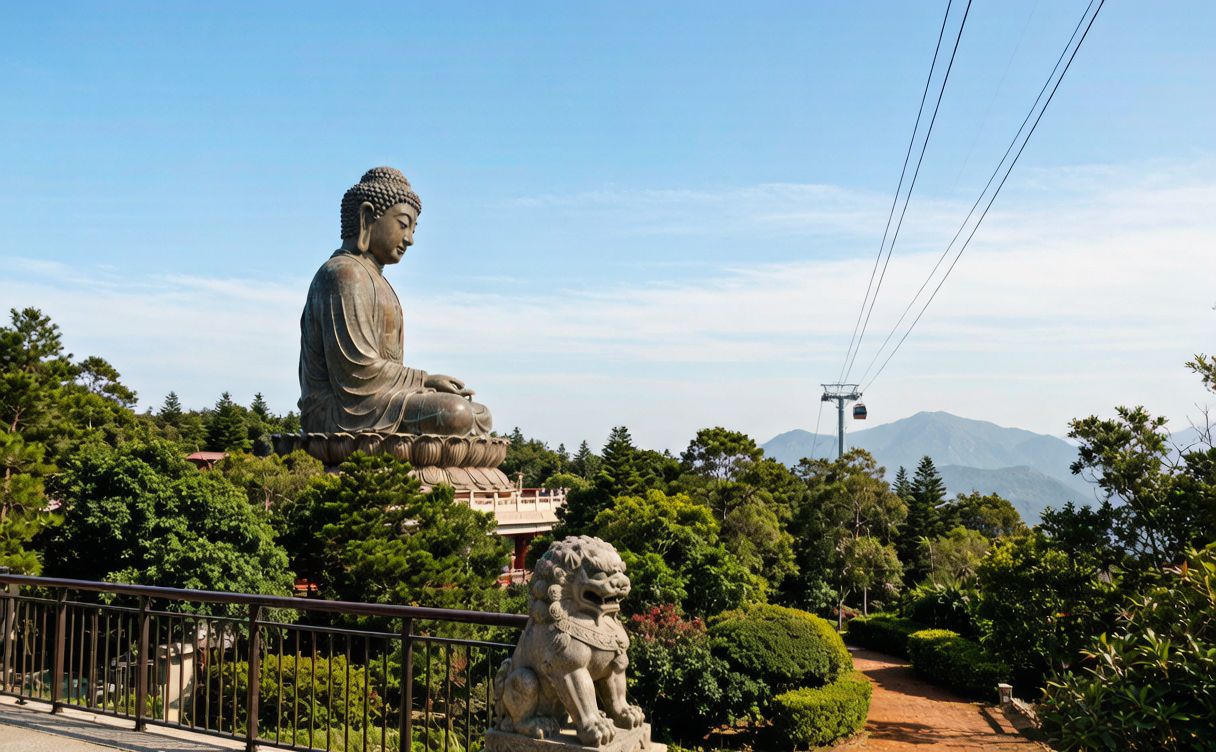
I’ll be honest: before I first rode the Ngong Ping 360, I thought the Big Buddha was just another photo stop. I was wrong. The moment the cable car lifted me above the South China Sea and the bronze Tian Tan Buddha came into view on the green slopes of Lantau Island, I understood why so many travelers list this as the spiritual heart of Hong Kong, China. This is a place where a modern city’s skyline melts into misty mountains, and where a 34-metre seated Buddha quietly commands the horizon.
Getting There
Most visitors begin in Tung Chung, Hong Kong, China, at the end of the MTR line. I took the Tung Chung Line from Hong Kong Station and was standing at the cable car terminal within about 40 minutes. The Tung Chung cable car station sits right next to the outlet mall, so it’s easy to combine a morning of shopping with an afternoon of mountain air.
From Tung Chung you have two choices. The headline option is the Ngong Ping 360 cable car, a roughly 25-minute ride that I’ll cover in its own section below. The alternative is the bus: the New Lantao Bus route 23 runs from Tung Chung to Ngong Ping and takes about 50 minutes, climbing through winding village roads. I tried the bus on a later trip during a storm warning when the cable car was paused — it’s scenic in its own way, but nothing beats the aerial view.
If you’re basing yourself in the city, pair this trip with other sights. Many travelers stay central and explore the waterfront through our Victoria Harbour guide for Hong Kong, China, then head out to Lantau the next day.
What to See
The star is, of course, the Tian Tan Buddha — the Big Buddha. Cast in bronze and completed in 1993, it stands 34 metres tall and weighs around 250 tonnes. I climbed the 268 steps to the base and, even slightly out of breath, paused at the top to take in the symmetry: six smaller bronze statues (the “Offering of the Six Devas”) surround the main figure, each representing a perfection of the Buddha’s teachings.
Right beside the statue is Po Lin Monastery, one of the most important Buddhist temples in Hong Kong, China. I arrived mid-morning and caught the monks chanting; the vegetarian restaurant there served me the best tofu I had in the city. Don’t skip it.
A short walk beyond the monastery leads to the Wisdom Path, a series of wooden pillars arranged along a hillside in the shape of an infinity symbol, inscribed with the Heart Sutra. Standing among them on a breezy day, with the South China Sea behind me, felt unexpectedly calm. It’s free, uncrowded, and my favourite quiet corner of the whole site.
If you want to extend the day, Ngong Ping Village sits next to the terminal with teahouses, a chance to try local snacks, and the Walking with Buddha exhibition. It’s touristy, but handy for a rest and a cold drink.
The Cable Car Experience
This is the part I tell everyone not to skip. The standard cabin is glass-walled and gives you uninterrupted views, but on my second visit I upgraded to the Crystal Cabin with a glass floor — watching the forest and sea drop away beneath my feet was equal parts thrilling and humbling. For the bravest (or most relaxed) travelers, there’s the Crystal+ cabin, a fully transparent pod.
The ride begins over Tung Chung’s urban edge, crosses the North Lantau Highway, and then opens out over the sea and Tung Chung Bay. I remember leaning toward the window as the cable car swayed gently, the coastline shrinking below. The final stretch climbs toward the plateau, and that’s when the Buddha appears — small at first, then growing as you approach Ngong Ping. It’s a 5.7-kilometre journey that somehow feels both short and unforgettable.
A tip from experience: sit on the left side of the cabin going up for the best sea views, and book the round trip in advance to skip the worst of the queue.
Tips
- Buy tickets online before you go. The on-site queue at Tung Chung can stretch for over an hour on weekends and public holidays. I learned this the hard way on a Saturday.
- Go early. I aimed for the first cable car of the day and had the steps to the Buddha almost to myself for ten minutes.
- Wear comfortable shoes. Between the 268 steps, the Wisdom Path walk, and the village, you’ll cover more ground than you expect.
- Bring a light layer. Lantau is breezier and cooler than central Hong Kong, China, especially at the top.
- If you have mobility needs, there’s a shuttle service from the village to near the Buddha base — ask at the information counter.
- Combine with the city’s other icons. After Lantau, I headed back and up to the peak using our Victoria Peak guide for Hong Kong, China, which pairs mountain views with skyline glamour perfectly.
Best Time
Hong Kong, China has a subtropical climate, and Lantau’s exposed plateau feels it keenly. I’ve found the sweet spots are late autumn (October to December) and early spring (March to April), when the humidity drops, the skies clear, and the Buddha is framed by blue rather than grey. Visibility matters here — on a clear day you can see all the way to the airport’s runways and beyond.
Avoid the height of summer (July and August) if you can; it’s hot, sticky, and prone to afternoon thunderstorms that can pause the cable car. Chinese New Year and the National Day Golden Week in early October bring big crowds, so if you must travel then, arrive at opening.
My personal favourite memory was a cool November morning: low mist burned off as I reached the top, and the bronze caught the first sunlight. That’s the Ngong Ping I recommend.
Good to Know
The site is open daily, roughly 10:00 to 17:30 for Po Lin Monastery and the Buddha viewing platform, though the cable car hours vary by season. Entry to the Buddha and Wisdom Path is free; the cable car and some exhibitions are paid. The Ngong Ping 360 terminal is fully accessible, with toilets, baby-changing facilities, and dining.
For official opening hours, ticket prices, and weather-related service updates, always check the destination’s authority before you travel: Hong Kong Tourism Board.
If you’re building a wider itinerary, this pairs naturally with our China travel guide for first-timers and, if you want a theme-park counterpoint, the Hong Kong Disneyland guide or Hong Kong Ocean Park guide. Travelers with extra days often hop to Macau, China — an easy extension from Hong Kong, China.