

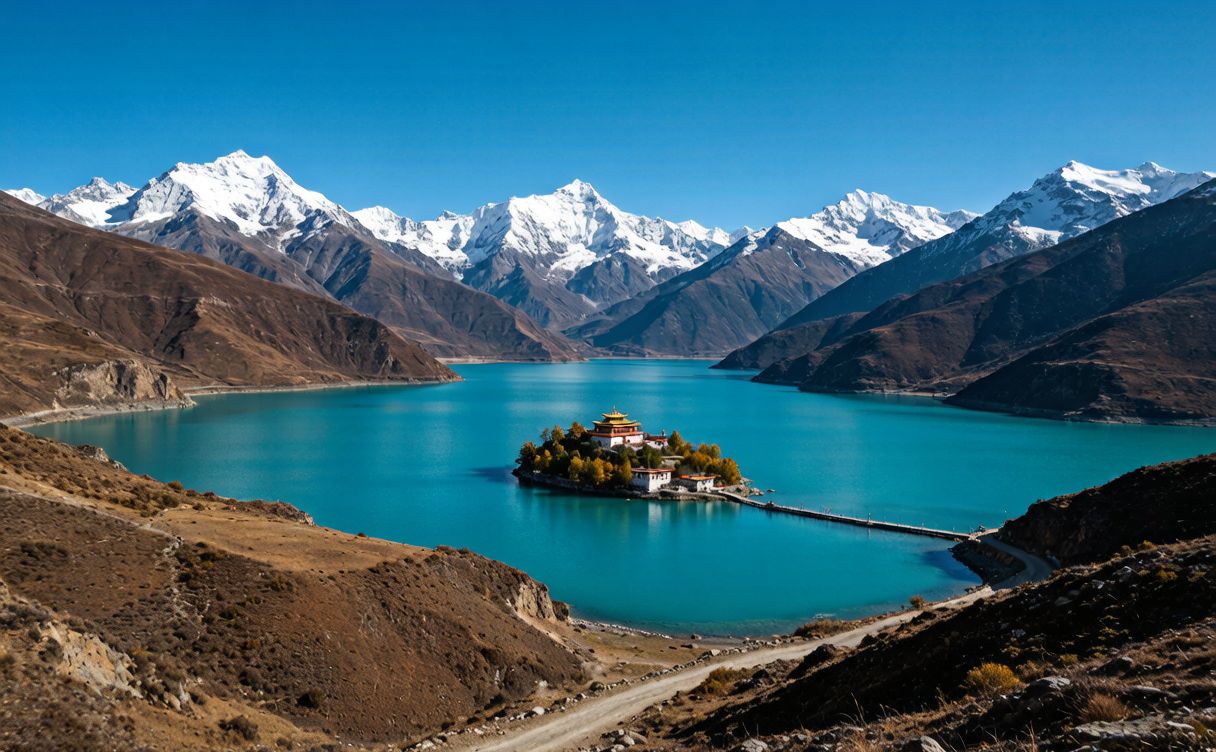
I still remember the first time I rounded the final bend of the road and the valley simply opened up. There it was — a sheet of impossibly turquoise water cradled by snow-streaked peaks, pine forest spilling down to the shore, and a tiny island temple sitting calmly in the middle of it all. That was my first glimpse of Basum Tso, and honestly, it stopped me in my tracks. For a traveler coming to Tibet, China hoping to find a lake that is both stunning and easy to reach, Basum Tso is the quiet overachiever that locals in Nyingchi love to show off.
Most people picture Tibet, China as a harsh, windswept plateau where every beautiful thing demands a punishing climb. Basum Tso breaks that rule. At roughly 3,480 meters above sea level, it sits lower than Lhasa and far lower than the great northern lakes, which means the air is kinder and the forest feels almost gentle. It is part of the larger Nyingchi region, often called the “Switzerland of Tibet, China” because of its green valleys and mild climate. I have now returned twice, and each visit has felt less like an expedition and more like a slow, grateful exhale.
Getting There
Reaching Basum Tso is refreshingly straightforward, which is half the reason I recommend it to first-time visitors to Tibet, China. The nearest hub is Nyingchi, a city in the southeast of the region that is now connected to Lhasa by a fast train line and a smooth highway. I flew into Nyingchi Mainling Airport, which itself is a small adventure — the descent threads between Himalayan foothills, and on a clear day you see layered ranges the whole way down.
From Nyingchi city, Basum Tso is about 120 kilometers east, roughly a two-hour drive along the G318 national highway. The road is paved and well maintained, winding past barley fields, small monasteries, and roadside prayer flag poles fluttering red and blue. I hired a local driver in Nyingchi, Tibet, China, and the relaxed pace let me stop whenever a viewpoint demanded it. If you are already planning a broader route, the lake also works as a natural stop between Lhasa and the eastern valleys.
One practical note: foreign travelers need the Tibet Travel Permit in addition to a Chinese visa. I arranged mine through a licensed agency in Lhasa before heading east, and the paperwork took about a week. Do not try to wing this — the checkpoint on the road does check. Once you are through, the final stretch to the lake is quiet and scenic, and the entrance gate sits right where the valley narrows.
If your trip starts in the capital, it is worth building a few days there first. My own route began with the classic sites, and reading a solid Lhasa Tibet travel guide beforehand saved me a lot of confusion about permits, altitude, and timing.
What to See
The lake itself is the headline, but the surroundings reward anyone willing to slow down. The water is the color of a polished gemstone — a deep, shifting turquoise that turns steel-blue in shadow and electric green where sunlight hits the shallows. I spent one whole morning just watching the surface change as clouds crossed the sun.
Around the shore you will find a wooden boardwalk, a modest lakeside promenade, and several quiet picnic spots where local families gather on weekends. Boat rides run from the main dock to the island monastery, and I found the short crossing to be one of the most peaceful moments of my trip — no engine noise, just oars and the soft lap of water against the hull.
Beyond the immediate shore, the wider Basum Tso scenic area includes hiking trails into the surrounding hills, seasonal wildflower meadows in late spring, and a higher viewpoint that looks back down over the entire valley. On my second visit I hiked up to that lookout and watched mist roll off the peaks. It was the kind of view that makes you forget your phone exists for an hour.
Wildlife is a quiet bonus. I saw yaks grazing near the tree line, a few curious marmots, and on the far shore what my guide insisted were wild geese. The mix of water, forest, and mountain here is unusual for Tibet, China, and it is exactly why photographers keep coming back.
The Island Monastery
The spiritual heart of Basum Tso is Tsodzong, a small Tibetan Buddhist chapel that sits on an island just off the western shore. Legend holds that the lake is itself sacred, a “holy lake” where local deities reside, and the monastery has drawn pilgrims for centuries. Crossing the short causeway or taking the boat brings you to a whitewashed structure with golden roofs, prayer wheels, and the smell of butter lamps inside.
I lit a stick of incense there on my first visit, mostly out of curiosity, and ended up staying far longer than planned. The caretaker monk poured me a small cup of butter tea and gestured at the murals with quiet pride. There is a calm about the place that has nothing to do with spectacle — it is intimate, worn smooth by generations of footsteps, and completely unlike the grandeur of the big-city monasteries.
For travelers building a monastery-focused itinerary across Tibet, China, this little island pairs beautifully with the heavier hitters elsewhere. After Basum Tso I went on to visit the Tashilhunpo Monastery in Shigatse, and the contrast — tiny floating shrine versus vast institutional complex — taught me more about Tibetan Buddhism than any guidebook page.
A small tip: dress modestly when you step inside, keep your voice low, and always walk clockwise around the chapel and the prayer wheels. These are not rules enforced by guards; they are courtesies the locals quietly appreciate, and as a guest in Tibet, China I found them easy and meaningful to honor.
Tips
- Acclimatize first. Even though Basum Tso is lower than Lhasa, give yourself a day or two at altitude before pushing around. I learned this the hard way on a previous trip and now treat the first day as pure rest.
- Hire a local driver. Public transport to the lake is limited. A driver based in Nyingchi, Tibet, China costs more but removes every logistical headache and often comes with good local commentary.
- Bring layers. Mornings are cold, afternoons can be warm and sunny, and the wind off the water bites. I packed a shell jacket, a fleece, and never regretted either.
- Cash helps. The entrance area has small vendors selling snacks, prayer flags, and souvenirs; some do not take foreign cards. Carry a little yuan.
- Respect the lake. This is a sacred site for local people. Do not swim, do not litter, and ask before photographing monks or pilgrims up close.
- Go early. The light is best before ten in the morning and the tour groups have not yet arrived. My favorite photos came from a 7 a.m. walk along the shore.
If you want a fuller sense of the region’s other sacred waters, the great northern lakes of Tibet, China make excellent companions to a Basum Tso stop on any longer itinerary.
Best Time
Basum Tso is a year-round destination, but the window from April to October is, in my experience, the sweet spot. Late spring brings fresh green on the hills and fewer crowds. Summer (June to August) is lush, warm, and the most reliable for clear skies, though it is also peak domestic travel season. I visited in early September and thought I had found the perfect balance — golden light, cool nights, and almost nobody on the trails.
Autumn (late September to October) paints the surrounding forest in reds and ambers and is, frankly, the most photogenic season. Winter is stark and very cold, but the lake rarely freezes completely and you may have the entire shore to yourself. If you are already mapping a bigger journey, pairing the lake with a visit to the Potala Palace in Lhasa works in any of these seasons.
Good to Know
Basum Tso sits within a protected scenic area, so there is an entrance fee and the site closes to new arrivals in the late afternoon — arrive with enough daylight to enjoy it. Facilities are decent: there is a visitor center, basic restaurants near the gate, and a few guesthouses if you want to stay overnight and catch the dawn. I stayed one night and waking up to mist on the water was worth every yuan.
Foreign travelers should remember the Tibet Travel Permit requirement mentioned earlier, and should always travel with a licensed operator inside Tibet, China. Mobile signal is patchy around the lake, so download maps and any translation help before you leave Nyingchi. Altitude sickness is unlikely to be severe here, but hydration and slow movement still matter.
For official, up-to-date information on permits, seasons, and regional travel advisories, consult the Tibet Culture and Tourism department before you go. I check it every time I plan a return, and it has saved me from more than one closed-road surprise.