

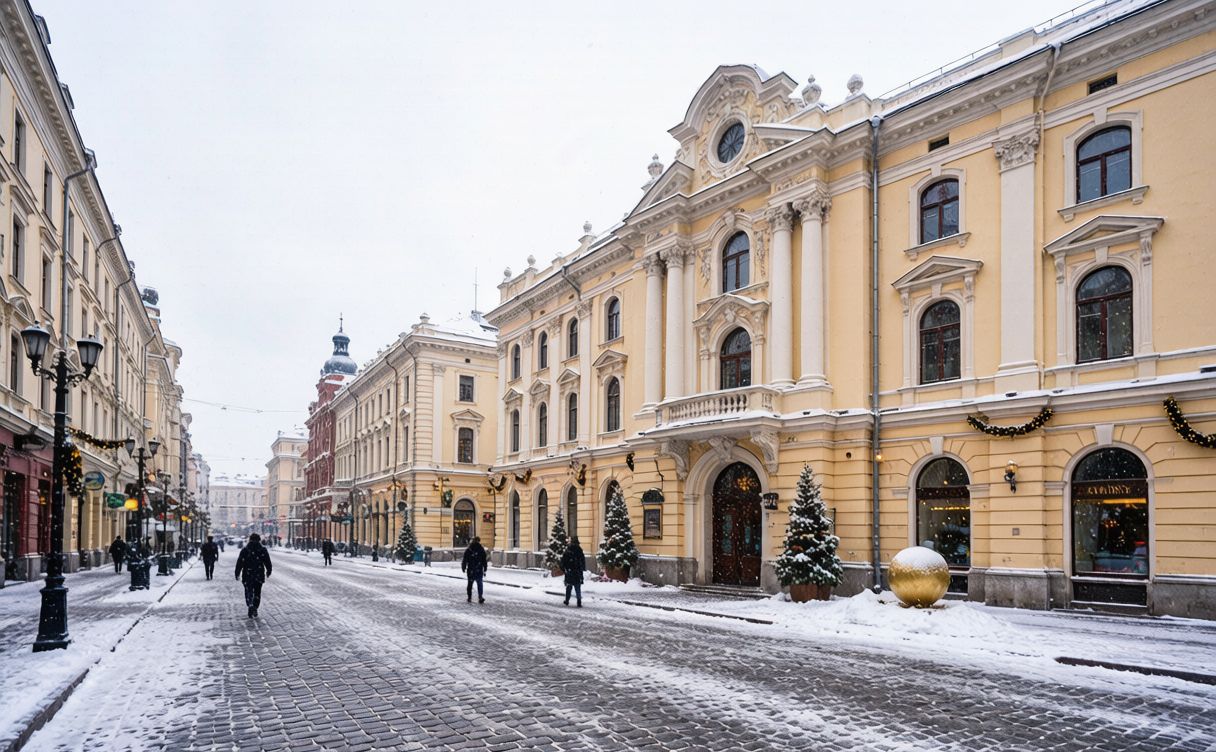
The first time I set foot on Central Street Harbin, I genuinely forgot which country I was in. One moment I was in northeastern China, the next I was staring up at a row of Baltic-style facades with ornate plasterwork, cast-iron balconies, and shop signs written in a mix of Chinese and Cyrillic. This is Zhongyang Dajie — the city’s main pedestrian street and, in my opinion, the single best place to understand how Harbin became the most European-feeling city in China. If you are building a winter itinerary, pair this walk with the Harbin ice festival travel guide for the full frozen-city experience.
I have now walked this street in July heat and in minus-25-degree snow, and it works in both seasons. What never changes is the cobblestone under your feet — roughly 1,000 meters of rectangular granite blocks laid by hand more than a century ago — and the constant, cheerful hum of people eating, shopping, and taking photos. This Central Street Harbin guide covers exactly how to get there, what to look for, the architecture that makes it special, and the practical tips I wish I had known on my first visit.
Getting There
Central Street (Harbin locals just call it Zhongyang Dajie) sits in the heart of Daoli District, on the west bank of the Songhua River. The easiest way in is the Harbin metro. Take Line 2 to Zhongyang Dajie Station (中央大街站) and use Exit 3 — you will surface about 200 meters from the south end of the walking street. From Harbin West Railway Station, the metro ride is around 35 minutes. From Harbin Taiping International Airport, budget 40–50 minutes by airport shuttle bus or taxi depending on traffic.
If you arrive by train at Harbin Station (the historic one near the Baroque-style facade), Central Street is only a 15-minute walk northwest, or a short taxi ride. I usually tell first-time visitors to simply open their map app and search “中央大街” — taxis and ride-hailing drivers recognize it instantly. The street itself is closed to cars, so you will be walking the whole way regardless of how you arrive.
One practical note: the Harbin walking street gets extremely crowded on weekend evenings and during the Ice and Snow Festival (roughly late December to February). If you can, arrive before 10 a.m. for clean photos and empty cobblestones, or after 8 p.m. when the whole strip glows with festive lights and the crowds actually add to the atmosphere rather than blocking your shot.
What to See
The street runs north–south for about 1,450 meters (the famous cobbled core is roughly the first 1,000 meters), starting near the flood-control monument on the Songhua riverbank and ending in the older shopping district to the south. I normally begin at the Flood Control Monument (防洪纪念塔) at the north end — it commemorates the city’s defense against the 1957 Songhua River flood and makes an easy landmark to orient yourself.
From there, just walk south and let the street unfold. The ground floor is a relentless, happy parade of bakeries, ice-cream counters, Russian souvenir shops, pharmacies, and global brands. Look up, though, because the real show is the upper facades. Don’t miss the old Modern Hotel (Madin Hotel) building near the middle — its green dome and early-20th-century signage are postcard staples. A few steps further you will find the Education Bookstore building, one of the best-preserved Baroque fronts on the strip.
I always save time for the side alleys. Thread off to the west and you reach Toulong Street and the adjacent Chinese Baroque Historic Block (中华巴洛克历史文化街区), where the architecture turns into a fascinating mash-up: European Baroque shells wrapped around traditional Chinese courtyards. It is quieter, free to wander, and gives you the “behind the scenes” version of the main drag.
Food is a major attraction here, not an afterthought. The single most famous stop is Madie’er (Modern) ice cream, sold from a window on the street itself — a vanilla-ish brick on a stick that locals and tourists line up for in every season, snow or shine. A little further south, Qiulin Kvass and the historic Qiulin Department Store offer the Russian-style dark bread (lieba) and fermented bread drink that Harbin is famous for. Try the bread fresh; the crusty, slightly sour loaf is unlike anything you will taste elsewhere in China.
The Architecture
This is the part that makes Central Street Harbin worth a dedicated visit rather than just a pass-through. The street was laid out in the early 1900s during the Russian-led construction of the Chinese Eastern Railway, and it became the commercial spine of a city that was, for a few decades, deeply international. What survives today is one of the largest collections of turn-of-the-century European street architecture in East Asia.
Walking the length of the Harbin walking street, you will pass facades in at least a dozen distinct styles: Baroque, Rococo, Renaissance revival, Byzantine, Eclectic, and early Modernist among them. The guide plaques (in Chinese and English) label many of the protected buildings, which I found genuinely helpful. The limestone and granite fronts, with their carved cornices, arched windows, and pastel paint, were restored in waves — most recently and thoroughly ahead of the 2010s tourism boom — so the colors read bright rather than faded.
My personal favorite detail is the cobblestone itself. The blocks are small rectangular granite set on edge, an old Russian paving method meant to last. After a century of footsteps they are polished smooth in the middle of the path, and on an icy winter morning they turn into a mild skating rink — wear shoes with grip. Standing in the middle of the street and turning a slow circle, you can read the city’s whole history in its rooftops: Orthodox onion domes in the distance, a Baltic merchant’s townhouse on your left, a 1920s cinema on your right.
For context on how this European flavor fits into a wider China trip, I recommend browsing our China bucket-list attractions — Harbin’s streetcar-era streetscapes pair surprisingly well with the garden cities farther south.
Tips
A few things I learned the hard way so you don’t have to:
- Dress for the season, hard. Harbin’s winter is no joke. In January the Central Street Harbin crowds are wrapped in full ski gear, and you should be too: insulated boots, a real down jacket, and palm-level hand warmers bought from any corner shop on the strip.
- Cash is rarely needed. Alipay and WeChat Pay cover nearly every stall, including the ice-cream window. Foreign cards linked to Alipay work, but have a small amount of yuan as backup for the tiny vendors.
- Go early or go late for photos. Midday on a weekend is a wall of people. Sunrise and the blue-hour after sunset are magic.
- Mind the ice underfoot. The cobblestones get treacherously slick after a snowfall. Walk like a penguin — small steps, feet slightly out — and you will stay upright.
- Combine it with Sophia Cathedral. Saint Sophia Orthodox Cathedral is a 10-minute walk east and is the other icon of European Harbin. Do both in one morning.
- Bargain gently at souvenir stalls. Russian nesting dolls and amber are common; prices drop if you buy several, but the fixed-price bakeries and ice cream are non-negotiable.
Best Time
Central Street Harbin is a year-round destination, but the experience changes completely with the season, so pick based on what you want.
Winter (December–February) is the headline act. The street is strung with lights, the air smells of roasted chestnuts and grilled meat, and the Ice and Snow Festival pulls the biggest crowds. It is cold enough that your eyelashes may frost, but the atmosphere is unbeatable. This is when the Harbin walking street feels most like a film set.
Summer (June–August) is genuinely pleasant. Harbin is one of the few places in China where summer nights stay cool, often in the low 20s Celsius. The street fills with outdoor beer gardens, street performers, and families enjoying the Songhua river breeze. If you hate extreme cold, come in July.
Spring and autumn are quiet shoulders with fewer tourists and cheaper hotels, though the weather can be unpredictable. I caught a gorgeous golden-October day here once with almost no crowds — easily my most relaxed visit.
If your trip is built around the ice and snow, lock in December or January. If you just want a charming walk and good bread, any warm month is fine. Either way, give yourself at least two hours, and ideally an evening return after you have seen the daytime facades.
Good to know
Central Street Harbin is free to enter and open around the clock, though individual shops and restaurants keep their own hours (most open by 9 a.m. and close between 9 and 10 p.m.). There are public restrooms along the route and at the Flood Control Monument end. For official events, festival dates, and transit updates, check the Harbin municipal tourism information from the Harbin government portal. If you want to extend your China city-hopping after Harbin, our Hangzhou Leifeng Pagoda guide and Sanya Tianya Haijiao guide cover two very different but equally memorable corners of the country.
When planning your trip, you can compare hotels, flights, and trains on Trip.com.