

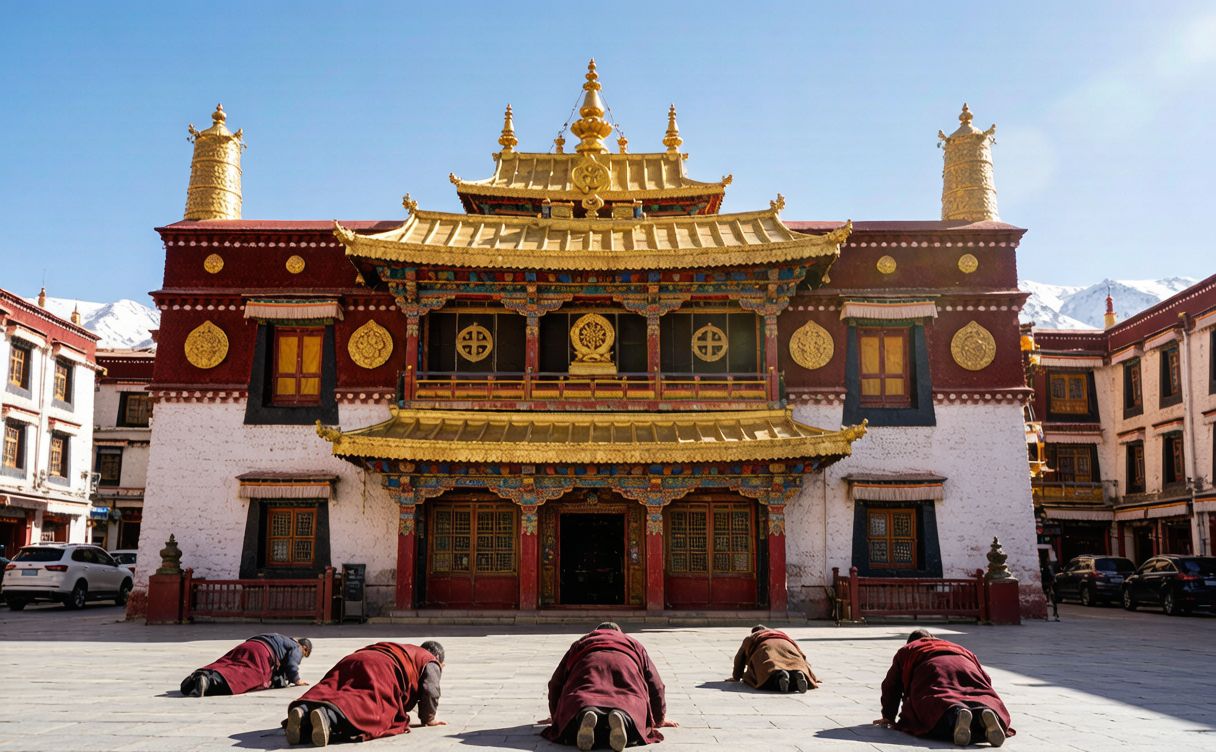
I have stood in a lot of famous temples across Asia, but nothing prepared me for the first time I stepped into the Jokhang Temple in Lhasa, Tibet, China. The air was thick with the smell of yak butter lamps, the murmur of prayer was constant, and a line of pilgrims was pressing forward on their knees to touch the threshold with their foreheads. This is not a museum piece. It is the spiritual center of Tibet, China, and people have worshipped here every single day for more than 1,300 years.
If you are planning a trip to Lhasa, the Jokhang Temple (locally called Tsuglakhang, or the Lhasa Jokhang) should sit at the very top of your list. In this guide I will walk you through how to get there, what to actually look at, how the pilgrim circuit works, and the practical things I wish I had known before I went.
Getting There in Lhasa
The Jokhang Temple Lhasa sits right on the northern edge of Barkhor Square, in the heart of the old Tibetan quarter. It is almost impossible to miss once you are in the old city, because the Barkhor is the labyrinth of streets that wraps around the temple like a protective ring.
From the rest of Lhasa, the easiest move is a short taxi ride. Most hotels in the city center are within 10 to 15 minutes of the temple, and a taxi usually costs under 20 yuan. If you are coming from the Potala Palace, it is about a 2.5 km walk or a quick 10-minute drive. I actually walked part of the way and found it a gentle way to adjust to the altitude, but only because I had already spent two days acclimatizing.
A few practical notes for getting there:
- Lhasa sits at about 3,650 meters above sea level. Move slowly. I saw fit travelers doubled over from walking too fast on their first morning.
- The main entrance faces Barkhor Square. There is a security checkpoint, so bring your passport. Foreign visitors need a Tibet Travel Permit in addition to a Chinese visa, and that permit is arranged through a registered tour operator before you fly or take the train in.
- The temple opens early, often around 7:00 am for pilgrims, with a later tourist window that usually runs roughly 9:00 am to 6:00 pm. Hours shift by season and by religious calendar, so confirm the day before.
What to See
Inside the Jokhang Temple in Lhasa, Tibet, China, the layout is a little confusing on purpose. Devotees move clockwise through dark, smoky chapels, and the route is designed for devotion rather than sightseeing. Here is what I found worth pausing for.
The most important statue is the life-size Jowo Shakyamuni Buddha in the main hall. It is said to have been brought to Tibet in the seventh century and is considered the holiest object in the country. The line to approach it can be long, but it moves, and the atmosphere when you finally stand in front of it is genuinely moving.
Around the ground floor you will find dozens of smaller chapels, each with its own protective deity, butter lamps, and offering bowls. I spent a long time in the side halls just watching how locals interacted with the statues. Nobody rushes. People leave small offerings of cash, pour oil into lamps, and recite prayers under their breath.
Climb the staircase near the back to reach the upper floors and the famous golden roofs. From up there you get the classic view over Barkhor Square and the rooftops of old Lhasa, with the Potala Palace rising in the distance. This is where most of my best photos came from, and where I finally understood how the whole old city is arranged around this one building.
The Pilgrim Circuit
The Barkhor is the pilgrim circuit, or kora, that wraps around the Jokhang Temple Lhasa. Locals call the inner ring the Nangkhor, the middle ring the Barkhor, and the outer ring the Lingkhor. As a visitor, you will mostly walk the Barkhor.
I strongly recommend doing at least one full clockwise loop on foot. It takes about 20 to 30 minutes at a stroll, longer if you stop. The street is lined with shops selling prayer beads, Tibetan incense, turquoise, and momos (dumplings). You will pass prostrating pilgrims, spinning prayer wheels, and monks in maroon robes. Walk clockwise, keep to the outer edge if you just want to observe, and step into the flow if you want the full experience.
A simple etiquette rule I learned the hard way: always move clockwise, never against the stream. If someone is prostrating, give them space and do not walk directly in front of them. Photography of people is sensitive here, so ask before you point a camera at a face.
If you want more context on the city as a whole, my Lhasa Tibet travel guide covers permits, neighborhoods, and how to sequence your days. And the Potala Palace Lhasa guide pairs perfectly with a Jokhang visit, since most people do both on the same trip.
Tips
These are the practical lessons I picked up so your visit goes smoothly.
- Acclimatize first. Spend at least two days in Lhasa before serious walking. The Jokhang Temple in Lhasa, Tibet, China, involves stairs and crowds, and altitude hits harder when you are exerting yourself.
- Dress respectfully. Shoulders and knees covered. This is an active place of worship, not a photo set. I wore long pants and a light long-sleeve shirt, which also helped with the sun.
- Bring small cash. You will want a few yuan notes for offerings and for the many small purchases around the Barkhor. Cards and apps are less reliable inside the old quarter.
- Hire a guide or audio tour. The symbolism behind each chapel is easy to miss on your own. A local guide turned a confusing maze into a story I still remember.
- Photography rules. You can usually shoot the exterior and roofs freely, but interior photography is often restricted. Look for signs and follow what locals do.
- Go early. The first tourist slot is calmer and the light on the golden roofs is better. By late morning the Barkhor gets crowded.
Best Time
Lhasa has a high, dry plateau climate, and the best window to visit the Jokhang Temple and the rest of the city is roughly May through October. Days are sunny and warm, nights are cool, and the roads into the region are open. I went in early September and found clear skies, comfortable walking temperatures around 15 to 20 degrees Celsius in the day, and thin but manageable crowds.
Winter, from November to March, is much colder and some passes close with snow, but the temple itself is open and the Barkhor is wonderfully quiet. If you can handle the cold, the off-season gives you the most intimate experience of the Lhasa Jokhang.
Avoid the peak of Chinese public holidays like National Day in early October if you can, because domestic tourism surges then. A normal weekday in shoulder season was ideal for me.
Good to Know
The Jokhang Temple is managed as part of Tibet’s cultural and religious heritage within China, and visitor information is coordinated with regional tourism authorities. For official, up-to-date details on permits, open seasons, and responsible travel in the region, I recommend checking the Tibet Tourism Bureau before you book.
One more thing worth knowing: the Jokhang is only one stop in a remarkable region. If you have extra days, a day trip to the Tibet Yamdrok Lake guide is one of the most beautiful drives in the country, with a turquoise lake that sits at over 4,400 meters.
I left Lhasa changed in a way I did not expect. The Jokhang Temple, Lhasa, Tibet, China is more than a landmark. It is a living heartbeat, and if you give it a slow morning and an open mind, it will be the part of your China trip you talk about for years.