

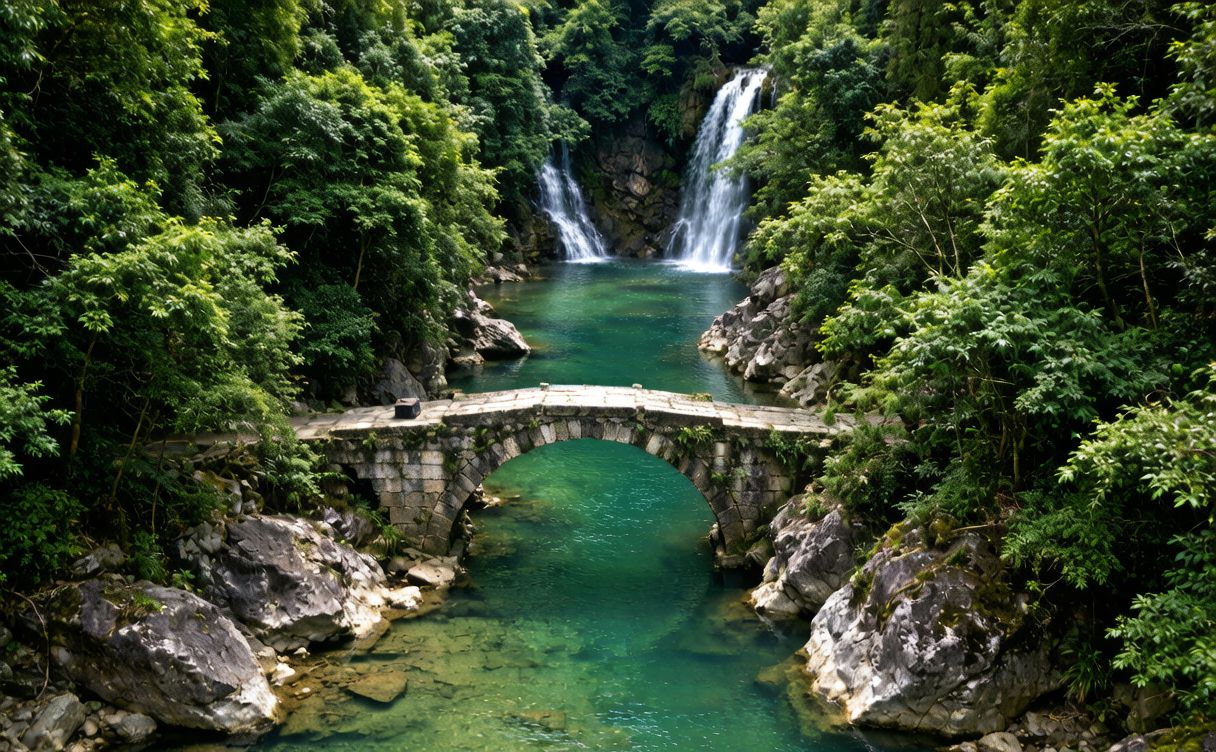
The first time I heard the name, I assumed “Xiaoqikong” was some minor roadside stop. It isn’t. When I finally rode the shuttle bus deep into the hills of southern Guizhou and stepped onto the tiny seven-arched stone bridge, I understood why travelers call this place the “Little Seven Arches” — and why it quietly rivals anywhere else I’ve visited in China.
Libo Xiaoqikong sits inside the Maolan karst forest, a UNESCO-protected landscape near the town of Libo in Qiannan Prefecture. What you get is a 7-kilometer ribbon of emerald rivers, layered waterfalls, ancient bridges, and dense subtropical forest, all stitched together in one very walkable scenic area. If you’re planning a trip to southwest China and you love nature more than crowds, this is the spot I’d put at the top of the list.
Getting There from Guiyang
Most foreign visitors base themselves in Guiyang, the provincial capital, and do Xiaoqikong as a 1–2 day side trip. I did exactly that, and it’s easier than the remote location suggests.
The fastest option is the high-speed train. Trains run from Guiyang North to Libo Station in roughly 1 hour 20 minutes. From Libo Station you’ll still need a transfer — a taxi or the local shuttle bus — for the final 30–40 minutes into the scenic area. Book your train ticket in advance through 12306 or a travel app, because morning departures sell out on weekends.
If you’d rather not juggle transfers, several tour operators and private drivers run the 3.5-hour highway drive from Guiyang directly to the east gate. I took the train up and a private car back, and honestly the car ride showed me more of the karst countryside than the rail line did.
One practical note: the scenic area has two gates, east and west. Almost everyone enters from the east gate, where the shuttle buses, ticket office, and most hotels cluster. Plan your hotel around the east gate so you’re not fighting morning traffic.
What to See
Xiaoqikong isn’t a single monument — it’s a linear park strung along the Xiaoqikong River. The shuttle bus drops you at a handful of stops, and you walk between them on well-paved boardwalks. I’d budget a full day; rushing it in half a day means missing the quiet corners.
Start at the namesake Xiaoqikong Bridge itself, a small Qing-dynasty stone bridge from 1836 that gives the whole area its name. It’s modest in size but photogenic, framed by vines and reflected in still water. From there the trail follows the river past forested gullies, clear pools, and wooden walkways that hover right over the water.
Further along is Wolong Lake (Crouching Dragon Pond), a deep blue-green pool where the water looks almost artificial in its clarity. I sat there for twenty minutes doing nothing, which is rare for me on a trip. The Laya Waterfall and the 68-level cascading waterfall are the headline sights — a long stair-step of small drops that the boardwalk runs alongside, so you hear and feel the spray the whole way down.
Then there’s the Shuishang Forest (Water Forest), where trees grow straight out of the riverbed and you walk on stepping stones through knee-deep flow. It’s the single most unusual thing in the park, and the part my photos never quite captured.
The Arches & Waterfalls
People ask me what actually makes Libo Xiaoqikong worth the journey. For me it’s the combination of two things that rarely sit side by side: the karst geology and the water.
The karst landscape here is textbook southern Guizhou — limestone peaks, sinkholes, and caves sculpted by water over millions of years. But unlike the bare stone of some karst regions, Xiaoqikong is covered in green. The emerald rivers aren’t a filter trick; the minerals and the depth really do turn the water that jade color, especially on sunny mornings.
The waterfalls are the other half. The 68-level waterfall is the star — a series of small cascades tumbling down a narrow gorge for several hundred meters. You descend on a boardwalk beside it, and at points the spray cools you completely. The Laya Waterfall is a single broad drop right next to the road, easy to reach and great for a wide shot.
The forest park setting matters too. Because this sits inside the Maolan karst forest reserve, the air is clean and the shade is thick. On a hot July afternoon I was comfortable in light clothing the entire time. If you’ve only seen China’s famous mountains as crowded staircases, this feels different — wilder and calmer.
Between the major stops you’ll also pass smaller, nameless pools and wooden viewing decks where locals stop to dangle their feet in the water. I treated these unmarked pauses as the real reward: no signs, no queues, just cool water and the sound of the river. The whole route is stroller- and wheelchair-friendly for most of its length thanks to the boardwalks, though the Water Forest section is stepped and uneven, so plan around that if mobility is a concern.
Tips
A few things I wish I’d known before going:
- Buy the combined ticket online. The entry plus shuttle bus is sold as one ticket. Buying at the gate works, but the QR-code line moves faster and you skip a step.
- Wear sandals or quick-dry shoes. The Water Forest and several boardwalks involve walking through shallow water. I wore trail runners and regretted it; the people in sandals were happier.
- Go early. Buses from the east gate start around 7:30 a.m. The first two hours are nearly empty, and the light on the river is best then.
- East-to-west flow. The classic route runs from the east gate down to the west, ending near the larger waterfalls. Do it in that direction so the big sights close your day.
- Pack water and snacks. There are vendors, but prices climb and options thin out between stops.
- Signal is patchy. Mobile data fades deep in the gorge. Screenshot your ticket QR, map, and hotel address before you leave the gate, and don’t rely on ride apps to find you inside the park.
- Consider an overnight in Libo town. Staying one night lets you catch the early bus and still have the evening for the local night market, which is far cheaper and more real than anything at the gate.
- Combine with Huangguoshu if you can. The two are the pillars of any Guizhou nature trip, and linking them makes the long travel worthwhile. See my guide to the Guizhou Huangguoshu Waterfall for how to pair them.
Best Time
The park is open year-round, but timing changes the experience a lot.
May to October is the wet season and, in my opinion, the best window. The rivers run full, the waterfalls are at their most powerful, and the forest is deepest green. Yes, it’s humid and you might catch an afternoon shower, but the water is why you came. July and August are peak domestic season, so arrive early to dodge the crowds.
March to April brings spring blooms and fewer visitors, with comfortable temperatures and still-clear water — a great shoulder-season choice if you want photos without people in them.
November to February is quiet and cool. The water level drops, so the waterfalls lose some drama, but the misty, leafless forest has its own moody appeal, and you’ll often have whole boardwalks to yourself.
I went in early July and wouldn’t change it. The emerald color was at its peak, and an afternoon thunderstorm actually cleared the air and emptied the paths for an hour.
Good to know
Libo Xiaoqikong is part of a larger Libo protected area that also includes the Daqikong (Big Seven Arches) section and the Zhangjiang scenic cluster. If you have a second day, Daqikong offers a more rugged, cave-and-canyon experience just nearby. The official Guizhou Provincial Culture and Tourism Department publishes season opening hours, holiday notices, and ticket policy in English-friendly summaries, and it’s the source I check before any Guizhou trip.
Foreign visitors need a valid passport for ticket purchase and for the occasional spot check at park gates, so carry it even on a day trip. English signage inside the park is limited, so download an offline map or a translation app before you lose signal in the hills.