

When I first climbed Purple Mountain (Zijin Shan) on the eastern edge of Nanjing, I expected another quiet imperial tomb. What I found instead was one of the most atmospheric walks in all of China — a half-kilometer Sacred Way lined with stone beasts, a deep forest silence, and the resting place of the man who founded the Ming dynasty. If you are planning a trip to Nanjing, the Ming Xiaoling Mausoleum (明孝陵, often called the Xiaoling Tomb or Zhu Yuanzhang tomb) deserves a full morning, not a rushed photo stop.
I have now visited three times across different seasons, and each visit revealed something new. The first time I came in a summer downpour and saw almost no one; the second time was a crisp autumn morning when the stone elephants glowed in low sunlight; the third was during plum-blossom season when the whole hillside turned pink. This guide shares exactly how to get there, what to see, and the small practical details that make the experience smoother for a foreign visitor.
A Brief History
Before you walk the site, it helps to know whose tomb you are standing in front of. Ming Xiaoling is the burial place of Zhu Yuanzhang (朱元璋), the founder of the Ming dynasty and one of the most remarkable figures in Chinese history. Born a poor peasant and orphaned young, he rose through a rebel army to seize power and declared himself the Hongwu Emperor in 1368, founding a dynasty that would rule China for nearly 300 years.
Construction of the tomb began in 1381 and took more than two decades, using an estimated 100,000 laborers. When it was finished, the layout was so respected that later Ming and Qing imperial tombs copied its central-axis design. In 2003, UNESCO listed Ming Xiaoling as part of the “Imperial Tombs of the Ming and Qing Dynasties” World Heritage Site. Knowing this background changed how I looked at the place — every gate and stone figure is part of a template that shaped imperial China for centuries.
Getting There
The easiest and cheapest way to reach Ming Xiaoling is Nanjing Metro Line 2. Take the train to Muxuyuan Station (苜蓿园站) and use Exit 1. From the exit, follow the signs and the steady flow of visitors for about 10–15 minutes on foot to the main entrance at the foot of Purple Mountain. I always prefer the metro because Nanjing traffic around the scenic area can be unpredictable, and parking near the mountain fills up fast on weekends and holidays.
If you arrive by taxi or ride-hailing app, set the destination to “明孝陵一号门” (Ming Xiaoling Gate 1). Drivers in Nanjing generally know it well, but having the Chinese characters ready avoids confusion. Public buses also run to the area, but the metro is more reliable for first-time visitors who cannot read the Chinese characters on bus boards.
Buy your ticket online in advance when possible — major travel apps and the official scenic-area platforms list it — to skip the worst of the queue at the gate. A combo ticket that includes other Purple Mountain attractions can save money if you plan to stay on the mountain for the whole day. Keep your QR code screenshot handy, because mobile signal can dip near the wooded entrance.
What to See
The main route takes you through the Daxi Hongmen (大金门), the outer gate, then across the Jinwen Bridge, and finally to the Square City (方城) and the Ming Lou (明楼), the tower that sits above the emperor’s underground chamber. Climbing the steps of Ming Lou rewards you with a view back down the axis and out over the forest. On my second visit, I came early and had the top almost to myself — that quiet moment made the history feel real.
The central axis is long and deliberate. Walking it, I found it easy to imagine the scale of the original project: a processional route, multiple gates, ceremonial bridges, and finally the burial mound hidden behind a small, tree-covered hill. The actual grave of Zhu Yuanzhang was never opened and remains sealed, so what you see is the ceremonial shell built to honor him rather than the chamber itself.
Beyond the tomb, the surrounding park is genuinely beautiful. Just south of the complex lies Meihua Shan (Plum Blossom Hill), planted with thousands of plum trees. In spring it draws huge crowds, but even without the blossoms the wooded paths are worth exploring. I once spent an hour simply sitting by a small pond near the tomb, listening to birds — a calm that is rare on a China trip packed with big cities.
The Sacred Way
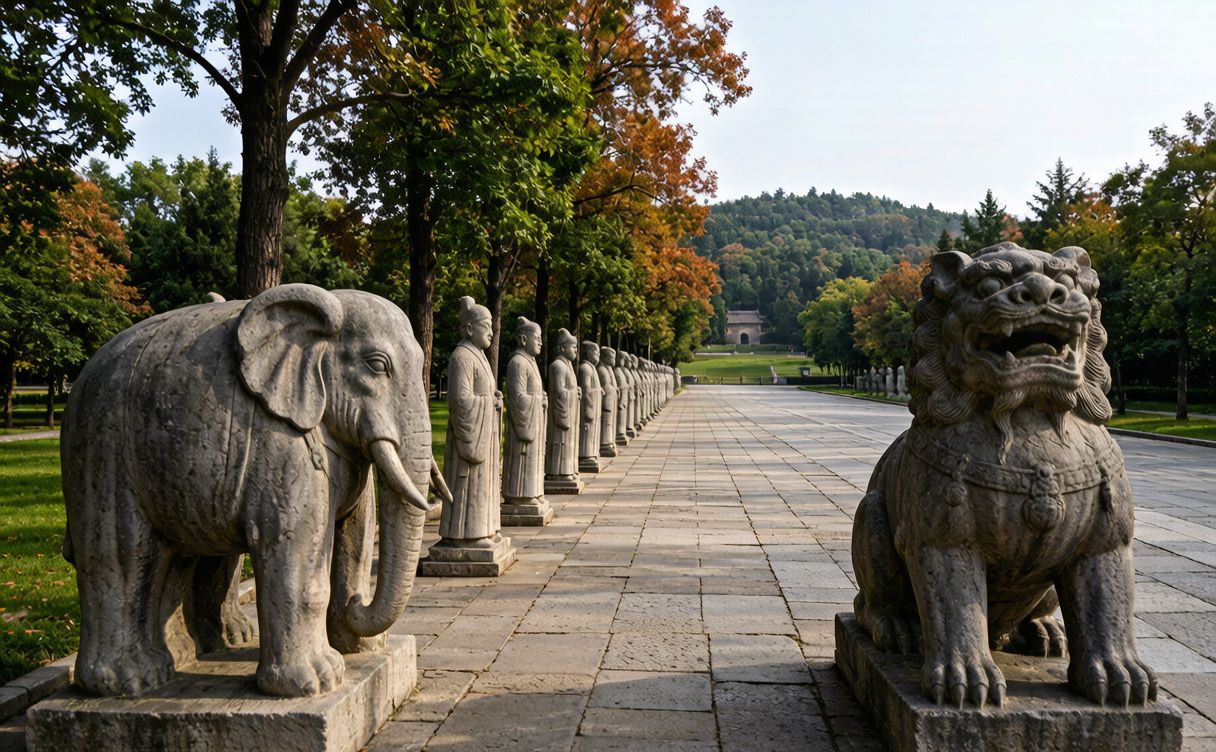
The highlight for most visitors — and my personal favorite — is the Sacred Way (神道, Shendao). This is the spirit road that leads the soul of the emperor to his tomb, and it is guarded by an extraordinary procession of stone sculptures carved in the 14th century. It is the single most photogenic and atmospheric part of the whole site.
The Sacred Way splits into two sections. The first is the Spirit Way of Animals, with 12 pairs of stone beasts: lions, xiezhi (a mythical unicorn-like creature), camels, elephants, qilin, and horses. Each animal appears twice — once standing, once kneeling — so six species and twelve pairs in total. I spent a long time photographing the weathered elephants; the carving is detailed enough that you can still see the saddle-cloth folds after more than 600 years of wind and rain.
The second section is the Spirit Way of Civil and Military Officials, guarded by four pairs of stone figures — generals in armor and officials in court robes, standing solemn and unmoving. Walking between them, especially in the low morning light, is genuinely eerie in the best way. The expressions on the stone faces are subtle but distinct, and I noticed each official seems to carry a slightly different posture.
A practical tip: walk the Sacred Way from the entrance toward the tomb early in the day, before the tour groups arrive around 10 a.m. The path is mostly flat and shaded by old trees, so it is an easy walk even in summer heat.
Tips
Here are the things I wish I had known before my first visit:
- Go early. Arrive at opening time (usually 6:30–7:00 a.m. in summer) to enjoy the Sacred Way in near silence. The light is also best for photos then.
- Wear comfortable shoes. You will walk 3–5 km across the site and up some steps. The paths are paved but long.
- Combine with nearby sights. Purple Mountain also holds the Sun Yat-sen Mausoleum and the Music Stage, both within walking distance. A whole day on the mountain is easy to fill.
- Bring water and a snack. Food options inside are limited and pricey. There are small stalls near the entrance but little inside the tomb park itself.
- Download an offline map. Mobile signal dips in the wooded sections, and the paths can confuse first-timers.
- Avoid Chinese public holidays. During Golden Week (early October) and Qingming, the site is packed. A weekday in the off-season is far better.
If you are building a broader China itinerary, I would pair this visit with other historic sites. A stop in Suzhou complements Nanjing well — see my guide to the Suzhou Lingering Garden for a softer, garden-focused contrast to the tomb’s grandeur. And if you love imperial history, the Huaqing Palace near Xi’an shows a very different, hot-spring side of Chinese dynastic life.
Best Time to Visit
Nanjing has four distinct seasons, and each changes the mood of Ming Xiaoling:
- Spring (March–April): Plum blossoms on Meihua Shan are spectacular, with the hillside turning white and pink. Expect crowds, especially on weekends.
- Autumn (October–November): My favorite season. Cool, clear weather and golden leaves on the mountain make the Sacred Way magical and the walking comfortable.
- Summer (June–August): Hot and humid, but the forest provides shade. Go at opening time to beat both the heat and the crowds.
- Winter (December–February): Quiet and atmospheric after light snow, though some facilities run reduced hours and it can be biting cold.
For the best balance of good weather and manageable crowds, I recommend late October or a weekday in early April. I have done both, and both were excellent.
Good to Know
Ming Xiaoling sits within the larger Purple Mountain Scenic Area on the eastern side of Nanjing, about 20–30 minutes from the city center by metro. It is part of the UNESCO-listed “Imperial Tombs of the Ming and Qing Dynasties.” Opening hours and ticket prices change by season, so always confirm before you travel. The official Nanjing municipal portal is the most reliable source for current details, maps, and transport updates: Nanjing Tourism (official).